

The Authority in Global Agricultural Chemistry & Bio-Resources
How to Choose Aeration Systems for Aquaculture Ponds by Stocking Density and Pond Size
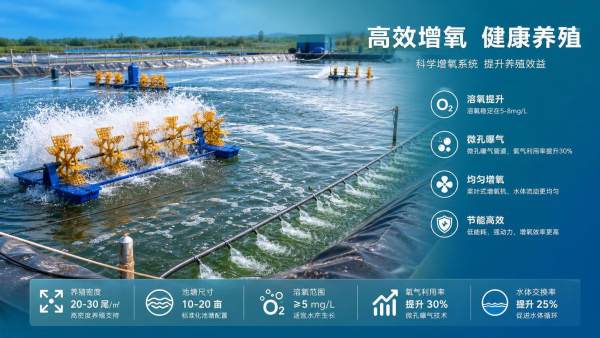
Selecting the right aeration systems for aquaculture ponds requires more than matching horsepower to water volume. For technical evaluators, stocking density, pond size, oxygen transfer efficiency, and operating cost must be assessed together to prevent growth losses, water quality instability, and unnecessary energy use. This guide outlines how to compare system types and sizing logic for reliable, standards-aligned pond performance.
In practice, most pond aeration mistakes come from treating oxygen demand as a static number. It is not. Demand changes with biomass, feed rate, water temperature, phytoplankton activity, sludge load, and how aggressively the farm is pushing production. A pond that looks adequately equipped during moderate weather can become oxygen-limited in a few hours during a hot, cloudy period or after a nighttime plankton crash.
For that reason, technical selection should begin with a production scenario, not with equipment catalogs. The core question is simple: what oxygen deficit must the system reliably cover at the pond’s highest-risk operating condition?
Start with production intensity, not pond geometry alone
Pond size matters, but stocking density usually drives the more consequential part of aeration design. A large, lightly stocked pond may need only circulation support and emergency aeration. A smaller pond under intensive culture can require continuous mechanical aeration with enough transfer capacity to offset peak respiration from fish or shrimp, microbial activity, and organic decomposition.
Technical evaluators typically look at four linked variables:
- target species and production system;
- expected standing biomass and feed input;
- pond depth, shape, and bottom condition;
- site-specific risk factors such as high temperature, low wind mixing, or unstable water quality.
This is where simplistic “hp per hectare” rules become risky. They remain useful as rough benchmarks, especially during early budgeting, but they are not enough for final design. The same nominal horsepower can perform very differently depending on whether the system relies on surface agitation, aspirated air, fine-bubble diffusion, or a hybrid arrangement. Oxygen transfer under standard test conditions rarely matches what happens in warm, algae-rich production water.
For low-density ponds, the objective is often preventive mixing and maintaining minimum dissolved oxygen before dawn. For medium- to high-density systems, the objective shifts toward sustained oxygen delivery, solids management, and hydraulic control of waste zones. Once stocking density rises, circulation pattern becomes almost as important as oxygen transfer rate.
Why pond size changes the preferred aeration architecture
Pond size influences more than the number of units required. It changes how effectively oxygenated water can be distributed. In small ponds, one poorly placed aerator can create overmixed zones near the machine and dead zones elsewhere. In large ponds, aeration capacity may look sufficient on paper while oxygen distribution remains uneven across corners, feeding lanes, or deeper sections.
Shape also matters. Long rectangular ponds are generally easier to organize hydraulically than irregular ponds with embankment interruptions or shallow shelves. In shrimp ponds, for example, aerator placement often has to support both dissolved oxygen control and movement of solids toward central or designated collection areas. In fish ponds, the concern may be keeping the full water body from stratifying while avoiding excessive stress from localized turbulence.
Depth needs careful interpretation. Deeper ponds are not automatically easier to aerate. They may store more water volume, but they can also develop stronger vertical gradients if circulation is weak. Surface aerators are effective for oxygen transfer and horizontal movement, yet may be less effective at correcting bottom-water problems in some pond geometries unless layout and power density are adequate.
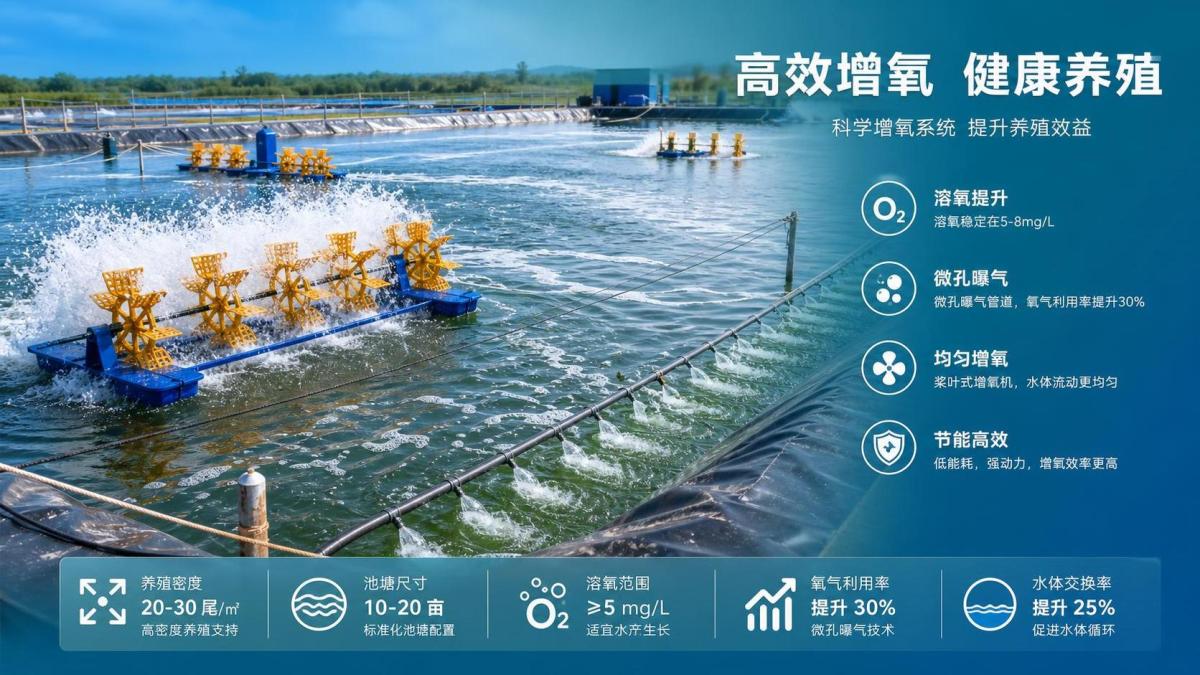
Comparing the main aeration system types
Technical selection usually comes down to a small set of established configurations, each with different strengths.
Paddlewheel aerators
Paddlewheels remain common in commercial ponds because they combine oxygen transfer with strong directional water movement. That dual function is valuable in intensive shrimp culture and in ponds where solids need to be pushed away from feeding areas or toward sumps. They are relatively straightforward to deploy, inspect, and replace.
The limitations are also well known. They can create highly localized turbulence, bank erosion if badly positioned, and non-uniform oxygen distribution when unit spacing is poor. They are often preferred where circulation is as important as aeration, but not always ideal where quiet, evenly distributed oxygenation is needed.
Aspirator and propeller-aspirator systems
These systems introduce air by drawing it into the water stream generated by a motor-driven propeller. They can provide both mixing and oxygenation, with useful flexibility in certain medium-depth ponds. Evaluators often consider them where stronger subsurface circulation is desirable.
Performance can vary significantly with submergence depth, motor efficiency, maintenance condition, and fouling. They may also require more attention to wear and debris management than some operators expect.
Diffused aeration systems
Air is delivered through blowers to diffusers, often producing fine or medium bubbles. These systems are attractive where broad oxygen distribution and gentler mixing are priorities. In some pond applications, especially lined or more engineered ponds, they can support more uniform dissolved oxygen profiles and reduced surface disturbance.
However, diffused systems should not be assumed to outperform surface aeration in every open pond. Actual oxygen transfer depends heavily on diffuser design, depth, blower efficiency, air distribution balance, and water quality. In earthen ponds with high suspended solids or biofouling risk, maintenance burden and diffuser clogging become real design issues. For shallow ponds, the contact time advantage of fine bubbles is also limited.
Vertical pump and fountain-style aerators
These are sometimes selected for moderate mixing and visible surface disruption, but they are usually less favored in highly intensive pond production where hydraulic control and transfer efficiency are under closer scrutiny. Their fit depends strongly on species, water depth, and whether the farm’s problem is oxygen deficit, circulation weakness, or both.
Hybrid systems
Hybrid layouts are increasingly common in technically managed farms. A site may use paddlewheels to create directional flow and solids transport, while diffusers or aspirators stabilize oxygen in zones that remain poorly served by surface equipment alone. This is often a better answer than trying to force one technology to solve every hydraulic and metabolic issue.
How stocking density should drive sizing logic
For evaluators, stocking density is best treated as a proxy for biological oxygen demand and for the farm’s tolerance for failure. As density rises, the margin for error narrows. Small underestimates in feed conversion, nighttime respiration, or sludge oxygen demand can become commercially significant.
A more defensible sizing process usually includes:
- estimating peak biomass by culture stage rather than average biomass across the cycle;
- linking feed input to expected oxygen demand and waste loading;
- identifying the minimum acceptable dissolved oxygen setpoint by species and growth phase;
- applying derating to equipment performance for field conditions rather than relying on idealized standard oxygen transfer values;
- reserving emergency or contingency capacity for power loss, storm conditions, or algae collapse.
Where farms intensify production but keep the original aeration philosophy, the first symptoms are often subtle: reduced feed response in the morning, slower growth uniformity, recurring low dissolved oxygen near pond edges, or increased bottom deterioration. By the time mortality appears, the technical problem is usually no longer just “not enough aerator power.” It is a combined shortfall in oxygen delivery, circulation pattern, and water quality management.
Operating cost is not secondary to capital cost
Aeration systems are often evaluated through installed cost, but the more consequential number is lifecycle cost per unit of usable oxygen delivered under farm conditions. This is where energy efficiency, maintenance intervals, spare parts availability, and uptime become decisive.
Two systems with similar purchase prices may have very different cost structures if one requires frequent gearbox service, diffuser cleaning, belt replacement, or blower maintenance. Likewise, a system with strong nominal efficiency may lose its economic advantage if it performs poorly in shallow ponds or if operators struggle to maintain optimal settings.
Technical teams should ask vendors for field-relevant performance data, not just laboratory claims. At minimum, the evaluation should distinguish between:
- rated motor power versus measured oxygen transfer in pond-like conditions;
- continuous operating cost versus emergency-use cost;
- routine maintenance labor versus unscheduled downtime risk;
- component life in corrosive, high-humidity aquaculture environments.
This is especially important in export-oriented aquaculture regions where energy tariffs, labor availability, and service support differ sharply by country. The “best” system in one market can become uneconomic in another simply because maintenance capability is weaker or replacement parts are imported with long lead times.
Layout and control strategy often determine whether sizing works in reality
Even well-chosen equipment underperforms when layout is weak. Aeration systems for aquaculture ponds should be evaluated as hydraulic systems, not as isolated machines. Unit orientation, spacing, cable routing, water depth at the installation point, and interaction with inlets, drains, feeding zones, and sludge areas all matter.
In higher-density ponds, control strategy also deserves more attention than it often gets. Fixed nighttime operation schedules are common, but they are not always adequate. Farms moving toward more precise production management increasingly combine aeration with dissolved oxygen monitoring, staged start-up logic, and emergency response protocols. Sensor-based control can improve energy use, but only if probe placement, calibration, and alarm logic are reliable. A badly placed sensor can create false confidence.
Redundancy is another neglected issue. If a pond depends on a small number of large units, a single failure can create acute risk. Distributing capacity across multiple units may improve resilience, though it can also complicate maintenance planning. The right balance depends on labor, electrical infrastructure, and how quickly backup equipment can be deployed.
Common evaluation errors
Several mistakes recur across pond projects:
- using pond area alone to size the system while ignoring feed loading and biomass trajectory;
- accepting standard oxygen transfer data without field derating;
- choosing for maximum transfer efficiency while neglecting circulation and solids transport;
- underestimating maintenance constraints in muddy, biofouling-prone ponds;
- failing to reserve contingency capacity for extreme weather or phytoplankton instability;
- treating all ponds on a farm as hydraulically identical.
Another frequent error is assuming that poor dissolved oxygen readings automatically justify more installed aeration. Sometimes the root issue is excessive organic loading, poor pond preparation, weak sludge management, or feeding practices that outpace the system’s biological carrying capacity. More aeration can help, but it may also mask a process control problem rather than solve it.
What a robust technical decision looks like
A sound selection process usually ends with a matrix rather than a single headline number. The preferred option should perform acceptably across oxygen transfer, circulation effectiveness, installation constraints, serviceability, energy demand, and failure resilience.
For lower-density and larger-area ponds, simpler surface systems may remain the most practical answer if they maintain pre-dawn oxygen and basic mixing at acceptable cost. For intensive ponds, especially where feeding rates are high and sludge management matters, the decision often shifts toward layouts that combine oxygenation with deliberate water movement. In more engineered ponds, diffused or hybrid systems may justify their complexity when control precision and uniformity are priorities.
Technical evaluators should be cautious about universal recommendations. The correct system depends less on brand or machine category than on whether the design matches the farm’s biological loading pattern, pond geometry, and operating discipline.
That is the real selection standard: not whether the aerator is widely used, but whether the full system can keep dissolved oxygen stable, maintain workable hydraulics, and do so at a lifecycle cost the farm can sustain through the highest-risk part of the production cycle.
Related Intelligence
- Aeration & Water TechWhat RO water treatment systems deliver consistent 98% salt rejection at 25°C with feed TDS over 3,000 ppm?RO water treatment systems that deliver proven 98% salt rejection at 25°C with >3,000 ppm TDS—engineered for API synthesis, aquaculture & grain processing.
- Aeration & Water TechCan pond aeration systems maintain dissolved oxygen above 5 mg/L during summer stratification in catfish ponds?Pond aeration systems can sustain >5 mg/L DO during summer stratification—when engineered for mixing *and* oxygen transfer. See field-proven data & design essentials.
- Aeration & Water TechHow to Choose Alarm Water Monitoring Systems for Critical Water FacilitiesAlarm water monitoring systems: learn how to select reliable sensors, alarms, communications, and workflows to protect critical water facilities and prevent costly failures.
The Morning Broadsheet
Daily chemical briefings, market shifts, and peer-reviewed summaries delivered to your terminal.
