

The Authority in Global Agricultural Chemistry & Bio-Resources
Sizing RAS Equipment: Matching Biofilters and Oxygen Supply to Feed Load
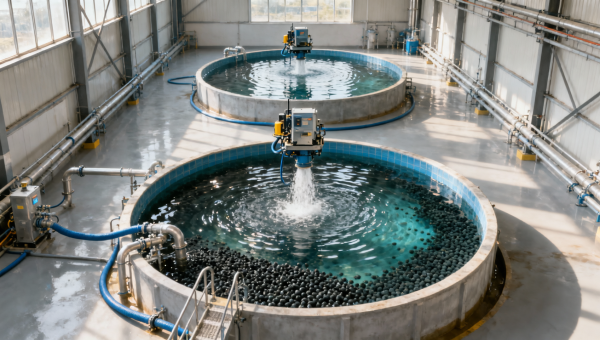
Sizing RAS Equipment: Matching Biofilters and Oxygen Supply to Feed Load
Sizing ras equipment by tank volume alone can leave a project short of biofiltration capacity or oxygen when feeding reaches its peak. Tank dimensions define the space available for production; feed input drives much of the treatment demand. For project managers and engineering leads, daily feed load provides a stronger starting point for estimating ammonia production, nitrification demand, and oxygen requirements.
The challenge is not simply installing a larger biofilter or oxygen generator. Those components must perform together under the same temperature, water chemistry, stocking plan, and failure scenarios. A defensible specification connects the production schedule to equipment duty, then identifies where operating flexibility and backup capacity are actually needed.
Start with the feeding schedule, not the annual production target
Annual tonnage is useful for the business case, but it hides the periods that determine equipment capacity. A system with overlapping cohorts can have a different maximum daily feed load from one producing the same annual harvest through synchronized batches. Grading, delayed harvests, and changes in stocking schedules can push several tanks toward peak demand simultaneously.
Build a production model that identifies standing biomass, expected feeding rate, water temperature, feed composition, and feeding hours for each production stage. Calculate maximum simultaneous feed input across every tank sharing a treatment loop. Keep maximum daily feeding separate from the hourly feeding pattern: biofilters respond to changing substrate loads, while oxygen demand can rise sharply around feeding activity.
The design basis should distinguish three conditions:
- Normal operation: the expected production schedule and routine feeding pattern.
- Maximum planned operation: the highest credible simultaneous biomass and feed input.
- Abnormal operation: equipment outages, restricted water exchange, delayed harvest, or unusually warm water.
Do not hide all three inside an unexplained safety factor. Different conditions require different responses, including installed capacity, standby equipment, feed reduction, or emergency oxygen.
Convert feed input into a transparent ammonia load
Biofilter sizing generally begins with total ammonia nitrogen, or TAN, expressed as mass of nitrogen per day. The conversion from feed to TAN depends on dietary protein, nitrogen retention, digestibility, species, and feed losses. A generic coefficient can support preliminary screening, but it should not become a contractual design value without justification.
Daily TAN load = daily feed input × TAN generation coefficient
Keep the units explicit. A coefficient expressed as kilograms of TAN-N per kilogram of feed is not interchangeable with kilograms of ammonia, NH3. Also establish whether the estimate includes delayed ammonia production from retained organic material. Solids removal affects the load reaching the biological treatment stage, but it does not remove dissolved ammonia already excreted by fish.
Consider an illustrative calculation, not a recommended design basis. If planned feeding is 1,000 kg/day and the project assumes 0.03 kg TAN-N/kg feed, the estimated load is 30 kg TAN-N/day. Both inputs require validation against the actual feed and production plan before equipment selection.
The TAN limit itself also needs context. The proportion present as more toxic unionized ammonia changes with pH, temperature, and salinity. A concentration acceptable under one operating condition may not be acceptable under another. Set water-quality limits for the species and operating envelope, rather than copying them from an unrelated installation.
Translate biological duty into usable biofilter capacity
A media surface-area claim is not a treatment guarantee. The useful sizing parameter is the ammonia removal rate demonstrated under conditions relevant to the project: temperature, salinity, dissolved oxygen, pH, TAN concentration, organic loading, and hydraulic conditions.
Required media volume = design TAN load ÷ validated volumetric TAN removal rate
Continuing the illustrative calculation, an assumed rate of 0.30 kg TAN-N per cubic metre of media per day would imply 100 m³ of media for a 30 kg/day load, before any explicitly justified allowance. This rate is an arithmetic assumption, not a transferable performance benchmark. A different temperature or low target TAN concentration could materially change the required volume.
Check what “volumetric” means in a supplier proposal. Some rates reference media volume; others reference reactor volume. For moving-bed systems, media volume must be translated into vessel size using the permissible filling fraction, mixing requirements, freeboard, and retention-screen arrangement. A calculation can be numerically correct and still produce an undersized vessel.
Nitrification also consumes oxygen and alkalinity. Theoretical complete oxidation requires approximately 4.57 kg oxygen and consumes alkalinity equivalent to 7.14 kg CaCO3 per kilogram of ammonia nitrogen oxidized. These are stoichiometric reference values, not complete operating budgets; biomass synthesis, other reactions, and incoming water chemistry affect actual balances.
Specify ammonia and nitrite performance separately. An immature or disturbed biofilter may oxidize ammonia while allowing nitrite to accumulate. Cold starts, salinity changes, and treatment chemicals deserve explicit review because installed media volume does not guarantee immediate biological capacity.
Build an oxygen balance without counting the same demand twice
Oxygen system sizing must cover fish respiration, nitrification, and other biological oxygen demand, while accounting for where oxygen enters and leaves the water. Respiration varies with species, body size, temperature, activity, and feeding. A single feed-based oxygen coefficient may support an early estimate, but a time-dependent balance is more useful for final engineering.
Separate fish demand from treatment demand. If a published or supplier-provided coefficient already includes nitrification, adding the full theoretical nitrification requirement again overstates demand. Conversely, using fish respiration alone can leave the biofilter short of oxygen. Document each coefficient’s boundary and operating conditions.
Next, distinguish oxygen consumption from oxygen supply. Generator or liquid-oxygen delivery capacity is not the same as oxygen dissolved into water. Transfer efficiency depends on the oxygenation device, gas purity, pressure, flow, inlet dissolved oxygen, and operating setpoint.
Required oxygen feed = oxygen duty assigned to the device ÷ verified transfer efficiency
State whether efficiency means dissolution into the water or overall utilization by the system. Oxygen can dissolve successfully and subsequently be lost through degassing or discharge. Assigning oxygen duty by location avoids purchasing capacity that cannot reach the point where it is needed.
Check the tank outlet, not just the oxygenation outlet
An oxygenation unit can meet its outlet setpoint while fish experience inadequate dissolved oxygen elsewhere. Tank mixing, biomass distribution, inlet arrangement, and circulation flow determine local conditions. The lowest acceptable tank oxygen concentration should therefore anchor the hydraulic check.
For a simplified steady-state tank balance, oxygen carried by the water equals flow multiplied by the inlet-to-outlet oxygen concentration difference. With flow in m³/hour and concentration difference in mg/L, multiply by 0.001 to obtain kg oxygen/hour. Include direct tank oxygen injection separately, and investigate short-circuiting or poorly mixed zones rather than assuming perfect mixing.
Resolve the constraints that larger equipment cannot fix
Adding oxygen does not remove carbon dioxide. A project can maintain dissolved oxygen yet remain limited by inadequate degassing. Likewise, an oversized biofilter cannot compensate indefinitely for poor solids capture, insufficient alkalinity dosing, or inadequate water distribution.
Review the treatment train as a connected system. Mechanical filtration affects organic loading; pumping and pipework determine available flow; degassing changes dissolved-gas conditions; biofilter aeration supports both oxygen supply and media movement. Equipment changes can shift the limiting factor elsewhere, so each revision needs an updated mass balance and hydraulic check.
Seasonal conditions deserve particular attention. Warmer water can increase fish oxygen demand while reducing oxygen solubility. Colder operation may constrain nitrification. These conditions do not necessarily occur together, which is why one blanket capacity allowance is less useful than checking separate design cases.
Specify failure performance and commissioning evidence
Backup capacity should address a defined failure, not merely duplicate a nameplate rating. Two oxygen generators sharing one electrical supply or compressor may retain a common failure point. Emergency oxygen also needs a delivery path that remains functional when normal circulation stops.
- Define essential loads during power loss and which devices receive standby power.
- Size emergency oxygen storage around credible demand, response time, and replenishment availability.
- Confirm alarm independence, sensor maintenance, and automatic response sequences.
- Establish feed-reduction thresholds for degraded operation and recovery.
Commissioning must distinguish mechanical completion from biological readiness. Pumps and oxygenation equipment can be tested before stocking, but biofilter maturation requires a controlled loading plan. Agree how ammonia, nitrite, dissolved oxygen, pH, alkalinity, temperature, and flow will be measured as loading increases. Acceptance criteria should identify the test conditions and duration, not simply require “stable water quality.”
For the AgriChem Chronicle, the connection between feed processing and aquaculture technology is especially relevant here: feed specifications are engineering inputs, not just purchasing details. Changes in formulation or feeding strategy should trigger a review of the treatment assumptions.
Before releasing a ras equipment specification, require one reconciled design-basis document linking peak feed input, nitrogen production, biofilter performance, oxygen delivery, hydraulics, and contingency operation. Where a coefficient remains uncertain, record who will verify it and when. That is a more reliable route to controlled capital spending than buying larger components around an unresolved load estimate.
Related Intelligence
- RAS SystemsAquaculture Filter Installation Costs: Plumbing, Labor, and CommissioningUnderstand aquaculture filter installation cost, from plumbing and labor to commissioning. Compare complete project scopes, uncover hidden expenses, and budget confidently before you buy.
- RAS SystemsSustainable Aquaculture Practices That Cut Feed Waste and Protect Fish Farm Water QualitySustainable aquaculture for fish farms: reduce feed waste, protect water quality, and build resilient, efficient systems with practical strategies.
- RAS SystemsDrum Filter System Price: How Flow Rate, Micron Rating, and Automation Affect CostDrum filter system price depends on flow rate, micron rating, automation, materials, and lifecycle costs. Compare quotes confidently and choose the right system.
The Morning Broadsheet
Daily chemical briefings, market shifts, and peer-reviewed summaries delivered to your terminal.