

The Authority in Global Agricultural Chemistry & Bio-Resources
How to Vet Middle East Oxygenation System Suppliers for RAS Projects
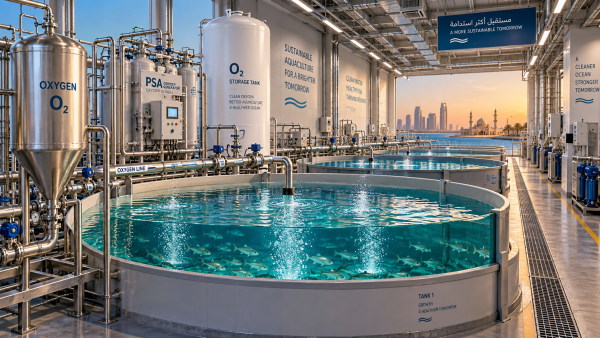
For a RAS project, an oxygenation supplier is not simply a source of cones, diffusers, oxygen generators, or liquid-oxygen tanks. The supplier is being trusted with a process that determines whether oxygen demand can be met during feeding peaks, warm-water periods, partial equipment failure, and emergency biomass events. A low equipment quotation can therefore conceal a high operational cost if the design basis is weak, the oxygen source is undersized, or critical parts cannot be obtained promptly.
When vetting oxygenation system suppliers in the Middle East, the central question is whether the supplier can deliver and support a defined oxygen-transfer duty under the farm’s actual water, biomass, temperature, salinity, and operating conditions. This is more demanding than asking for a nominal flow rate or a catalogue oxygen-transfer figure. Suppliers should be evaluated against a common technical brief, a transparent cost model, and evidence that their stated performance can be traced to the proposed configuration.
Start with the oxygen balance, not the equipment list
A credible supplier assessment begins with the project’s oxygen balance. The design must connect biomass, feeding regime, species, water temperature, salinity, tank hydraulics, and allowable dissolved-oxygen range to an hourly oxygen demand. It should distinguish normal operation from the conditions that create the highest risk: peak feeding, high seasonal water temperature, biomass accumulation before harvest, reduced circulation, and recovery after a power interruption.
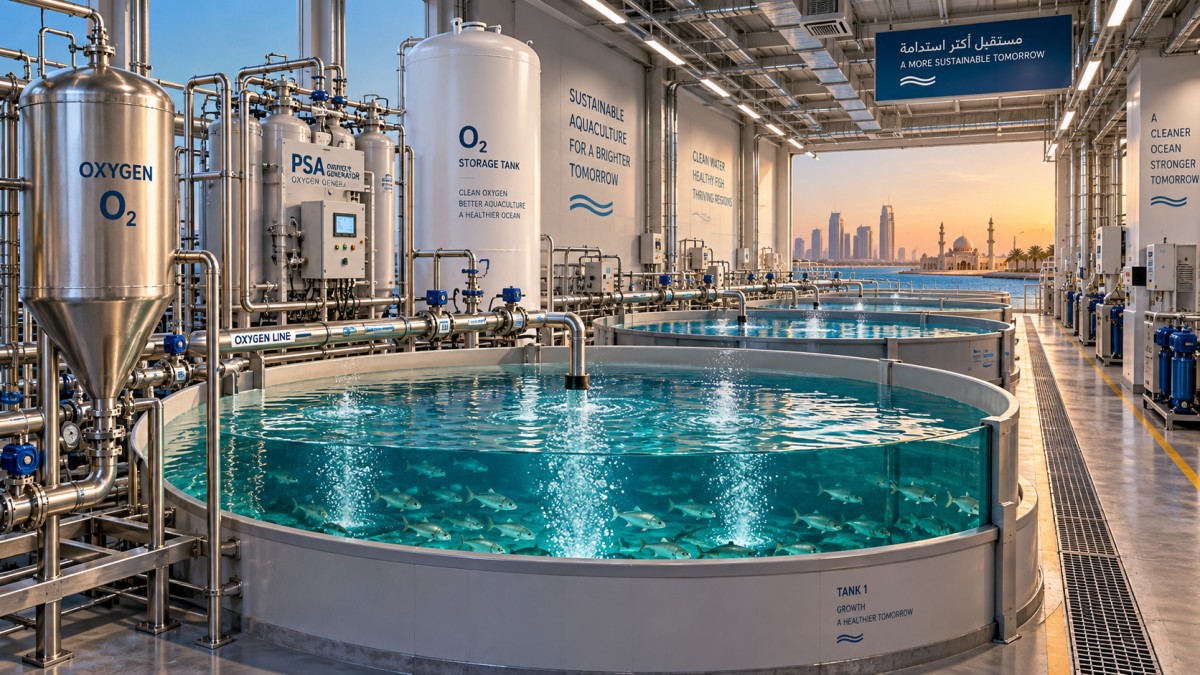
Suppliers may propose different architectures: liquid oxygen (LOX) storage with oxygen cones or low-head oxygenators; pressure swing adsorption (PSA) generation with storage and distribution; pure-oxygen injection into side streams; or hybrid arrangements that use PSA for routine demand and stored oxygen for resilience. None is automatically superior. The appropriate configuration depends on site electricity reliability, logistics for oxygen deliveries, operating scale, allowable capital expenditure, staff capability, and the consequence of a supply interruption.
A proposal that states only “oxygen capacity” is incomplete. Buyers need to know whether the stated capacity refers to oxygen produced, oxygen injected, or oxygen actually dissolved and retained in the process water. These are different values. Gas can leave a generator or cylinder manifold at the required volume yet still perform poorly at the tank if contact time, pressure, water flow, degassing, back-pressure control, or pipe distribution are inadequately engineered.
Request an oxygen mass-balance sheet in kilograms of O2 per hour. It should show the assumed peak demand, available oxygen supply, expected transfer efficiency, design margin, emergency reserve, and the destination of each oxygen stream. A supplier unwilling to disclose the assumptions behind its sizing is asking the buyer to accept an untestable design.
Separate the scope of supply from responsibility for performance
Many procurement disputes arise because a package is sold as an “oxygenation system” while the supplier’s responsibility ends at the skid, tank, or generator outlet. The purchaser may then be left to arrange unsuitable pumps, poorly sized headers, incompatible controls, insufficient ventilation, or tank-side injection equipment. If system performance later falls short, each contractor can point to an interface outside its scope.
The tender documentation should identify responsibility for:
- oxygen-source selection, storage, generation, or both;
- oxygenator type, number of duty and standby units, and process-water flow;
- distribution pipe materials, pressure ratings, isolation valves, flow control, and pressure relief;
- pumps, filtration requirements, bypasses, and provisions for cleaning or maintenance;
- oxygen, dissolved-oxygen, flow, pressure, and temperature instrumentation;
- controls integration with the RAS supervisory system and alarm logic;
- emergency operation during power loss or generator failure;
- commissioning, site acceptance testing, operator training, and handover records.
One supplier need not provide every item, but one party must own the process design and explicitly coordinate the interfaces. A supplier offering individual components can be appropriate when an experienced RAS engineering contractor controls the process design. It is riskier when the site expects the component vendor to solve integration issues after delivery.
Test performance claims against the water conditions that matter
Oxygen-transfer performance is highly dependent on operating conditions. The same device can behave differently with freshwater and saline water, at different temperatures, under varying inlet dissolved-oxygen concentrations, and at different water flows or operating pressures. In RAS, the relevant result is not an idealised maximum transfer value but the dissolved-oxygen concentration delivered to the fish tanks without excessive gas supersaturation, unstable control, or unacceptable energy use.
Ask suppliers to provide performance documentation that identifies the water type, temperature, salinity where relevant, hydraulic flow, oxygen purity, operating pressure, inlet and outlet dissolved oxygen, and test method. The documentation should also state whether results come from the exact offered equipment or from a related model. Laboratory data can be useful, but it should not be treated as a guarantee for a full farm unless the design conditions align.
Supersaturation needs particular attention. Adding oxygen successfully does not mean that all gas-management problems are solved. In systems using pressurised oxygenation, dissolved nitrogen and carbon dioxide management, pressure changes, and degassing strategy remain part of fish-welfare and process-control design. A supplier that only discusses oxygen concentration, without discussing the wider gas balance, may be supplying equipment rather than engineering a viable aquaculture process.
Performance guarantees should be written as measurable conditions, not promotional descriptions. They may define a specified water flow, inlet water quality, outlet dissolved-oxygen target, maximum pressure drop, oxygen consumption, and electrical consumption for the supplied package. The agreement should also define the instrument calibration requirements, test duration, acceptance method, exclusions, and remedy if the guaranteed duty is not met.
Regional suitability is a design issue, not a sales-office issue
“Middle East supplier” can describe a locally established engineering company, an international manufacturer with a regional distributor, or a trader arranging imported equipment. These models carry different risks. Local presence matters most when it is backed by trained technicians, a documented spare-parts inventory, and clear authority to diagnose and resolve warranty issues. A local sales contact without technical service capability does not reduce operational exposure.
Regional conditions also affect equipment selection. High ambient temperatures can reduce PSA efficiency and raise cooling and ventilation requirements. Dust ingress can increase maintenance exposure for compressors, air-treatment equipment, control cabinets, and cooling systems. Coastal facilities may require attention to corrosion protection, enclosure ratings, stainless-steel grade selection, and the suitability of fasteners, valves, and electrical components. Remote sites need a realistic strategy for consumables, filters, seals, sensors, and compressor maintenance.
For LOX-based designs, evaluate the supply chain separately from the equipment supplier. The supplier should identify the oxygen purity specification, delivery arrangement, storage-vessel ownership, refill lead time, minimum delivery quantities, telemetry arrangements if used, and contingency provisions when deliveries are delayed. The farm’s oxygen autonomy is not the same as tank volume; it depends on usable inventory at peak demand and the rate at which the supplier can replenish it.
For PSA systems, demand a site-specific utility schedule. This should state electrical load at expected operating conditions, compressed-air requirements, heat rejection, ventilation, drainage, and maintenance intervals. Claims of “low operating cost” are not comparable unless they use the same oxygen output, energy price assumption, runtime, and maintenance scope. The cost of electricity, compressor overhaul, adsorbent replacement, air pretreatment, and standby generation can outweigh a lower initial package price.
Review manufacturing evidence and compliance documentation proportionately
Compliance documents are necessary, but they are not a substitute for engineering validation. A certificate should be linked to the actual equipment and relevant risk, rather than presented as a generic indication of quality. Pressure-bearing vessels, oxygen piping, electrical panels, lifting equipment, storage systems, and control equipment may fall under different national or project-specific requirements. Requirements can vary by jurisdiction, project owner, insurer, and installation location.
Before award, establish which documents are mandatory for import, construction approval, commissioning, insurance, and operation. Depending on the supplied scope, these may include material certificates, pressure-test records, welding documentation, electrical drawings, conformity documentation, manuals, hazardous-area assessments where applicable, and calibration certificates. Where a supplier references international standards, require the specific standard edition and the part of the system to which it applies.
Oxygen service deserves a more detailed review than ordinary water piping. Components exposed to elevated oxygen concentrations must be suitable for oxygen service, including appropriate cleaning and avoidance of incompatible materials or contamination that could create ignition risk. The supplier should provide its oxygen-cleaning and assembly procedures where relevant, identify pressure-relief arrangements, and explain how venting is handled. A complete safety review also considers oxygen-enriched areas, ventilation, warning signage, emergency isolation, and staff procedures.
Factory quality systems can provide useful confidence, but a general quality-management certificate does not prove that a particular skid meets its duty. Inspect the supplier’s manufacturing records, test protocols, and traceability approach for critical components. For imported systems, confirm who bears responsibility for document translation, local approvals, customs classification, and correction of nonconforming paperwork.
Price comparisons become meaningful only after normalising the scope
Comparing headline quotations is especially misleading in oxygenation projects because suppliers may include different boundaries. One offer may include only an oxygen generator, while another includes compressor, dryer, receiver, oxygen storage, control panel, analyzers, pipework, commissioning, and training. A seemingly expensive proposal may have fewer unpriced interfaces; a cheap proposal may transfer essential work and risk to the project.
A bid comparison should separate capital cost from lifecycle cost. Capital cost includes equipment, freight, duties and taxes where applicable, site installation, civil works, electrical connections, piping, commissioning, and any local approvals. Lifecycle cost includes power, delivered oxygen or LOX rental and refill charges, routine service, consumables, sensor replacement, compressor and pump maintenance, spare-parts holding, labour, and expected downtime exposure.
Use a common operating scenario rather than accepting each supplier’s own assumptions. For example, model the same annual oxygen demand, peak-hour demand, electricity tariff, expected LOX delivery arrangement, and maintenance period. This does not require a speculative long-range forecast. It creates a comparable decision basis from known project inputs.
Resilience has a cost and should be priced openly. A package with no standby compressor, no emergency manifold, no stored oxygen, and no independent alarm path may be less expensive because it omits protection rather than because it is more efficient. The appropriate redundancy level depends on the biomass at risk and the time available to intervene, but the residual risk should never be hidden inside a basic equipment quotation.
Verify service capacity before treating it as a contractual promise
Service commitments should be examined with the same discipline applied to equipment specifications. Request the regional service organisation chart, technician qualifications, escalation route to the original manufacturer, stock list for critical spares, and a stated response process. Ask which parts are held in-country, which are held elsewhere in the region, and which must be shipped from the manufacturing country. “Available on request” is not an inventory commitment.
Critical spares commonly include oxygen analyzers and sensor consumables, solenoid valves, pressure transmitters, controller components, seals, pump parts, compressor service kits, filters, and air-treatment components. The project should identify failure modes that can stop oxygen delivery or disable monitoring, then define what must be stored on site. A supplier’s recommended spares list should be reviewed against lead times and not accepted as a generic accessory schedule.
Remote monitoring can improve fault diagnosis, but it does not replace local response capability. Its value depends on secure connectivity, clear data ownership, alarm escalation, and an agreed division of responsibility. A supplier should be able to explain what can be diagnosed remotely, what requires an on-site technician, and how control-system access is managed after handover.
Use the tender stage to expose weak suppliers
The most useful vetting questions are those that require a supplier to make its assumptions visible. Request a process-flow diagram, piping and instrumentation diagram, utility schedule, oxygen mass balance, equipment datasheets, control narrative, general arrangement drawing, maintenance plan, spare-parts schedule, commissioning plan, and reference contacts for comparable duty where disclosure is permitted. The quality and internal consistency of these documents often reveal more than a polished commercial presentation.
During technical clarification, watch for four warning signs: capacity figures that shift when questioned; guarantees stated without test conditions; unexplained exclusions around installation and controls; and regional service claims unsupported by named personnel or inventory evidence. Another concern is a proposal that treats backup oxygen as optional while offering no calculation of the consequences of source or power loss.
Contract terms should preserve the information obtained during evaluation. Attach the approved design basis, drawings, performance guarantee, document register, commissioning procedure, training requirements, spare-parts commitment, warranty boundaries, and acceptance criteria. Payment milestones should reflect meaningful deliverables, including document approval, factory testing where appropriate, delivery, commissioning, and successful site acceptance—not merely shipment of hardware.
The strongest supplier is not necessarily the one offering the most complex technology or the lowest initial price. It is the one that can demonstrate a traceable design duty, state what its equipment will achieve under defined water conditions, support the installation locally, and accept responsibility for the boundaries it controls. In Middle East RAS projects, that discipline is what turns an oxygenation package from a purchased asset into a dependable life-support system.
Related Intelligence
- RAS SystemsHow to Vet Middle East Oxygenation System Suppliers for RAS ProjectsOxygenation system suppliers Middle East: learn how to vet RAS partners for proven performance, resilience, local service, and lifecycle value.
- RAS SystemsHow to Select an Ammonia Water Quality Sensor for Aquaculture SystemsAmmonia water quality sensor selection guide for aquaculture: compare technologies, accuracy, salinity compatibility, maintenance, and integration for reliable monitoring.
- RAS SystemsDo UV water treatment systems eliminate chlorine-resistant pathogens in aquaculture recirculation?UV water treatment systems can inactivate chlorine-resistant pathogens like Cryptosporidium in aquaculture RAS—when properly engineered, validated, and maintained.
The Morning Broadsheet
Daily chemical briefings, market shifts, and peer-reviewed summaries delivered to your terminal.
