

The Authority in Global Agricultural Chemistry & Bio-Resources
How to Assess Heavy Agricultural Machinery Producers for Dealer Support and Parts Availability
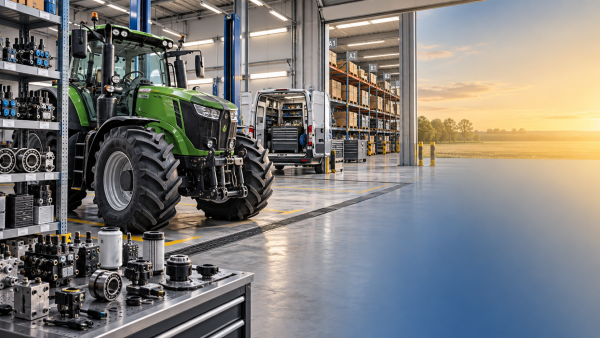
A machine that is unavailable during planting, harvest, or a narrow weather window can cost more than a higher purchase price. That is why procurement teams assessing heavy agricultural machinery producers should treat dealer capability and parts support as part of the machine itself. A tractor, combine, loader, forage harvester, or high-capacity sprayer is only as productive as the service network that can diagnose it, supply components, and return it to work.
The practical question is not simply, “Does this manufacturer have dealers in our region?” It is: Can the assigned dealer support this specific machine, at our operating location, during our critical season, with parts and technicians that are genuinely available? The answer determines downtime exposure, rental dependence, maintenance labor, and the equipment’s useful fleet life.
Assess the local dealer before relying on the manufacturer name
A large OEM may have a strong global reputation while its local dealer has limited workshop capacity, few field technicians, or weak inventory discipline. Conversely, a less familiar producer can be a sensible choice where its regional distributor is technically capable, well stocked, and established in the same crop and operating conditions as the buyer.
Start with the dealer assigned to the actual delivery territory. Ask who will perform commissioning, warranty work, scheduled service, emergency repairs, and software diagnostics. These responsibilities should not remain vague or be described only as “dealer support.” Procurement should identify the legal operating entity, service location, parts counter, workshop, and escalation contact that will handle the fleet.
Then look at capacity rather than promotional claims. A dealer serving a broad rural territory may be adequate for routine maintenance but unable to respond quickly when multiple customers experience failures during harvest. Useful questions include:
- How many technicians are trained on the proposed machine family, rather than on the brand generally?
- How many mobile service vehicles are available during peak agricultural periods?
- Can the dealer perform electronic diagnostics, calibration, hydraulic testing, and complex repairs in the field?
- What is the process when the local workshop cannot resolve a fault?
- Who covers the operation outside standard business hours during critical seasons?
- Does the dealer support comparable machines already working in the same region?
A provider with one experienced technician may be sufficient for a small, low-utilization fleet. It is rarely enough for a contractor, large farm group, cooperative, or processor whose machinery operates long shifts and cannot wait for the next available workshop appointment.
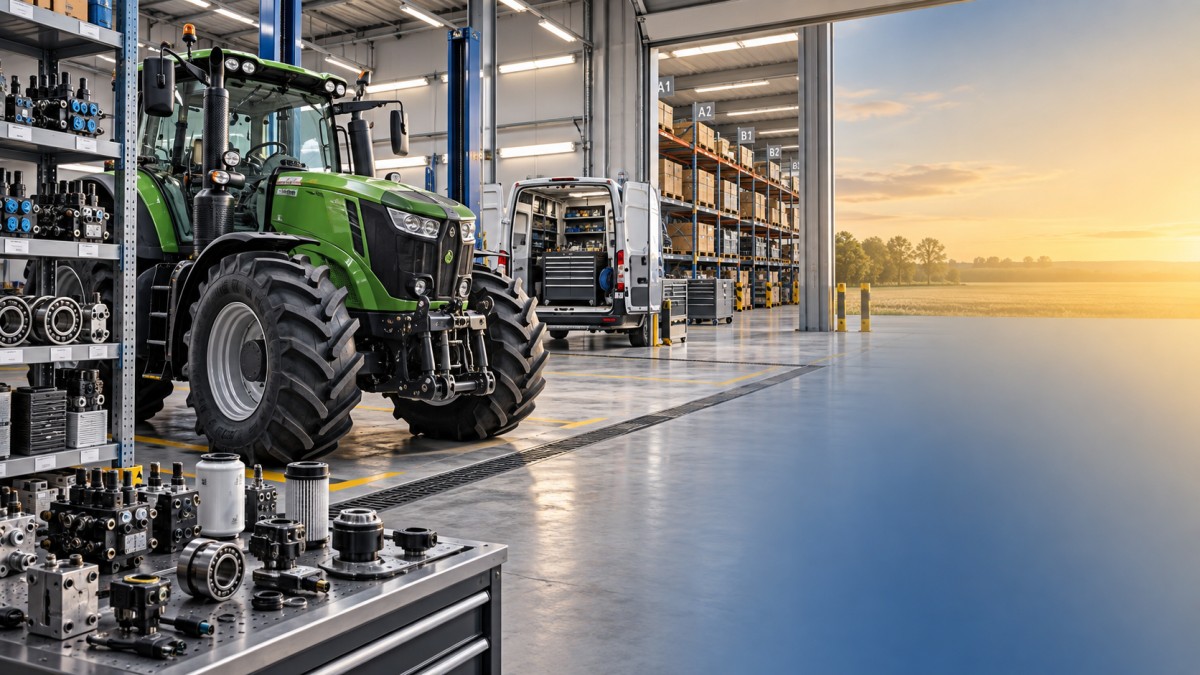
Parts availability must be tested by machine-critical components
“Parts available” is not a meaningful procurement standard unless it refers to the parts most likely to stop operation. Dealers can usually supply filters, belts, lubricants, and common fasteners. The greater risk lies in components that immobilize a high-value machine: electronic control modules, sensors, hydraulic valves, drivetrain parts, bearings, harvesting headers, injection-system components, cooling assemblies, and model-specific wear parts.
Ask the dealer and producer to distinguish among three categories:
Do not accept a generic parts catalogue as evidence of supply resilience. It shows that a part exists, not that it can reach the operation in time. Instead, request a discussion around the proposed configuration: engine, transmission, hydraulic system, precision-agriculture hardware, attachments, and regional adaptation package. Optional equipment can create a separate support risk if it is uncommon in the local installed base.
This is particularly important for imported equipment. A producer may manufacture reliable machinery, but long replenishment routes, customs handling, small regional volumes, or limited local forecasting can extend the time required for less common components. That does not automatically rule out the supplier. It changes the purchasing model: the buyer may need a recommended on-site stock package, a second-machine contingency plan, or contractual service commitments appropriate to the operational risk.
Match support expectations to the cost of downtime
Not every machine needs the same service standard. A standby loader used intermittently and a combine operating through a short harvest window should not be evaluated with identical criteria. Procurement should classify each asset by operational criticality before comparing bids.
For a non-critical machine, planned maintenance support and ordinary parts access may be enough. For a primary harvesting machine, a high-horsepower tractor supporting time-sensitive field work, or equipment tied directly to a processing schedule, the assessment should focus on recovery speed. Consider the cost created by an idle machine: lost working hours, delayed harvest quality, labor disruption, replacement rental, transport, contractor charges, and knock-on effects on other equipment.
This approach changes an apparently simple price comparison. A lower-priced offer with weaker local support can become the higher-cost option when the fleet has no redundancy. In contrast, a producer with higher initial pricing may justify the difference where it offers skilled field service, credible local stock, and a clear escalation route for machine-down events.
Ask for the service workflow, not a promise of responsiveness
Service response is often described in broad language during a sales process. Procurement should ask the dealer to walk through a realistic sequence: fault reported, remote diagnosis, technician dispatch, parts identification, stock check, approval, delivery, repair, and closure. Each step reveals potential delays.
For connected equipment, clarify whether remote diagnostics are available and who has access to the machine data. Remote support can shorten troubleshooting when it helps identify the likely failed part before the technician travels. It does not replace a field technician or stocked component, and it should not be treated as proof of full service readiness.
It is also useful to ask how the dealer manages peak-season triage. When several machines are down at once, support capacity is allocated somehow. Buyers with critical fleets should understand whether priority is based on warranty status, service agreement, fleet size, relationship history, or first-reported order. A transparent policy is more useful than an informal assurance.
Review warranty terms as an operating process
Warranty coverage has value only when the approval and repair process works under field conditions. Read beyond the duration and broad coverage language. Determine which party diagnoses the fault, who authorizes repairs, whether labor and travel are included, how replacement parts are handled, and what occurs when a failure is linked to an attachment or third-party precision system.
Buyers should also separate warranty from service support. A machine may have a broad warranty but still wait for a technician or unavailable part. Likewise, a dealer may provide excellent support on work outside warranty, but that should be reflected in the expected service cost rather than assumed from the warranty document.
Before purchase, ask for the process for repeat failures and disputed fault causes. Complex machinery combines mechanical, hydraulic, electronic, and software systems. When responsibility is unclear, repairs can stall between the OEM, dealer, attachment supplier, and owner. A supplier that defines the coordination process is easier to manage over the equipment lifecycle.
Use installed-base evidence carefully
Reference conversations can reveal more than brand-level reputation, but they should be relevant. A reference operating a small tractor in light-duty work does not answer questions about support for a high-capacity harvester under intensive seasonal use. Seek operations using the same or closely related model, with comparable utilization, terrain, crop conditions, and distance from the dealer.
Questions should focus on observable service behavior: Were routine parts available before service intervals? How were urgent faults handled? Did the dealer provide accurate fault diagnosis? Were repeat repairs required? Did the operator have to source parts independently? These discussions are more useful than asking whether the owner “likes” the brand.
Be cautious with a dealer that relies only on distant references or references for older, simpler equipment. A new model with advanced emissions systems, telematics, automated guidance, or electronically controlled hydraulics may require different diagnostic skills and stocking practices.
Build support requirements into the commercial evaluation
Dealer support is often assessed informally, then excluded from the final bid comparison because it is difficult to place in a spreadsheet. That creates a predictable problem: the lowest equipment price appears strongest even when operating risk is materially different.
A more disciplined request for proposal can require each heavy equipment supplier to provide the same support information. Score the response alongside machine capability, commercial terms, and total cost of ownership. The objective is not to produce a false precision score; it is to make hidden service assumptions visible before contract award.
- Named service locations and territory coverage for the operating sites.
- Technician qualifications for the proposed model range.
- Mobile repair capability and peak-season support arrangements.
- Recommended commissioning, preventive maintenance, and operator-training scope.
- Local, regional, and central parts-routing process.
- Proposed initial stock package for machine-down and wear components.
- Warranty claim workflow, labor treatment, and escalation contacts.
- Availability of service contracts, seasonal inspections, and fleet reporting where relevant.
For multi-unit purchases, negotiate support as a fleet requirement rather than buying each machine as an isolated asset. This may include pre-season inspections, agreed stock levels for common parts, training for operators and maintenance staff, and a designated escalation contact. The value is highest where several units share components or where a single failure can disrupt a tightly scheduled operation.
Common purchasing mistakes
Choosing by dealer proximity alone. A nearby sales outlet is not necessarily a capable service base. Confirm workshop resources, technician availability, field-service coverage, and parts authority.
Assuming a large producer guarantees local support. Manufacturer scale matters, but the buyer’s day-to-day experience is shaped by the regional dealer, warehouse network, and model-specific expertise.
Focusing only on preventive-maintenance parts. Filters and fluids are easy to source. The more expensive question is how the supplier handles a non-standard component that stops a machine during peak work.
Accepting vague delivery language. “Fast,” “priority,” and “normally available” are not operating commitments. Procurement needs the supply route and decision process behind those descriptions.
Adding complex options without checking local competence. Guidance systems, specialized headers, telemetry, and electronic controls can add value, but only if the dealer can support their configuration and diagnose faults promptly.
Make the final choice at the fleet level
The most suitable producer is not automatically the one with the lowest acquisition cost, the broadest product range, or the most recognizable name. It is the supplier whose equipment and support model fit the farm’s operating calendar, technical capability, location, and tolerance for downtime.
When comparing heavy agricultural machinery producers, place a heavier burden of proof on the supplier where equipment is mission-critical, the fleet lacks backup capacity, the operating site is remote, or the machine uses specialized configurations. In those conditions, dealer competence and parts resilience are not secondary buying criteria. They are part of the asset’s productive capacity and should be evaluated with the same discipline as engine power, throughput, and purchase price.
Related Intelligence
- Heavy Agri MachineryHow to Assess Heavy Agricultural Machinery Producers for Dealer Support and Parts AvailabilityHeavy agricultural machinery producers: learn how to assess dealer expertise, critical parts availability, service response, and downtime risk before you buy.
- Heavy Agri MachineryWhich agricultural machinery manufacturer offers modular service documentation compatible with OEM diagnostic software?Which agricultural machinery manufacturer delivers modular service docs that integrate natively with OEM diagnostic software? Discover CLAAS, John Deere & SDF—real interoperability, zero PDF friction.
- Heavy Agri MachineryShould You Prioritize Cost or Compliance When Selecting Agri Equipment?Should I prioritize cost or compliance when selecting agri equipment? Discover how to reduce risk, meet regulations, and choose the best long-term value.
The Morning Broadsheet
Daily chemical briefings, market shifts, and peer-reviewed summaries delivered to your terminal.
