

The Authority in Global Agricultural Chemistry & Bio-Resources
India Expands Farm Machinery Import Duty Exemption
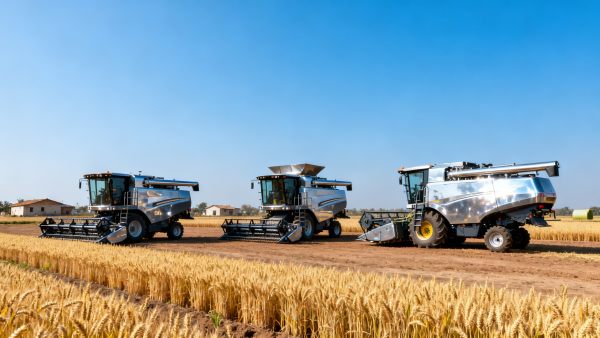
On May 14, 2026, India’s Ministry of Agriculture and Farmers’ Welfare (MoA&FW) announced an update to its Agricultural Machinery Import Duty Exemption List, significantly broadening tariff relief for heavy agricultural machinery. The move directly impacts global exporters—particularly Chinese manufacturers—and signals a strategic shift toward modernizing India’s farm mechanization infrastructure amid rising demand for precision, automation, and post-harvest efficiency.
Event Overview
The MoA&FW officially updated the Agricultural Machinery Import Duty Exemption List on May 14, 2026. The revision adds 17 new categories of Heavy Agri Machinery—including fully automatic grain dryers,北斗/GPS-compatible smart tractor terminals, and integrated straw baling-and-wrapping machines—to the zero-duty import list. The exemption applies immediately and remains valid until March 31, 2027.
Industries Affected
Direct Exporting Enterprises
Chinese OEMs and export-focused distributors of heavy agri machinery face immediate cost advantages: the duty waiver reduces landed cost by 9–12% for newly listed items. This improves price competitiveness in India’s fragmented but rapidly consolidating equipment market—especially where tender-based procurement (e.g., state-level farm mechanization schemes) prioritizes landed price and compliance over brand legacy.
Raw Material Sourcing Firms
Suppliers of critical components—including GNSS modules, high-torque hydraulic systems, and food-grade film for bale wrapping—may see increased order visibility from exporters preparing for India-bound shipments. However, no tariff change applies to component imports under this notice; impact is indirect and demand-driven rather than regulatory.
Manufacturing & Assembly Units
Domestic Indian assemblers importing CKD/SKD kits—including those co-developing smart terminals with Chinese partners—benefit from lower input costs and faster customs clearance. Yet, the exemption does not extend to non-agricultural auxiliary systems (e.g., general-purpose diesel engines or generic telematics hardware), limiting scope for cross-category cost optimization.
Supply Chain Service Providers
Cargo forwarders, customs brokers, and certification agencies specializing in Indian agricultural imports will likely experience higher inquiry volume related to exemption documentation (e.g., Certificate of Origin, conformity declarations per IS 17781:2023). Notably, the notification requires proof of end-use alignment with notified agricultural activities—a procedural checkpoint that may lengthen pre-shipment verification cycles.
Key Considerations and Recommended Actions
Verify Product Classification Against Updated Schedule
Exporters must cross-check HS codes against the official annex (Notification No. G.S.R. 321(E), dated May 14, 2026) before shipment. Misclassification—even for functionally similar models—may disqualify duty exemption, as the list specifies technical parameters (e.g., drying capacity ≥5 t/h, GPS accuracy ≤2 cm RTK).
Prepare for Accelerated Standard Alignment Efforts
While not mandatory under this notice, the MoA&FW explicitly links the expansion to ongoing bilateral work on technical standards harmonization. Exporters should proactively align product documentation with India’s draft standards for smart agriculture devices (BIS Draft IS/IEC 62443-3-3:2025, IS 17781:2023) to avoid future certification delays.
Monitor State-Level Implementation Variability
Duty exemption applies at the central customs level, but state agricultural departments control subsidy disbursement and procurement rules. Early indications suggest Punjab and Maharashtra are fast-tracking integration into their farm mechanization missions; others (e.g., Bihar, Odisha) have yet to issue implementation guidelines—creating near-term regional disparity in uptake speed.
Editorial Perspective / Industry Observation
Analysis shows this policy shift is less about short-term trade stimulus and more about structural recalibration: India is selectively de-risking its agri-tech import dependency while avoiding full localization mandates. Observably, the inclusion of北斗-compatible terminals—not just GPS—signals tacit openness to multi-constellation navigation solutions, potentially easing entry for Chinese tech-integrated platforms. From an industry perspective, this is better understood as a calibrated step toward interoperable digital farming ecosystems, not merely a tariff reduction. Current data does not support assumptions about long-term quota expansions or extension beyond March 2027; the timeline suggests a deliberate 11-month evaluation window.
Conclusion
This exemption update marks a concrete inflection point in India’s farm mechanization strategy—prioritizing scalability, post-harvest resilience, and intelligent connectivity. For global suppliers, it lowers entry friction but raises expectations around technical compliance and use-case specificity. A rational reading suggests sustained opportunity exists—not as a blanket opening, but as a targeted corridor for high-value, standards-aware agri-tech exports.
Source Attribution
Official source: Ministry of Agriculture and Farmers’ Welfare (MoA&FW), Government of India — Notification No. G.S.R. 321(E), dated May 14, 2026, published in The Gazette of India, Extraordinary, Part II, Section 3, Sub-section (ii).
Additional reference: Draft Indian Standards IS 17781:2023 (“Requirements for Smart Agricultural Machinery”) and BIS Consultation Paper on GNSS-Based Farm Equipment (Ref. BIS/AGRI/2025/DP/07).
Note: Implementation guidance from state agricultural departments remains pending in 8 of 28 states; ongoing monitoring advised.
Related Intelligence
- Heavy Agri MachineryMachinery Supplier Verification: A Due-Diligence Checklist for Overseas BuyersMachinery supplier verification made practical: use this due-diligence checklist to assess quality, compliance, export readiness, and after-sales support before buying overseas.
- Heavy Agri MachineryHow to Assess Heavy Agricultural Machinery Producers for Dealer Support and Parts AvailabilityHeavy agricultural machinery producers: learn how to assess dealer expertise, critical parts availability, service response, and downtime risk before you buy.
- Heavy Agri MachineryCan Agricultural Equipment Be Retrofitted for Precision Agriculture?Can agricultural equipment be retrofitted for precision agriculture? Discover practical upgrades, compatibility checks, costs, and smarter ways to boost farm efficiency.
The Morning Broadsheet
Daily chemical briefings, market shifts, and peer-reviewed summaries delivered to your terminal.
