

The Authority in Global Agricultural Chemistry & Bio-Resources
How to Choose Heavy Agricultural Machinery for Post Harvest Handling and Grain Loss Control
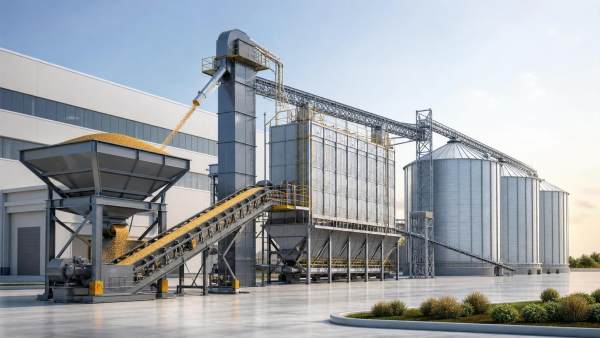
Choosing heavy agricultural machinery for post harvest handling is rarely a simple equipment decision. It shapes grain loss rates, storage stability, labor planning, plant uptime, and the economics of every ton moved through a modern handling system.
That is why grain conveyors, dryers, cleaners, bucket elevators, loaders, and receiving systems now sit closer to strategic infrastructure than to standalone farm assets. When loss control becomes a board-level concern, machinery selection must connect field realities with processing, compliance, and downstream market expectations.
In sectors tracked by AgriChem Chronicle, this matters even more. Agricultural production, feed processing, and primary industrial supply chains are increasingly linked, and post-harvest inefficiency can quickly cascade into quality claims, contract disputes, and avoidable operating costs.
Why post-harvest machinery selection now carries more weight
The classic buying approach focused on capacity, power, and purchase price. That lens is too narrow for current grain operations, especially where throughput and traceability must work together.
Heavy agricultural machinery for post harvest applications now has to protect grain from three kinds of loss at once. The first is visible spillage. The second is hidden physical damage. The third is value loss caused by moisture, contamination, or delayed handling.
Even a mechanically efficient line can underperform if transfer points crack kernels, if dryers create uneven moisture profiles, or if unloading systems slow harvest traffic. In practice, grain loss control is often a systems issue rather than a single-machine issue.
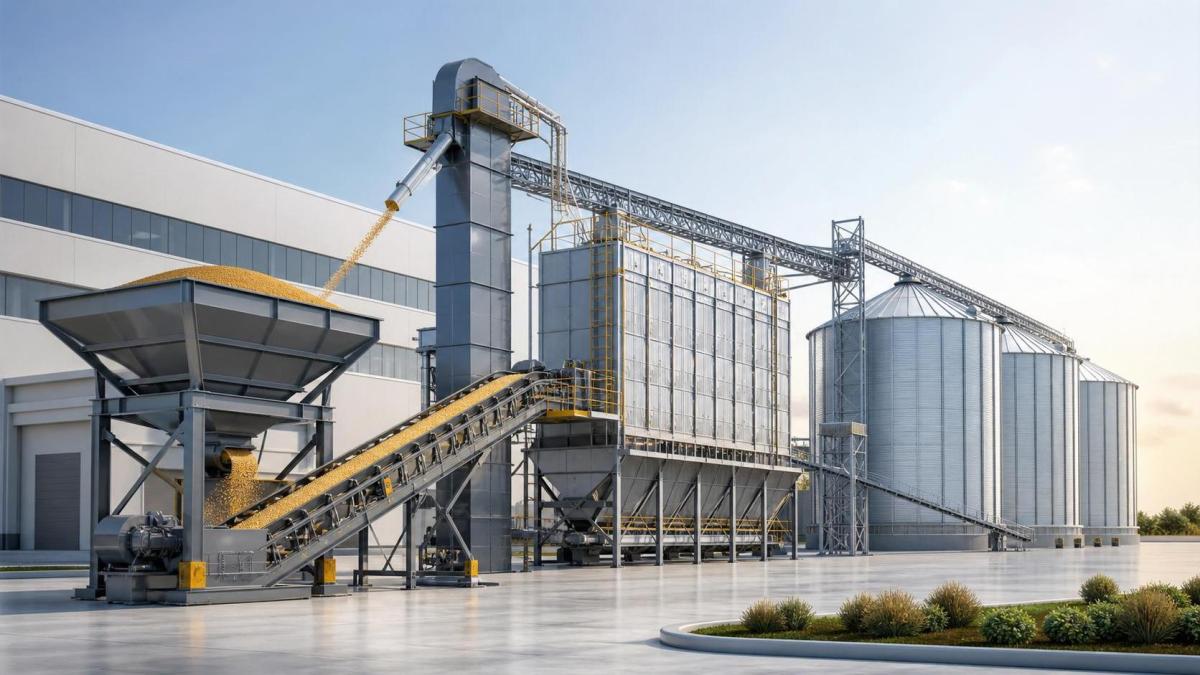
This explains the growing attention to integrated post-harvest layouts. Decision quality improves when machinery is evaluated as part of a connected flow, from field intake to drying, cleaning, storage, and dispatch.
What counts as heavy agricultural machinery for post harvest
The term covers more than large tractors or harvest vehicles. In post-harvest handling, it usually refers to robust equipment built for high-volume grain movement, conditioning, and storage support.
Common categories include receiving hoppers, chain conveyors, belt conveyors, bucket elevators, mobile grain handlers, high-capacity dryers, grain cleaners, stackers, loaders, and bulk transfer systems.
Some sites also include telehandlers, front-end loaders, and trailer unloading systems in the same selection process. The right mix depends on crop type, harvest window, site layout, energy access, labor availability, and storage design.
Heavy agricultural machinery for post harvest should therefore be judged by function within the material flow, not by machine size alone. A compact transfer unit may be more critical than a larger machine if it controls a high-risk bottleneck.
The real cost of grain loss is broader than shrink
Grain loss is often discussed as a percentage. That is useful, but incomplete. Loss also appears as downgraded quality, added energy use, rejected loads, dust management problems, pest exposure, and extra labor at transfer points.
In high-volume operations, a small reduction in breakage can be more valuable than a modest gain in nominal throughput. Intact grain stores better, processes more consistently, and supports stronger downstream yield in feed or milling applications.
This cross-sector effect is one reason industry journals such as ACC track machinery decisions alongside broader supply chain intelligence. Post-harvest equipment performance increasingly affects not only farm economics, but also the reliability of primary processing industries.
Where losses typically originate
- Impact damage at receiving pits, augers, and elevator discharge points.
- Spillage caused by poor sealing, misalignment, or rushed loading cycles.
- Uneven drying that creates spoilage risk during storage.
- Delayed movement that leaves wet grain waiting too long before conditioning.
- Cross-contamination between crop lots, grades, or treated material.
Selection criteria that matter in real operating conditions
A sound evaluation framework starts with flow design. Heavy agricultural machinery for post harvest must match actual tonnage peaks, not just average daily volume. Harvest pressure is usually concentrated, and undersized equipment exposes the entire site.
Capacity still matters, but it should be paired with grain-care performance. High throughput loses value if it increases cracked kernels, fines, or moisture inconsistency.
Key decision dimensions
Another practical issue is transfer geometry. Machinery that performs well in brochures may create damaging drop heights or awkward turning angles on site. Layout review should happen before final specification, not after delivery.
Integration often decides whether machinery performs as promised
In actual operations, machinery rarely fails in isolation. Problems usually appear at interfaces between receiving, conveying, drying, cleaning, and storage. That makes integration quality a central selection factor.
Heavy agricultural machinery for post harvest should be checked for control compatibility, power demand, civil footprint, dust handling, and service access. A faster conveyor is not automatically an upgrade if the downstream cleaner or dryer becomes the new choke point.
It is also wise to examine data visibility. Increasingly, grain systems benefit from temperature sensors, moisture tracking, motor load data, and alarm histories. These tools support earlier intervention and create a stronger basis for performance audits.
Questions worth asking during evaluation
- How does the machine behave under wet harvest conditions, not only standard test conditions?
- Which components are most exposed to abrasion, dust, or overload?
- Can operators clean and inspect the system without long shutdowns?
- Is spare-parts support local, regional, or dependent on long import lead times?
- What evidence shows reduced breakage, not just higher rated capacity?
Different site scenarios call for different machinery priorities
A centralized grain hub usually prioritizes intake speed, route flexibility, and automation. A mixed agricultural and feed-processing site may place more weight on segregation, cleanliness, and stable conditioning before storage or milling.
Remote locations often need simpler heavy agricultural machinery for post harvest because maintenance resources are limited. In those settings, durability and repairability can outperform advanced features that are difficult to support locally.
Seasonality also changes the equation. If the harvest window is short and intense, surge management becomes critical. If grain stays on site longer, aeration support and moisture consistency deserve more attention.
There is no universal best machine. The stronger approach is to rank risks by site condition, crop behavior, throughput pressure, and quality obligations.
How to move from specification sheets to a reliable decision
The most reliable selection process usually combines technical review with operational evidence. Factory ratings are useful, but they should be tested against installation references, service history, and site-specific handling paths.
A practical shortlist can be built around four checkpoints: expected loss reduction, achievable throughput under peak conditions, maintenance burden, and integration effort. This narrows the conversation to measurable outcomes.
For organizations tracking supply chain resilience, documentation quality matters too. Performance data, compliance records, and traceable component support increasingly influence confidence in post-harvest investment decisions.
That is where the broader ACC perspective remains useful. Equipment choices are no longer isolated capital purchases. They sit within regulated, quality-sensitive, and globally connected raw material systems.
Before selecting heavy agricultural machinery for post harvest, map the grain journey, identify the real loss points, and compare machines against that flow rather than against headline specifications alone. Better decisions usually begin with a better handling map.
Related Intelligence
- Heavy Agri MachineryHow to Assess Heavy Agricultural Machinery Producers for Dealer Support and Parts AvailabilityHeavy agricultural machinery producers: learn how to assess dealer expertise, critical parts availability, service response, and downtime risk before you buy.
- Heavy Agri MachineryCan Agricultural Equipment Be Retrofitted for Precision Agriculture?Can agricultural equipment be retrofitted for precision agriculture? Discover practical upgrades, compatibility checks, costs, and smarter ways to boost farm efficiency.
- Heavy Agri MachineryWhich agricultural machinery manufacturer offers modular service documentation compatible with OEM diagnostic software?Which agricultural machinery manufacturer delivers modular service docs that integrate natively with OEM diagnostic software? Discover CLAAS, John Deere & SDF—real interoperability, zero PDF friction.
The Morning Broadsheet
Daily chemical briefings, market shifts, and peer-reviewed summaries delivered to your terminal.
