

The Authority in Global Agricultural Chemistry & Bio-Resources
Zhengzhou–Hamburg China-Europe Railway Launches Cold-Chain Service
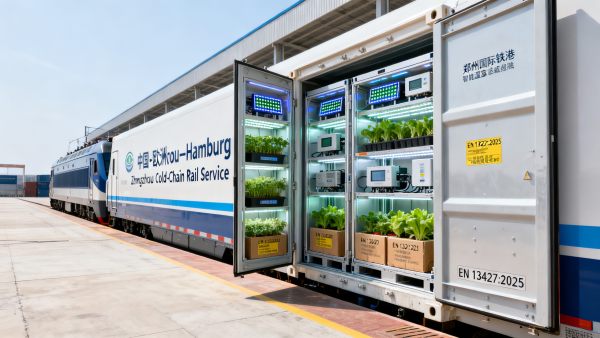
On May 15, 2026, the Zhengzhou–Hamburg China-Europe Railway launched its first dedicated cold-chain train operating at a constant -25°C, specifically transporting temperature-sensitive components for smart greenhouses—including LED supplemental lighting modules, CO₂ concentration controllers, and climate sensing terminals. This development directly impacts precision agriculture equipment exporters, cold-chain logistics providers, and EU-market-facing manufacturers, as it redefines transit-time expectations and environmental compliance thresholds for high-value agri-tech hardware.
Event Overview
On May 15, 2026, the China-Europe Railway service from Zhengzhou to Hamburg introduced its inaugural full-route refrigerated train, maintaining a stable -25°C environment throughout transit. The train is exclusively assigned to carry core thermal control components for smart greenhouses: LED supplemental lighting modules, CO₂ concentration controllers, and climate sensing terminals. According to publicly confirmed information, this service reduces the delivery cycle for these components to the European market from 42 days by sea to 18 days by rail. Temperature deviation during transit is reported to be ≤ ±0.5°C, meeting the requirements of EU standard EN 13427:2025 for transport conditions of precision agricultural equipment.
Industries Affected
Direct Exporters of Smart Greenhouse Components
These enterprises—primarily manufacturers of LED lighting systems, CO₂ controllers, and environmental sensors—face immediate implications for order planning, inventory turnover, and contractual delivery terms. The shortened lead time enables faster response to EU seasonal demand (e.g., winter greenhouse lighting peaks), but also raises expectations for just-in-time replenishment and tighter quality traceability across the cold chain.
Cold-Chain Logistics Providers Serving Agri-Tech Clients
Specialized freight forwarders and rail logistics operators handling temperature-sensitive electronics must now validate their end-to-end monitoring capabilities against EN 13427:2025’s real-time logging, alarm thresholds, and calibration documentation requirements. Unlike general refrigerated cargo, these components require sub-zero stability *and* minimal thermal shock—demanding upgraded sensor integration, pre-trip validation protocols, and certified handover documentation at both origin and destination terminals.
EU-Based Distributors and Integrators of Controlled-Environment Agriculture Systems
Distributors sourcing from Chinese OEMs may revise minimum order quantities and safety stock levels in light of the 18-day rail option. However, they must concurrently verify whether existing import compliance workflows—including CE marking verification, EN 13427-aligned transport certification, and customs classification for refrigerated ICT hardware—are aligned with this new modality. Delays may occur if transport documentation does not explicitly reference EN 13427:2025 conformance.
What Stakeholders Should Monitor and Act On
Track official updates on scalability and frequency of the cold-chain service
The initial launch confirms technical feasibility—not commercial scale. Stakeholders should monitor whether Zhengzhou International Land Port Co., Ltd. or Deutsche Bahn announces regular weekly departures, capacity allocation policies, or eligibility criteria (e.g., minimum consignment weight, pre-booking windows) before adjusting long-term procurement plans.
Verify EN 13427:2025 alignment beyond temperature specs
Compliance under EN 13427:2025 covers data logging intervals, sensor calibration certificates, alarm response records, and post-transit verification reports—not only temperature stability. Companies should request full cold-chain audit trails from carriers and assess internal readiness to store and submit such documentation during EU market surveillance checks.
Distinguish between transit-time reduction and total landed cost impact
While the 18-day rail transit is significantly faster than 42-day maritime shipping, stakeholders must model actual landed costs—including rail surcharges for refrigeration, terminal handling fees at Hamburg Altona, and potential demurrage if unloading or customs clearance lags—before concluding that rail is universally more economical than sea for all shipment sizes or frequencies.
Prepare for phased adoption in procurement and contract terms
Early adopters should pilot the service for non-critical shipments first, documenting temperature logs, customs clearance times, and handover durations. Contract amendments (e.g., Incoterms® 2020 revisions to specify DPU Hamburg Altona with cold-chain annexes) and supplier training on documentation requirements should precede full-scale deployment.
Editorial Perspective / Industry Observation
Observably, this initiative signals a strategic shift toward modal specialization—not just speed optimization—in China-Europe rail freight. It reflects growing recognition that certain high-value, low-bulk industrial goods (e.g., precision agri-tech sensors) benefit less from generic “fast rail” claims and more from certified, standards-aligned cold-chain infrastructure. Analysis shows the 18-day timeline alone does not constitute a market-wide inflection point; rather, it establishes a benchmark for regulatory-compliant transit of sensitive electronics—a niche currently underserved by most existing rail cold-chain offerings. From an industry perspective, this is best understood as an early-stage capability demonstration—one requiring sustained operational consistency, third-party verification, and cross-border customs harmonization before it becomes a widely adopted alternative to maritime or air freight.
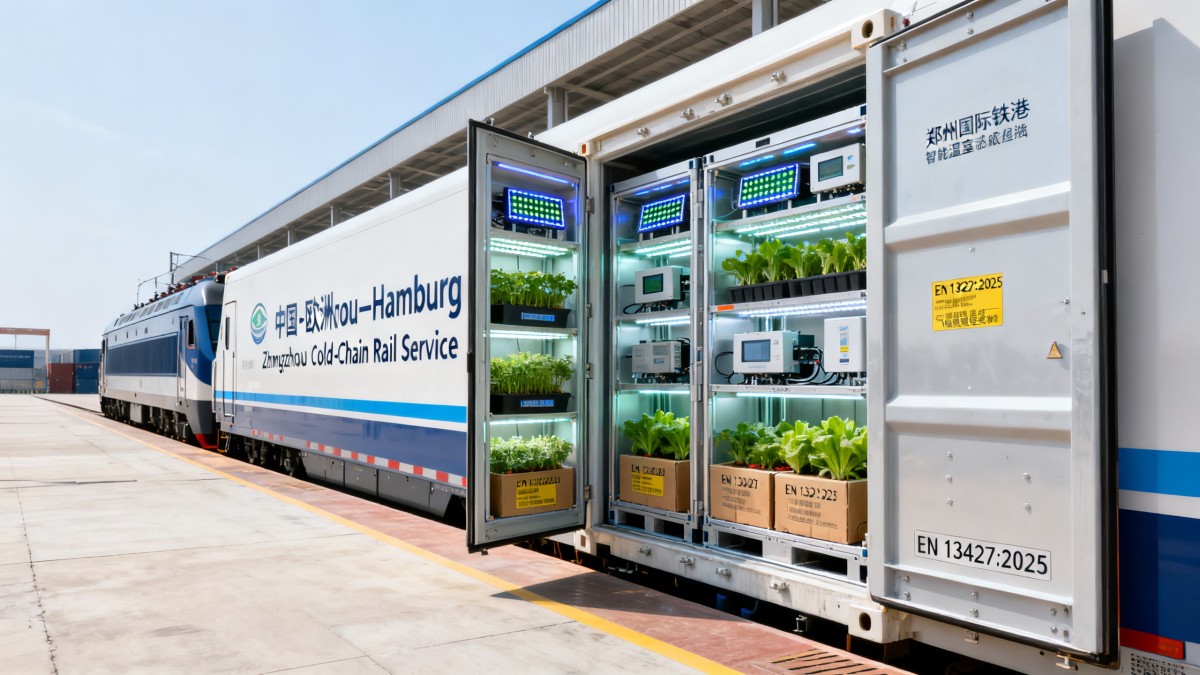
In summary, the Zhengzhou–Hamburg cold-chain train introduces a technically validated, standards-compliant transit option for a narrow but high-stakes segment of agri-tech hardware. Its significance lies not in immediate volume displacement, but in setting a precedent for how regulatory-grade environmental control can be embedded into intercontinental rail logistics. Currently, it is more accurately interpreted as an operational proof point than a mature commercial channel—warranting close monitoring, selective piloting, and documentation readiness, rather than wholesale supply chain redesign.
Source: Public announcement by Zhengzhou International Land Port Co., Ltd. (May 15, 2026); referenced standard EN 13427:2025 (European Committee for Standardization).
Note: Ongoing observation is required regarding service frequency, carrier certification status, and EU customs acceptance of EN 13427-aligned rail documentation.
Related Intelligence
- Smart GreenhouseGreenhouse Equipment for Vertical Farming: Choosing Lighting and VentilationChoose greenhouse equipment for vertical farming with confidence. Compare lighting, airflow, and moisture control to improve crop uniformity and manage costs. Explore the guide.
- Smart GreenhouseSelecting Greenhouse Propagation Equipment for Hot, Humid Southeast Asian NurseriesGreenhouse propagation equipment Southeast Asia: discover how to select resilient irrigation, ventilation, benches, and automation for hot, humid nurseries.
- Smart GreenhouseWhat Are the Biggest Challenges in Agri-Tech Adoption in 2026?What are the biggest challenges in agri tech adoption for 2026? Explore cost, data, connectivity, skills, compliance, and ROI barriers.
The Morning Broadsheet
Daily chemical briefings, market shifts, and peer-reviewed summaries delivered to your terminal.
