

The Authority in Global Agricultural Chemistry & Bio-Resources
SABIC to Ban Non-Biodegradable Plastic Packaging for Food-Grade Enzymes in Saudi Arabia from 2026
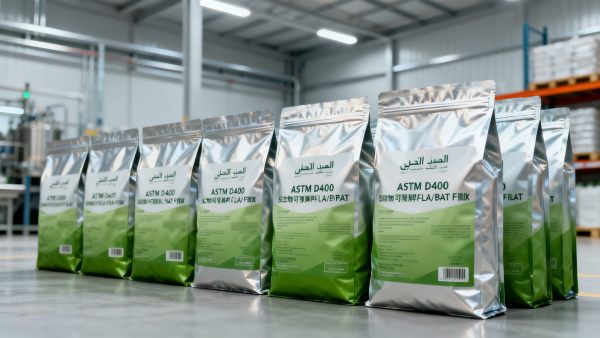
On May 14, 2026, Saudi Basic Industries Corporation (SABIC) announced a mandatory packaging transition for food-grade enzymes supplied into or transshipped through Saudi Arabia — requiring full replacement of conventional PE/PP packaging with ASTM D6400-certified bio-based PLA/PBAT composite films starting October 1, 2026. Exporters based in China — a key supplier region — must complete packaging conversion and update their SASO certification by end-August 2026. This development directly affects enzyme manufacturers, packaging suppliers, regulatory compliance service providers, and international trade operators serving the Middle East food ingredients market.
Event Overview
SABIC issued a supply chain notice on May 14, 2026, mandating that all suppliers of food-grade enzymes for sale or transit in Saudi Arabia cease using traditional polyethylene (PE) and polypropylene (PP) packaging effective October 1, 2026. Replacement packaging must be certified to ASTM D6400 and composed of polylactic acid (PLA) and polybutylene adipate terephthalate (PBAT) blends. The requirement applies universally across all food-grade enzyme products distributed in or routed through Saudi Arabia. Chinese exporters are required to finalize packaging changes and obtain updated SASO certification by August 31, 2026.
Industries Affected
Direct Exporters of Food-Grade Enzymes
These companies face immediate compliance pressure: failure to meet the October 1, 2026 deadline risks shipment rejection or customs delays at Saudi ports. The shift requires not only new packaging procurement but also revalidation of product stability under the new film’s barrier properties and moisture transmission characteristics.
Packaging Material Suppliers & Converters
Suppliers of PLA/PBAT laminates must demonstrate ASTM D6400 certification and provide batch-level documentation traceable to SABIC’s verification process. Converter facilities handling final pouch/film assembly will need to adjust sealing parameters, shelf-life testing protocols, and labeling compliance for biodegradability claims under Saudi regulatory interpretation.
Regulatory & Certification Service Providers
Firms supporting SASO certification updates must now integrate packaging material verification into their scope — including review of compostability test reports, raw material declarations, and manufacturing site audits specific to biopolymer handling. Turnaround time for SASO amendment submissions may tighten as demand surges ahead of the August deadline.
Food Ingredient Distributors & Regional Logistics Operators
Distributors managing inventory in Jeddah or Dammam free zones must verify incoming stock against the new packaging standard before onward distribution. Logistics partners handling temperature-sensitive enzyme shipments may need to reassess cold-chain compatibility with PLA/PBAT films, particularly under high-humidity Gulf conditions.
Key Actions for Stakeholders
Monitor official SASO guidance on ASTM D6400 implementation
SASO has not yet published detailed technical annexes clarifying acceptable test laboratories, validity periods for certification, or transitional provisions. Stakeholders should track SASO Circulars issued between June and August 2026 for binding operational instructions.
Validate packaging performance under real-world storage and transport conditions
ASTM D6400 certifies industrial compostability — not necessarily shelf-life integrity. Exporters should conduct accelerated stability studies (e.g., 40°C/75% RH for 6 months) on enzyme activity retention when packaged in PLA/PBAT films, especially for proteases and amylases prone to humidity-induced deactivation.
Confirm lead times and minimum order quantities with qualified PLA/PBAT film suppliers
Global demand for certified compostable films is rising; lead times for custom-printed, food-contact-grade PLA/PBAT laminates currently range from 10–14 weeks. Exporters should secure samples and place first production orders no later than mid-June 2026 to allow buffer for qualification and SASO submission.
Update internal documentation control systems for material traceability
SABIC’s notice implies audit-readiness requirements. Companies must maintain records linking each enzyme batch to its packaging lot number, ASTM D6400 test report ID, and SASO certificate version — accessible for potential SABIC or SASO verification during port inspections or post-clearance audits.
Editorial Perspective / Industry Observation
Observably, this SABIC mandate functions less as an isolated compliance threshold and more as a signal of tightening circular-economy enforcement across GCC regulated markets. While limited in geographic scope, its timing — aligned with Saudi Vision 2030 sustainability targets — suggests broader adoption of similar packaging mandates may follow in UAE and Qatar. Analysis shows that the requirement prioritizes verifiable certification (ASTM D6400) over vague ‘eco-friendly’ claims, indicating regulators are shifting toward standardized, third-party-validated environmental criteria. From an industry perspective, this reflects growing convergence between food safety regulation and environmental compliance — where packaging is no longer treated as ancillary, but as an integral part of product specification.
This development is best understood not as a one-off regulatory change, but as an early inflection point in the regional harmonization of sustainable packaging standards for functional food ingredients. It signals increasing expectation that export-ready formulations must embed both safety and end-of-life accountability — without exception.
Current understanding should treat this as a binding operational requirement for Saudi-bound shipments, not a voluntary initiative. Its enforceability stems from SABIC’s role as both major customer and supply chain gatekeeper — meaning non-compliance carries commercial, not just administrative, consequences.
Information Source: Official SABIC Supply Chain Notice (issued May 14, 2026); SASO Public Guidance Portal (as of June 2026). Note: Final SASO technical implementation guidelines remain pending and require ongoing monitoring through August 2026.
Related Intelligence
- Food Grade EnzymesWhat Drives Industrial Enzyme Costs? Activity, Format, and Supply Risk ExplainedIndustrial enzyme cost factors explained: compare activity, formulation, shelf life, documentation, and supply risk to reduce process costs and improve purchasing decisions.
- Food Grade EnzymesIs There a Global Standard for Biochemical Engineering Product Quality?Is there a global standard for biochemical engineering product quality? Explore GMP, ISO, traceability, and supplier checks for confident global sourcing.
- Food Grade EnzymesHow Enzymes for Cracker Formulation Improve Texture and Shelf LifeEnzymes for cracker formulation can enhance dough handling, crisp texture, and shelf life. Explore targeted enzyme strategies for consistent, high-quality crackers.
The Morning Broadsheet
Daily chemical briefings, market shifts, and peer-reviewed summaries delivered to your terminal.
