

The Authority in Global Agricultural Chemistry & Bio-Resources
India Eases BIS Rules for Smart Greenhouse Imports

On July 5, 2026, India’s Ministry of Agriculture and Farmers Welfare (MoAFW) announced a rule change for imported Smart Greenhouse systems, shifting them away from mandatory BIS IS 17622:2025 certification and into a compliance path based on self-declaration plus a third-party test report from the country of origin. For exporters, importers, procurement teams, testing providers, and supply chain operators involved in climate control, irrigation automation, and energy management systems, this is worth watching because it changes the documentation and clearance logic that can directly affect customs timing and delivery planning.
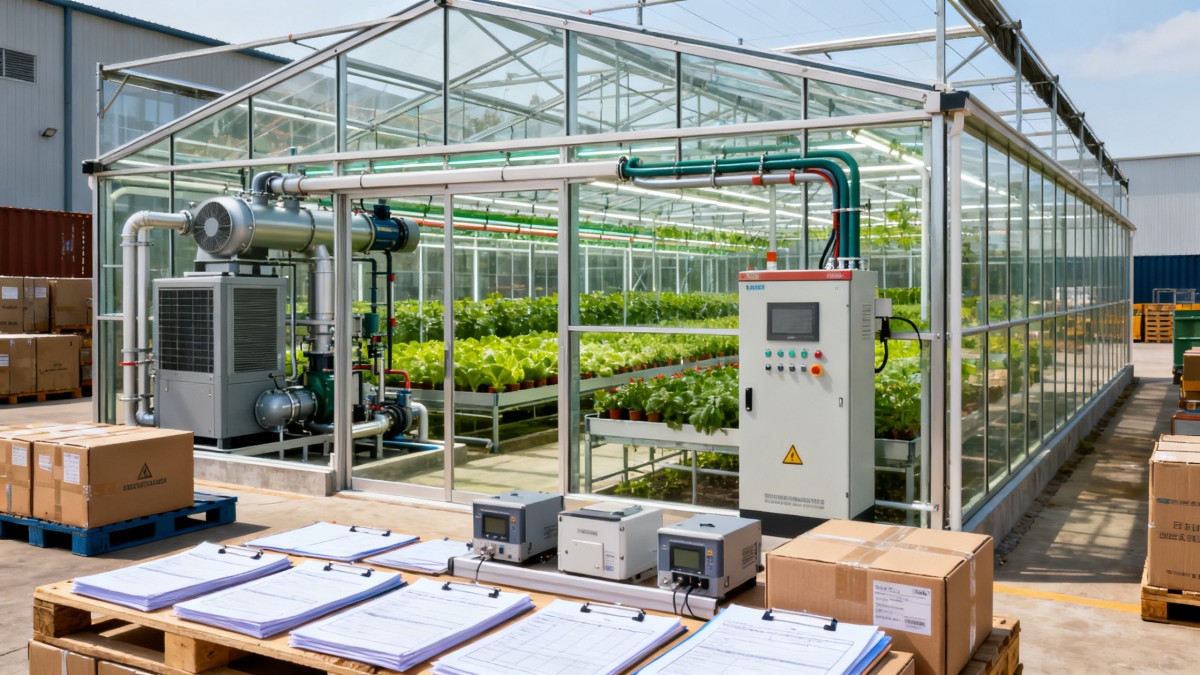
What the July 5 Notice Confirms
According to the notice released by MoAFW on July 5, 2026, imported Smart Greenhouse turnkey equipment is exempted from mandatory BIS IS 17622:2025 certification. The covered scope includes climate control, irrigation automation, and energy management systems within Smart Greenhouse equipment. Under the new arrangement, compliance will move to a model based on self-declaration together with a third-party test report issued in the country of origin.
The new rule is scheduled to take effect on July 7. The summary provided indicates that customs clearance time is expected to be reduced by more than 60%, with the first-year quota temporarily set without a quantity limit.
Where the change may be felt first in the trade flow
Export shipments may move faster, but document accuracy becomes more central
Analysis shows that exporters of Smart Greenhouse systems may see the most immediate effect in shipment preparation and border clearance timing. If mandatory BIS certification is no longer the entry requirement for the covered equipment, the main operational shift moves toward preparing self-declaration materials and country-of-origin third-party test reports that match the imported system scope. What deserves closer attention is whether product descriptions, system configuration lists, and supporting technical documents are consistent across trade and compliance files.
Import procurement teams may need to revise supplier qualification checks
From an industry perspective, buyers and import-side procurement teams may need to adjust how they screen suppliers for India-bound projects. The change does not remove compliance review; it changes the form of that review. This means procurement decisions may increasingly depend on whether suppliers can provide complete third-party test documentation from the origin market, along with declaration materials that align with shipment content and project specifications.
Testing and compliance service providers may see a shift in demand
Observably, the rule change may alter the role of certification and testing service participants. Instead of focusing on mandatory BIS certification for the covered imports, attention may move toward the quality, scope, and usability of origin-country test reports in customs and trade documentation. For service providers, the practical issue is less about expanding claims and more about ensuring that reports support the exact equipment package being shipped.
Logistics and delivery planning could become more sensitive to execution details
For supply chain and delivery teams, the stated expectation of a customs clearance reduction of more than 60% suggests a potential change in lead-time planning. Analysis shows that this may affect booking rhythm, installation scheduling, and project delivery sequencing. At the same time, because the summary does not provide detailed execution guidance, companies still need to monitor how the new documentation model is applied in practice from July 7 onward.
Practical issues companies should track now
Check whether product scope matches the exempted equipment category
Companies should first review whether their exported or procured package clearly falls within the stated Smart Greenhouse turnkey equipment scope, including climate control, irrigation automation, and energy management systems. This matters because the compliance benefit described in the notice is tied to the covered product category rather than to all agricultural or automation equipment more broadly.
Rebuild document packs around the new compliance path
Analysis shows that document preparation now deserves closer attention than before. Businesses should review whether self-declaration materials, third-party test reports from the country of origin, technical descriptions, and shipment documentation are aligned in terminology and scope. Where internal templates still assume mandatory BIS certification, those templates may need to be updated for India-bound transactions under the new rule.
Watch for official wording in implementation and tender practice
What deserves closer attention is not only the notice itself, but also how the new approach is reflected in practical execution. Companies involved in bids, project procurement, or framework supply should track whether tender documents, buyer compliance checklists, and customs-facing document requests are revised in line with the exemption. Since no detailed implementation layer was provided in the input, this remains an area to verify rather than assume.
Reassess delivery promises and after-sales traceability
Observably, a shorter expected clearance cycle may influence delivery commitments. Even so, companies should avoid treating the timing benefit as automatic in every shipment. Exporters and service teams may need to maintain clear quality traceability and post-delivery documentation, especially where integrated systems are shipped as complete sets and require later service support.
Why this looks like an execution signal rather than a closed case
Analysis shows that this development is more appropriately understood as an executed rule change with immediate operational relevance, because an effective date has been stated and the compliance route has been explicitly redefined. At the same time, it is not yet a closed compliance story. Observably, the market still needs to see how consistently the self-declaration plus origin-country third-party testing model is interpreted in customs handling, procurement review, and project documentation after July 7.
From an industry perspective, the first-year unlimited quota adds to the practical significance of the change, because it removes an immediate quantity cap from the initial adjustment period. Even so, the absence of further detail in the provided summary means businesses should continue to validate execution practice rather than rely on assumptions about uniform treatment across all transactions.
How the market may best read this development
At this stage, the most balanced reading is that India has introduced a concrete easing measure for imported Smart Greenhouse turnkey equipment by replacing mandatory BIS certification with a lighter documentation-based route. The immediate importance lies in customs timing, compliance workflow, and procurement documentation rather than in any guaranteed market outcome. It is more appropriate to understand this as a real rule change that can affect trade execution quickly, while still requiring close attention to implementation language, document acceptance, and market response.
Basis of this article
This article is generated based on the user-provided news title, event date, and event summary. For events of this type, commonly relevant source categories may include official notices, releases from regulatory authorities, customs or trade administration information, industry association updates, standards-related documents, and reporting by established industry media. No specific official source link was provided in the input, so the exact source link remains to be independently verified. Further observation is still needed on implementation details, compliance interpretation, tender document changes, industry feedback, and how companies execute under the new rule after it takes effect.
Related Intelligence
- Smart GreenhouseGreenhouse Equipment for Vertical Farming: Choosing Lighting and VentilationChoose greenhouse equipment for vertical farming with confidence. Compare lighting, airflow, and moisture control to improve crop uniformity and manage costs. Explore the guide.
- Smart GreenhouseSelecting Greenhouse Propagation Equipment for Hot, Humid Southeast Asian NurseriesGreenhouse propagation equipment Southeast Asia: discover how to select resilient irrigation, ventilation, benches, and automation for hot, humid nurseries.
- Smart GreenhouseWhat Are the Biggest Challenges in Agri-Tech Adoption in 2026?What are the biggest challenges in agri tech adoption for 2026? Explore cost, data, connectivity, skills, compliance, and ROI barriers.
The Morning Broadsheet
Daily chemical briefings, market shifts, and peer-reviewed summaries delivered to your terminal.
