

The Authority in Global Agricultural Chemistry & Bio-Resources
Layer Cage Wire and Galvanizing: Durability Checks for Farms in Zambia
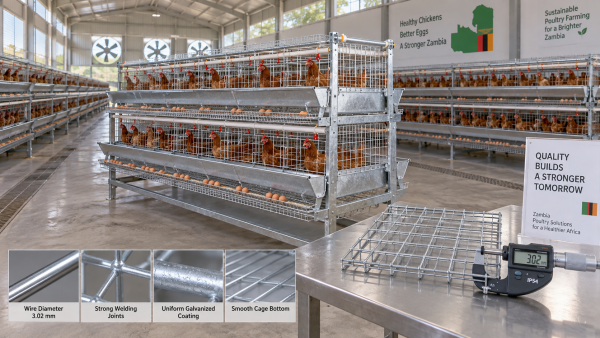
Layer cage durability is often judged by how thick the wire looks and how bright the galvanized surface appears. Neither observation is enough. A cage can have substantial wire but weak welds, or an attractive zinc finish with exposed steel at joints and cut ends. For farms in Zambia, technical evaluation should connect wire strength, coating quality and cage geometry with the actual poultry-house environment.
The main question is whether the cage will retain its shape and protective coating under bird loading, cleaning, manure exposure and repeated handling. Premature deterioration can leave rough surfaces, distorted floors and loose partitions, affecting bird welfare, egg movement and maintenance costs. A useful inspection therefore covers the finished assembly, not just a loose wire sample or a coating certificate.
Define the farm exposure before comparing cage specifications
Cages in a dry, well-ventilated house face different conditions from those near leaking drinkers or above manure that remains wet. Zambia’s seasonal rainfall can increase moisture exposure, but conditions inside the house depend heavily on ventilation, drainage, stocking arrangements and manure removal. National location alone cannot establish an expected service life.
Persistent moisture, manure deposits and cleaning residues can create aggressive local conditions. Corrosion may begin around drinker lines, floor intersections and joints where deposits accumulate, even while nearby wire remains sound. Ammonia is a warning sign of air-quality and manure-management problems, but coating deterioration should not be attributed to ammonia concentration alone.
Before requesting quotations, record the manure-removal method, cleaning chemicals, washdown frequency and likely drying time. Include water quality where mineral deposits or unusual chemistry are a concern. Identify whether replacement panels can be fitted without dismantling an entire row. These details help turn “galvanized cage” from a broad sales description into a specification matched to the farm.
When assessing chicken layers cages for sale in zambia, battery cage layouts provide useful context for comparing floor panels, partitions, support frames and manure access. However, a system description is only a starting point: technical approval requires evidence about wire dimensions, welding, zinc protection and the delivered configuration.
Wire diameter matters, but unsupported span matters too
Wire diameter influences stiffness and resistance to deformation. Yet two cages using the same wire diameter can behave differently because of mesh spacing, unsupported span, floor slope and support placement. A floor panel carried by well-positioned supports may perform differently from one with a wider unsupported section, even if their material descriptions match.
Request wire dimensions by function rather than accepting one diameter for the whole cage. Floors, partitions, doors and feeder supports carry different loads. The specification should distinguish steel-core diameter from diameter measured over the coating; these are not interchangeable measurements.
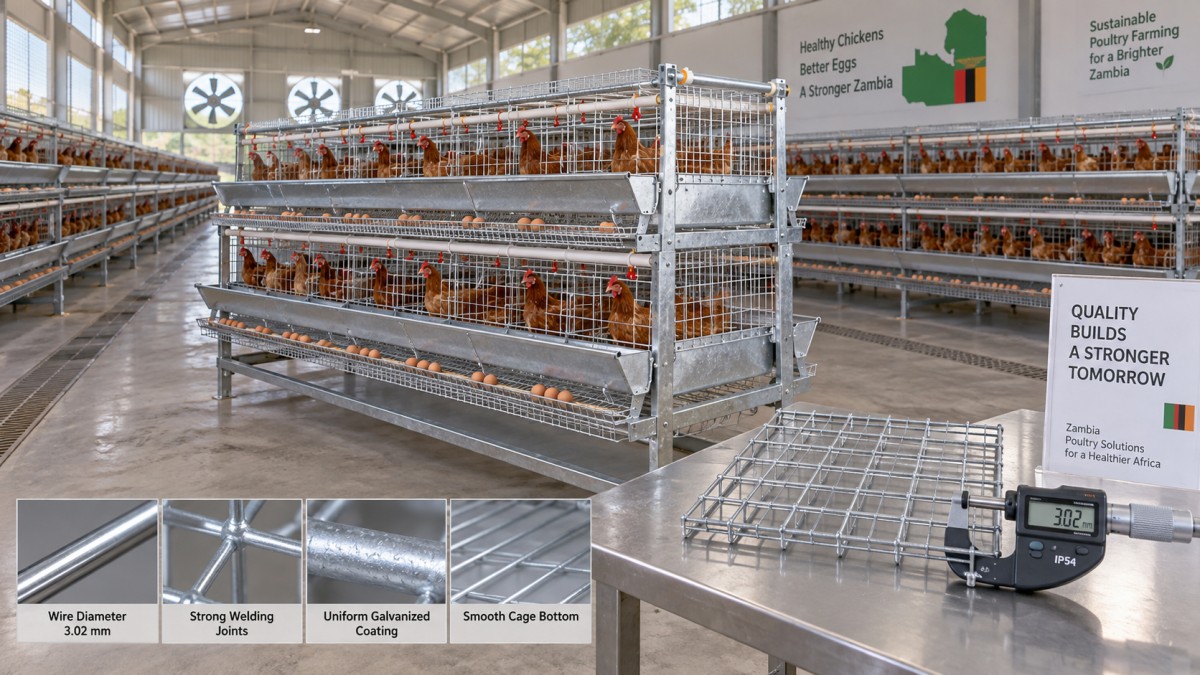
Use a calibrated micrometer on representative straight sections, avoiding weld buildup and obvious zinc accumulations. Sample more than one panel and measure different positions. A single compliant reading does not establish batch consistency. Agree permissible variation in the purchase specification rather than deciding after delivery what seems acceptable.
Steel grade and mechanical properties also affect performance. High tensile strength does not automatically make a cage better: forming requirements, weld quality and resistance to brittle failure matter. Where material certificates are supplied, check that they can be traced to the production batch. A certificate for unrelated wire provides little assurance about the finished panels.
A practical assembly check should reproduce the intended support arrangement and representative distributed loading. Loading one isolated point by hand is not a reliable substitute. Observe floor deflection, permanent deformation after unloading, door alignment and movement at connections. The assessment should also confirm mesh openings and floor geometry against bird-welfare requirements and egg-roll behavior; structural strength cannot compensate for an unsuitable floor.
Clarify when and how the zinc coating is applied
“Galvanized” describes a family of zinc-protection processes, not one uniform quality level. Zinc generally protects steel through a barrier effect and sacrificial action where small areas become exposed. Protection depends on coating continuity, available zinc, environmental conditions and the size and location of any damage.
The sequence of manufacture is particularly relevant to welded cages:
Hot-dip processing does not eliminate the need for inspection, and pre-galvanized wire should not be rejected merely because of its production sequence. The relevant comparison is the finished product’s condition and verified specification. Ask suppliers to identify the process for each major component: frames, mesh panels and fasteners may receive different treatments.
A heavier zinc coating can offer more protective material, but excessive buildup can create rough projections or obstruct small openings. Smoothness matters wherever birds contact the wire and where eggs travel. An acceptable finish must balance corrosion protection with safe, functional geometry.
Measure coating quality without confusing appearance with protection
A bright finish is not proof of adequate zinc thickness. Depending on the process, sound galvanized surfaces may appear shiny, dull or uneven in tone. Visual inspection is better used to identify bare areas, flaking, rough deposits and signs of poor handling than to estimate coating quantity.
Coating measurements on thin, curved wire need particular care. Magnetic gauges suitable for flat steel may produce unreliable readings on small-diameter wire unless the instrument, probe and calibration method are appropriate. Welds and intersections introduce further geometric errors. Require the test method to suit the component rather than accepting an unexplained gauge reading.
Laboratory methods can assess zinc mass or thickness, but results must state their measurement basis. Coating mass per unit area differs from zinc mass per unit mass of wire. Results cannot be compared directly when suppliers use different reporting conventions. If a result is converted to an equivalent thickness, the calculation assumptions should be stated.
Agree where samples will be taken and how local defects will be assessed. An average coating value can conceal a poorly protected weld or a bare cut end. For demanding exposures, the inspection plan may need both overall coating measurements and closer examination of vulnerable details.
Accelerated corrosion testing can help compare samples produced and tested under the same conditions. It does not directly establish years of service in a Zambian poultry house. Salt-spray exposure, for example, does not reproduce every combination of manure, drying, cleaning chemicals and mechanical wear. Treat test results as supporting evidence, not a service-life guarantee.
Inspect welds, edges and connections as separate failure points
Welded mesh must transmit load through its intersections. A visually substantial weld may still be defective, while a neat weld can have inadequate bond strength. Sampling should include weld integrity checks appropriate to the wire and panel design, with acceptance criteria agreed before production.
Look for broken intersections, cracks near welds and wire movement under representative loading. Destructive testing of selected production samples can provide stronger evidence than visual inspection alone, though the method and failure criteria need to be defined. Grinding or coating over a questionable joint does not demonstrate structural adequacy.
Cut ends, door edges and protruding wire tails deserve a separate safety inspection. These details may injure birds or workers and can also become early corrosion sites. Check whether fabrication leaves exposed steel and whether any repair coating is suitable, controlled and documented. A touch-up layer should not be assumed equivalent to the original galvanizing process.
Fasteners and supports are easy to overlook when the mesh looks satisfactory. Review their protective finish, contact surfaces and exposure to trapped moisture. Where dissimilar metals are used together, assess galvanic compatibility under wet conditions. Connections should allow secure assembly without crushing wire, stripping threads or damaging the zinc unnecessarily.
Set acceptance checks before shipment and repeat them on delivery
Inspection becomes more useful when it is tied to a defined batch and purchase document. Request component drawings, dimensional tolerances, material identification, coating details and the proposed sampling plan. Any cited standard should apply to the actual product or test method; a general claim of compliance is insufficient without its scope and supporting records.
A manageable acceptance plan can include:
- Dimensional checks: wire diameter, mesh openings, panel dimensions, floor slope and support positions.
- Finish checks: bare areas, sharp projections, coating damage, weld coverage and obstructed openings.
- Mechanical checks: sampled weld integrity, assembled floor response and secure door operation.
- Traceability checks: batch references linking delivered panels with relevant material and coating records.
Record defects with photographs and their locations, rather than reporting only that a cage is “rusty” or “weak.” Separate functional or safety defects from cosmetic variation. Establish how rejected components will be replaced and whether replacement panels will remain available in compatible dimensions.
Transport can alter the condition of an otherwise acceptable batch. Panels rubbing together may damage coatings, while tightly packed wet components can develop white corrosion products during storage. White rust is different from red rust on exposed steel, but heavy deposits warrant assessment for coating loss. Packaging should limit abrasion and moisture retention; delivered panels should be stored dry with appropriate ventilation.
Judge durability through maintenance and replacement cost
No practical cage specification removes the need for maintenance. Drinker leaks should be repaired promptly, manure accumulation controlled and cleaning chemicals used at compatible concentrations. Aggressive scraping can damage zinc at wire intersections. After washing, drainage and drying influence how long surfaces remain exposed to moisture.
Inspection should concentrate on recurring wet zones, floor supports, welds and damaged coating areas. Where repairs are appropriate, preparation and repair materials need a defined procedure. Coating treatment cannot restore strength to wire already significantly thinned by corrosion or reconnect failed welds.
Procurement comparisons should include replacement labor, access restrictions and spare-panel compatibility, rather than purchase price alone. A cheaper cage may be reasonable in a relatively dry, accessible installation, while a harder-to-maintain house may justify stronger evidence of coating coverage and panel performance. Avoid assigning a fixed lifespan without exposure data.
The defensible purchasing decision is based on a verified assembly: wire suited to its span, sound welds, continuous zinc protection and safe contact surfaces. For the receiving farm, the most useful final check is whether the supplied cage meets those agreed requirements after transport and installation, especially at the locations most likely to stay wet or carry repeated loads.
Related Intelligence
- Poultry Housing & CagingLayer Cage Wire and Galvanizing: Durability Checks for Farms in ZambiaComparing chicken layers cages for sale in zambia? Discover essential wire, weld and galvanizing checks to choose durable cages, reduce repair costs and buy with confidence.
- Poultry Housing & CagingHow Cage Specifications Affect Poultry Housing Costs in NigeriaLocally made poultry cage price in Nigeria: compare cage specifications, housing costs, durability, ventilation, manure systems, and installation factors for smarter poultry investment.
- Poultry Housing & CagingWhat Determines Battery Cage Prices in Nigeria Beyond Bird Capacity?Battery cage price in Nigeria depends on more than capacity. Compare steel, automation, logistics, and installation scope for a smarter poultry investment.
The Morning Broadsheet
Daily chemical briefings, market shifts, and peer-reviewed summaries delivered to your terminal.
