

The Authority in Global Agricultural Chemistry & Bio-Resources
Poultry Feed Pan System Sizes, Feed Flow, and Line Spacing Explained
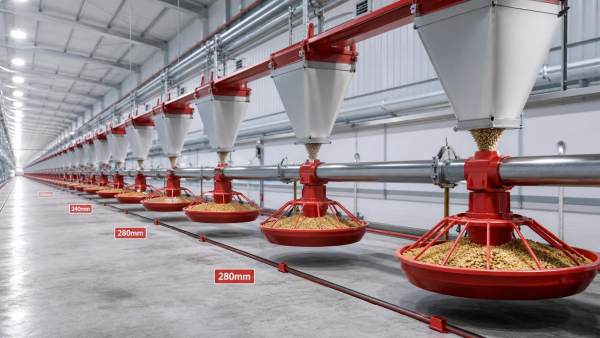
A well-matched poultry feed pan system does more than move feed from a hopper to birds. It shapes access, feeding rhythm, floor cleanliness, and daily labor consistency.
That is why system size, feed flow, and line spacing remain practical concerns across modern feed and grain processing, poultry housing design, and agricultural machinery selection.
When pan dimensions or line layout are slightly off, the result is rarely dramatic at first. More often, it appears as uneven crop fill, higher feed loss, and avoidable flock variation.
Why feed pan design still deserves close attention
In large poultry houses, feeding equipment is expected to perform as a stable production tool, not just a delivery mechanism. Small setup choices influence feed conversion and bird movement every day.
AgriChem Chronicle often tracks equipment decisions through the wider lens of primary industries. In that context, a poultry feed pan system sits at the intersection of mechanical reliability, feed handling efficiency, and biological response.
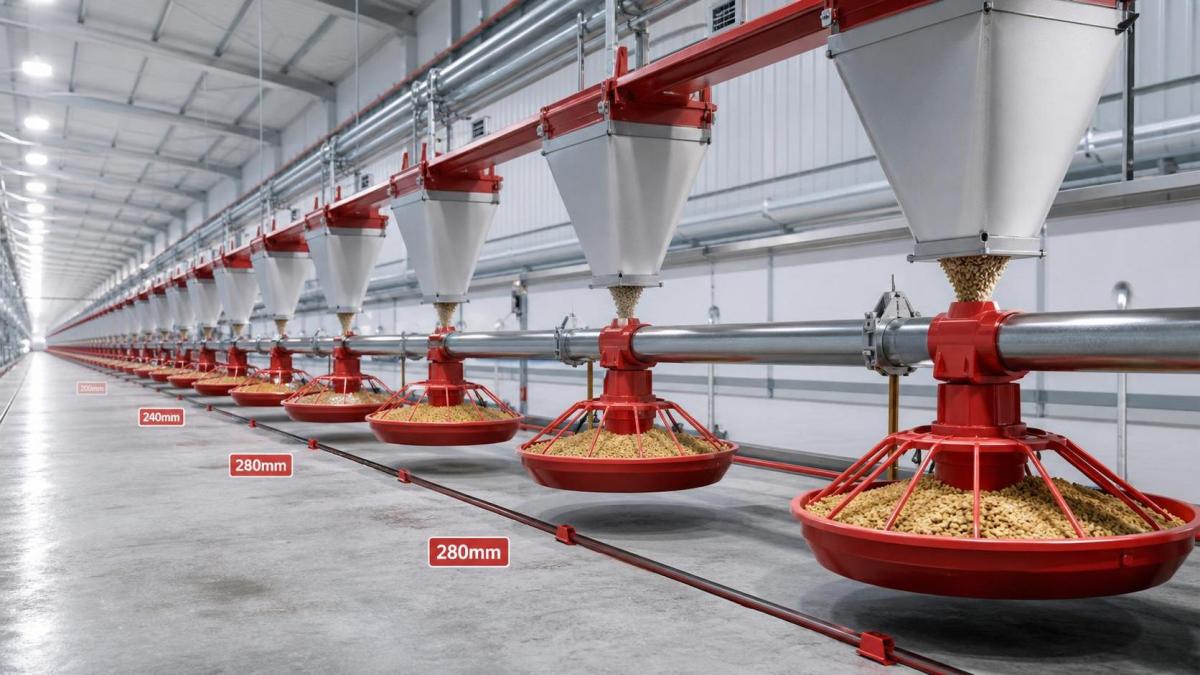
This becomes more relevant as feed costs remain sensitive and housing density leaves less room for inconsistent distribution. A poor setup can quietly erode margins even when the system appears functional.
The best results usually come from treating pan size, flow control, and line spacing as one connected system rather than three separate specifications.
What a poultry feed pan system actually controls
At a basic level, the system carries feed along a line and meters it into pans. In practice, it also controls how quickly birds locate feed, how evenly they eat, and how much feed stays in the pan.
A poultry feed pan system usually includes the feed line, pans, grill or anti-scratch components, drop tubes, drive unit, and adjustment settings for feed depth.
Operators often focus first on capacity. That matters, but the more useful question is whether the system matches bird size, stocking pattern, and the feeding behavior expected at each growth stage.
Pan size is about access, not only volume
Smaller birds need easy reach and clear pan edges. Larger birds need enough eating space to reduce crowding without encouraging waste from overfilled pans.
A pan that is too shallow may empty quickly at peak demand. A pan that is too wide or too deep may let birds rake feed outward.
Simple sizing decisions can therefore affect both accessibility and feed retention. That balance is central to any poultry feed pan system evaluation.
How pan sizes relate to bird age and production style
There is no universal pan size that performs equally well across brooding, grow-out, and heavier finishing weights. Matching the pan to the flock stage reduces adjustment pressure later.
Starter-phase birds benefit from low lip height and easy visibility of feed. If the first access point is awkward, early intake can fall behind.
As birds grow, pan geometry should support more simultaneous access. The aim is not simply to hold more feed, but to keep multiple eating positions usable.
The same logic applies when comparing broiler and pullet environments. Feeding behavior, body shape, and line pressure differ enough to justify closer review of pan design.
Feed flow is where many systems win or fail
Even a correctly sized poultry feed pan system underperforms when feed flow is uneven from the beginning to the end of the line. Birds quickly respond to those differences.
Feed flow depends on auger performance, tube condition, feed form, drop timing, and depth settings. It is also affected by ingredient consistency and pellet durability.
In real houses, poor flow often appears as fuller pans near the drive end and lighter pans farther away. That pattern can lead to clustering and repeated movement during feeding periods.
Signs that flow needs adjustment
- Pans at the end of the line empty sooner than those near the feed entry point.
- Feed depth changes noticeably between adjacent pans.
- Birds gather in the same sections during each feeding cycle.
- Fine material builds up while larger particles move inconsistently.
- Spillage increases after flow settings are raised to compensate.
A reliable poultry feed pan system should deliver repeatable pan fill, not just high throughput. Consistency matters more than aggressive delivery rates that create waste.
Line spacing affects behavior as much as hardware
Line spacing is often discussed as a layout issue, but it is really a bird access issue. Distance between feed lines changes walking patterns, competition points, and how evenly birds occupy the house.
When spacing is too wide, some areas become underused and birds spend more energy moving to feed. When lines are too close, traffic density rises and litter conditions may worsen.
Good spacing supports even distribution across the floor area while preserving service access for inspection, cleaning, and height adjustment.
What to review before fixing line positions
- House width and total usable floor area.
- Number of birds per line and target stocking density.
- Drinker line placement and traffic overlap.
- Ventilation pattern, especially in tunnel systems.
- Equipment height changes during different growth stages.
The point is not to chase one universal spacing figure. It is to avoid forcing the poultry feed pan system into a house pattern it was not designed to serve.
Where layout, feed form, and maintenance intersect
Many field problems blamed on equipment size are actually linked to feed texture, cleaning intervals, or line wear. That broader view matters in mixed agricultural operations.
For example, crumb, mash, and pellet feed do not move through a poultry feed pan system in the same way. Ingredient oil level, fines content, and moisture also influence flow behavior.
In processing-oriented businesses, this is where machinery selection connects with feed formulation discipline. A well-designed line still depends on feed that can travel and settle predictably.
Maintenance adds another layer. Worn augers, damaged pans, and misaligned tubes reduce consistency long before a full failure occurs.
A practical way to assess system fit
A useful review starts with observation during active feeding, not with a catalog specification alone. Watch where birds gather, which pans empty first, and where litter shows repeated feed loss.
Then compare those observations against three questions: Is pan access correct for current bird size? Is feed flow uniform across the line? Does spacing support even house occupancy?
If one answer is weak, the poultry feed pan system may still function, but it is unlikely to perform efficiently. Incremental corrections often produce meaningful gains without a full replacement.
Useful next checks
- Measure bird access per pan instead of relying on nominal line capacity.
- Inspect pan fill at several points along each line during the same feeding cycle.
- Review feed physical quality alongside equipment settings.
- Check whether line spacing still fits current stocking and ventilation strategy.
- Document waste points before changing depth settings or line height.
For any operation comparing new installations or upgrades, the clearest path is to build a short assessment around bird stage, house geometry, feed form, and service history. That produces a more defensible poultry feed pan system decision than price or diameter alone.
Related Intelligence
- Feeding & Watering SystemsHow to Size Commercial Farm Feed Systems for Herd Capacity and Feed FlowFarm commercial feed systems: learn how to size storage, conveyors, and feed flow for herd capacity, peak demand, resilience, and efficient farm operations.
- Feeding & Watering SystemsSelecting a Nipple Drinking System for Broiler and Layer HousesNipple drinking system selection guide for broiler and layer houses: compare water flow, pressure control, flushing, durability, and installation needs.
- Feeding & Watering SystemsHow to Select Poultry Feeding Systems for Broiler Farms by Flock Size and Feed WasteFarm poultry feeding systems: learn how to match feeder design to broiler flock size, reduce feed waste, improve uniformity, and control lifecycle costs.
The Morning Broadsheet
Daily chemical briefings, market shifts, and peer-reviewed summaries delivered to your terminal.
