

The Authority in Global Agricultural Chemistry & Bio-Resources
International B2B Ventilation Fans: How to Compare Airflow, Certification, and MOQ

International B2B Ventilation Fans: How to Compare Airflow, Certification, and MOQ
Sourcing international B2B ventilation fans is not just about finding the lowest quote.
A low unit price can hide weak airflow, incomplete documents, or rigid order terms.
That creates risk for factories, farms, warehouses, and processing lines.
When comparing international B2B ventilation fans, three checks matter most.
First, verify real airflow under working conditions.
Second, confirm that certifications match the target market and application.
Third, test whether MOQ supports rollout, spare parts, and future scaling.
Start With Application Fit, Not the Catalog
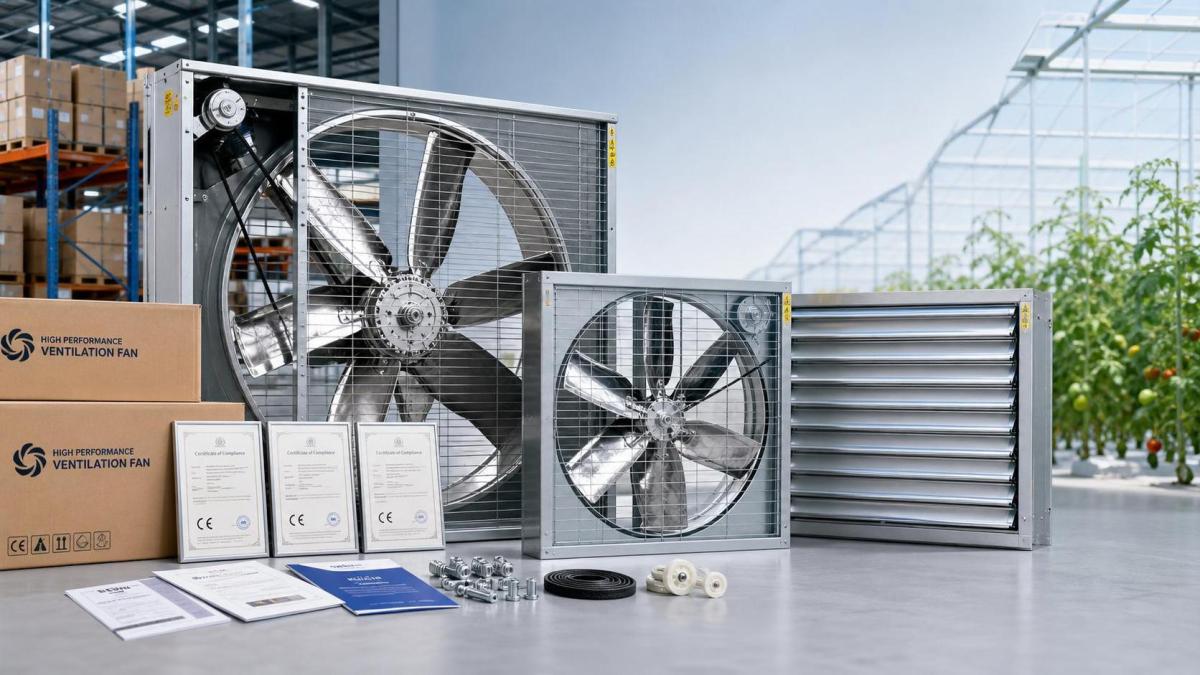
Many international B2B ventilation fans look similar on paper.
In practice, the right model depends on heat, dust, moisture, corrosion, and operating hours.
A poultry house needs a different fan setup than a chemical blending room.
A grain facility also faces different static pressure than a greenhouse tunnel.
That is why the first comparison point should be use case.
Ask suppliers for reference projects in similar environments.
Request details on motor type, blade material, housing finish, and ingress protection.
If the supplier cannot map the fan to operating conditions, the quote is still incomplete.
Core application questions to ask
- Is the fan for exhaust, circulation, cooling, drying, or odor control?
- Will it run continuously, seasonally, or only during peak loads?
- Is the air stream clean, humid, dusty, corrosive, or explosive?
- Does the site require wall mounting, ducting, shutters, or speed control?
- What voltage, frequency, and plug or terminal standards apply locally?
Compare Airflow Beyond the Nameplate
Airflow is usually the first filter in international B2B ventilation fans selection.
But headline CFM or m3/h figures can be misleading.
Some suppliers quote free-air performance with no system resistance.
Real sites include louvers, screens, ducts, filters, and pressure loss.
So a higher quoted number does not always mean better ventilation.
A more reliable comparison uses fan curves.
These show airflow across different static pressure points.
What to request from suppliers
- Airflow data at multiple static pressure levels.
- Power consumption at rated operating points.
- Noise figures with test distance clearly stated.
- Test method or laboratory standard used.
- Blade diameter, RPM, and motor efficiency details.
From a cost perspective, airflow should always be paired with energy use.
A cheaper fan with lower efficiency can raise operating costs for years.
That matters even more in facilities with 24-hour ventilation demand.
A practical comparison table
Check Certification Against Market Access Risk
Certification is where many international B2B ventilation fans deals go wrong.
A certificate may exist, yet still fail to match the shipment, model, or destination.
This is especially common with electrical and industrial products.
Buyers should verify both compliance scope and document authenticity.
That step protects customs clearance, installation approval, and insurance validity.
Common certifications and approvals
- CE for many European market entries.
- UL or ETL for North American electrical acceptance.
- RoHS where restricted substance control matters.
- ISO-related manufacturing controls as supporting quality evidence.
- ATEX or explosion-proof documentation for hazardous environments.
Not every international B2B ventilation fans project needs every certificate.
However, every project needs the right certificate for the actual use case.
A greenhouse exhaust fan and a solvent-area fan face very different compliance demands.
This also means documentation should be reviewed before deposits are released.
How to validate documents
- Match the model number on the certificate to the quoted product.
- Check the issuing body and verify it through official databases.
- Confirm validity dates and any scope limitations.
- Review test reports, not just summary certificates.
- Ask whether the shipped motor and controller are covered.
Treat MOQ as a Supply Chain Variable
MOQ is often discussed late in international B2B ventilation fans negotiations.
That is a mistake.
MOQ affects cash flow, warehouse use, installation timing, and after-sales planning.
A supplier with strong performance data may still be a poor fit.
The reason can be simple.
Their MOQ may exceed the first project phase or the spare parts strategy.
In actual procurement, MOQ should be evaluated in three layers.
The first is pilot quantity.
The second is commercial rollout quantity.
The third is replacement and maintenance quantity over time.
Useful MOQ questions
- Is the MOQ different for standard and customized international B2B ventilation fans?
- Can sample orders convert into bulk pricing later?
- Will mixed models fit one production batch or container?
- Can spare motors, blades, and shutters be ordered separately?
- What is the lead time change when order size doubles?
Flexible MOQ can reduce total risk even when unit pricing is slightly higher.
This is especially true in seasonal agriculture and phased industrial expansions.
Look at the Full Landed Cost and Supplier Depth
International B2B ventilation fans should never be selected on EXW price alone.
Freight, duties, packaging, controls, and warranty handling can reshape the comparison.
A supplier with stronger export experience often prevents expensive delays.
That matters more than a small price gap on the invoice.
The same logic applies to packaging, labeling, and parts traceability.
Include these commercial checks
- Incoterms and port options.
- Packaging suitable for long-distance shipping and humid storage.
- Availability of manuals, wiring diagrams, and parts lists in English.
- Warranty response process and replacement part lead times.
- Factory audit records or recent third-party inspection support.
More experienced suppliers usually answer these points quickly and consistently.
That consistency is often a better signal than polished brochures.
Build a Shortlist With a Simple Decision Framework
A practical shortlist for international B2B ventilation fans should stay evidence-based.
That means scoring suppliers across technical, compliance, and commercial criteria.
Keep the structure simple enough to use across multiple quotations.
The goal is clarity, not paperwork for its own sake.
- Technical fit: airflow at pressure, efficiency, noise, materials.
- Compliance fit: valid certifications, test scope, destination readiness.
- Commercial fit: MOQ, lead time, price structure, spare parts support.
- Operational fit: documentation quality, communication speed, export capability.
This approach helps separate serious manufacturers from trading-only quotations.
It also makes internal approval easier.
Decision makers can see why one offer creates less long-term risk.
When international B2B ventilation fans are compared this way, price becomes one variable among many.
That is usually where better sourcing outcomes begin.
Start with airflow under real conditions, verify certification line by line, and negotiate MOQ around actual deployment needs.
Related Intelligence
- Climate Control & VentilationHow to Specify Modular Control Panels for Poultry House Ventilation SystemsModular control panels for poultry ventilation: learn how to specify reliable I/O, sensors, alarms, variable-speed fans, and future-ready expansion.
- Climate Control & VentilationWhat Variable Speed Insights Matter Most When Optimizing Greenhouse Ventilation?Variable speed insights reveal how fan speed affects humidity, airflow, stability, and energy use in greenhouse ventilation. Learn what to adjust first for smarter, more reliable climate control.
- Climate Control & VentilationPoultry Ventilation for Broilers: How to Balance Airflow, Temperature, and Litter QualityPoultry ventilation for broilers made practical: learn how to balance airflow, temperature, humidity, and litter quality to improve flock health, growth, and house performance.
The Morning Broadsheet
Daily chemical briefings, market shifts, and peer-reviewed summaries delivered to your terminal.
