

The Authority in Global Agricultural Chemistry & Bio-Resources
China Customs Launches AI Pre-Check System for Agrochemical Exports
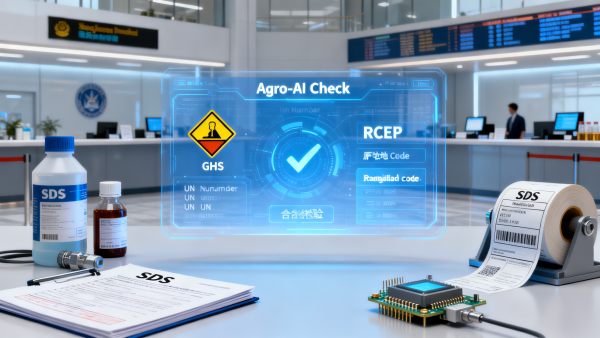
On May 15, 2026, China Customs launched the 'Agro-AI Check' system nationwide — an AI-powered pre-inspection platform for agrochemical exports. The system covers technical-grade pesticides, formulations, and intermediates, and directly impacts exporters, formulators, and supply chain service providers handling cross-border shipments to RCEP markets or jurisdictions enforcing GHS and hazardous goods regulations.
Event Overview
At 00:00 on May 15, 2026, the General Administration of Customs of China officially activated the 'Agro-AI Check' system across all national ports. The system automatically validates declarations against four key rule sets: GHS label compliance, UN hazard classification, banned/restricted substance databases, and RCEP origin criteria. As a result, the agrochemical export declaration rejection rate dropped from 4.7% to 1.2%, and average document processing time was reduced to 11 minutes.
Industries Affected by This Change
Direct Exporters (Trading Enterprises)
These firms submit customs declarations for finished agrochemical products. They are affected because the system now performs real-time, automated validation at submission — meaning errors in GHS labeling, incorrect hazard class assignment, or misapplied RCEP rules trigger immediate feedback rather than post-submission rejection. Impact includes tighter pre-filing quality control requirements and reduced tolerance for documentation inconsistencies.
Formulation & Manufacturing Enterprises
Manufacturers supplying labeled formulations or custom blends must ensure their product data — especially hazard classification and ingredient composition — aligns precisely with what is declared. Discrepancies between lab test reports, SDS versions, and declared UN numbers now risk automatic flagging before shipment.
Raw Material Suppliers & Intermediates Producers
Suppliers of pesticide intermediates face indirect but material impact: downstream formulators increasingly require certified, up-to-date regulatory dossiers (e.g., full component lists, CAS numbers, impurity profiles) to satisfy AI validation. Lack of traceable, machine-readable substance data may delay formulation partners’ filing readiness.
Supply Chain & Compliance Service Providers
Third-party customs brokers, regulatory consultants, and labeling vendors must adapt service offerings to support AI-precheck readiness — including pre-declaration validation checks, GHS label template audits, and RCEP origin rule mapping. Their value proposition now hinges more closely on data accuracy and system-aware process design than on post-rejection remediation.
What Enterprises and Practitioners Should Focus On Now
Monitor official guidance on AI validation logic updates
While the system’s scope is confirmed (GHS, hazard class, banned substances, RCEP origin), its underlying decision thresholds — such as how it interprets borderline hazard classifications or partial ingredient disclosures — remain unpublished. Observably, future notices from Customs may clarify edge-case handling; enterprises should subscribe to official bulletins and track pilot-phase feedback shared via industry associations.
Verify data consistency across SDS, labels, and declaration fields
The AI system compares structured inputs across multiple sources. Analysis shows that mismatches — e.g., differing UN numbers between SDS Section 14 and the declared hazard class, or CAS numbers missing from labels but present in technical dossiers — are primary drivers of the remaining 1.2% rejections. Firms should conduct internal cross-document alignment audits before submission.
Distinguish policy signal from operational readiness
The 1.2% rejection rate reflects current performance under live conditions, not a theoretical baseline. From industry perspective, this figure signals strong initial system stability but does not guarantee uniform behavior across all port-level implementations or product categories. Enterprises should treat early operational experience — especially first-time filings for new SKUs or emerging markets — as calibration opportunities, not definitive benchmarks.
Prepare updated substance databases and labeling templates
Current more suitable action is to consolidate and standardize chemical identity data (CAS, EC numbers, IUPAC names), hazard classifications (GHS pictograms, signal words, H-statements), and RCEP tariff headings into reusable, version-controlled templates. This supports faster AI-compatible filing and reduces dependency on manual re-entry or interpretation during declaration.
Editorial Perspective / Industry Observation
This rollout is better understood as an operational milestone — not just a technological upgrade. Observably, it marks the first nationwide deployment of AI-driven, rule-based pre-clearance for a highly regulated chemical subsector. While the drop in rejection rate (4.7% → 1.2%) is a measurable outcome, the broader implication lies in shifting accountability upstream: compliance is no longer verified *after* submission but validated *at the point of entry*. Analysis suggests this accelerates pressure on data governance maturity across the agrochemical value chain — particularly among SME exporters reliant on legacy documentation practices. It is less a one-time policy shift and more a structural recalibration of how regulatory certainty is embedded in daily trade operations.
Conclusion
This initiative signifies a tangible tightening of procedural discipline in agrochemical trade — driven not by new restrictions, but by enhanced enforcement precision. For stakeholders, it is neither a disruption nor a simplification, but a formalization of existing obligations through automated verification. Currently, it is more accurate to interpret this as a reinforcement of long-standing regulatory expectations — now enforced with higher consistency and lower latency. Enterprises benefit most by treating the AI system not as an external gatekeeper, but as a mirror reflecting the completeness and coherence of their own regulatory documentation infrastructure.
Information Sources
Main source: Announcement issued by the General Administration of Customs of China, effective May 15, 2026.
Note: Details regarding future expansion (e.g., integration with overseas regulatory databases or non-RCEP markets) remain unconfirmed and are subject to ongoing observation.
Related Intelligence
- AgrochemicalsWhat Are the Main Risks of Non-Transparent Agricultural Supply Chains?what are the main risks of non transparent agri supply chains? Explore traceability, compliance, contamination, disruption, and cost risks—plus practical controls.
- AgrochemicalsGrain Production: Key Practices for Improving Yield While Protecting Soil HealthGrain production strategies to improve yield, protect soil health, manage nutrients, reduce compaction, and build resilient fields for lasting results.
- AgrochemicalsHow Do New FDA Rules Affect Agri-Chemical Sourcing Strategies?How do new FDA rules impact agri chemical sourcing strategies? Explore practical supplier screening, traceability, contaminant control, and risk-based compliance steps.
The Morning Broadsheet
Daily chemical briefings, market shifts, and peer-reviewed summaries delivered to your terminal.
