

The Authority in Global Agricultural Chemistry & Bio-Resources
ANVISA Opens Fast-Track Remote GMP Pilot for Agrochemicals
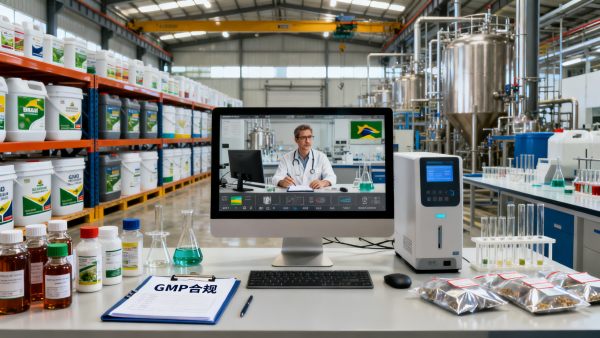
On June 28, 2026, Brazil’s health regulator ANVISA launched a pilot program for remote GMP audits of overseas agrochemical manufacturing facilities, creating a new procedural channel that may shorten part of the approval path for companies seeking registration and import permits in Brazil. For exporters, manufacturers, registration teams, and supply-chain planners, the development is worth watching because it links audit handling, temporary certification, and market access timing more directly than before for selected product categories.

A procedural change centered on remote audit access
According to the provided event summary, ANVISA started a pilot program on June 28, 2026 for remote GMP audits of overseas agrochemical production facilities. The program is aimed at key supplying countries including China and India.
For eligible applicants that submit complete documentation, ANVISA will issue a temporary GMP certificate within eight working days. The certificate is valid for six months and is intended to accelerate agrochemical registration and import permit review in Brazil.
The first batch of the pilot covers three product groups: insecticides, fungicides, and plant growth regulators.
Where the commercial impact is likely to appear first
Export-facing manufacturers may see timing become a more active compliance variable
From an industry perspective, manufacturers supplying the Brazilian market may be affected because GMP review timing can influence when registration and import procedures move forward. The practical impact is likely to appear in documentation readiness, internal audit coordination, and product-category screening, especially for facilities tied to insecticides, fungicides, and plant growth regulators.
What deserves closer attention is whether a company’s materials are complete at submission, because the stated eight-working-day pathway is tied to eligible applicants with complete files. In practice, this places more weight on document accuracy, facility information consistency, and coordination between regulatory and production teams.
Registration and trade teams may need to adjust filing and shipment sequencing
Companies handling product registration, import planning, or Brazil-bound export execution may be affected because the temporary certificate is specifically linked to faster registration and import permit review. Analysis shows that this could change how filing schedules, customer commitments, and shipment preparation are sequenced.
The main operational issue is not only whether a temporary GMP certificate can be obtained, but also how its six-month validity aligns with registration progress, import licensing steps, and delivery windows. Trade and compliance teams should therefore monitor whether internal timelines, contract milestones, and submission calendars need to be adjusted around the temporary-certification window.
Procurement and channel participants may need to recheck supplier qualification logic
Buyers, distributors, and channel participants connected to the Brazilian agrochemical market may also be affected because supplier eligibility may increasingly depend on whether a facility falls within the pilot scope and can support the required compliance package. The impact would be felt in supplier screening, sourcing rhythm, and order confirmation timing.
Observably, the immediate issue is less about a broad market shift and more about whether counterparties can demonstrate valid temporary GMP status, category fit, and document completeness during ongoing procurement or market-entry discussions.
What companies should track in the near term
Check whether the product line is actually within the current pilot scope
Companies should first verify whether the relevant products fall within the initial scope stated in the event summary. The pilot currently covers insecticides, fungicides, and plant growth regulators, so businesses should avoid assuming that all agrochemical categories are included at this stage.
Prepare documentation with the temporary-certificate mechanism in mind
Analysis shows that the value of the pilot depends heavily on the ability to submit complete materials. Companies involved in Brazil filings should review technical documents, facility records, and supporting compliance materials early, because the accelerated pathway described in the summary applies only after complete documentation is submitted.
Watch the six-month validity against delivery and approval milestones
The temporary GMP certificate is valid for six months, which means businesses should pay attention to the relationship between certification timing and downstream approval or shipment steps. Where planning depends on import authorization or registration progress, teams may need to map that six-month period carefully rather than treating the certificate as a full substitute for longer-term regulatory certainty.
Follow later clarification on execution standards and official wording
The provided information confirms the pilot launch and key parameters, but it does not set out detailed implementation standards beyond those points. Companies should therefore continue to watch for later clarification on submission expectations, review practice, and how the pilot is applied in actual registration and import-permit workflows.
Why this looks more like an execution signal than a finished rule set
Observably, this update is best read as a concrete execution signal rather than a fully settled long-term framework. ANVISA has already opened the pilot and attached a defined processing promise for eligible applicants with complete materials, which indicates real procedural movement. At the same time, because this is described as a pilot, the market still needs to observe how consistently the mechanism is applied and whether later clarification changes filing behavior or commercial expectations.
From an industry perspective, the key point is that compliance handling and trade timing are becoming more closely linked in this part of the Brazilian agrochemical approval process. That does not by itself establish a final regulatory model, but it does create a practical signal for companies that depend on Brazil-bound supply continuity.
How the market should read this development for now
At this stage, it is more appropriate to understand the ANVISA move as a targeted procedural opening with immediate relevance for selected agrochemical categories and affected supplying countries, rather than as a blanket relaxation of market-entry requirements. The near-term significance lies in timing, documentation discipline, and qualification planning across registration, export execution, and procurement coordination.
A measured reading is still necessary. The pilot is already a live operational change based on the provided summary, but its broader market effect will depend on later execution details, company readiness, and how the temporary certificate functions in real approval and import scenarios.
Basis of this article and what still needs verification
This article is based on the user-provided news title, event date, and event summary. For events of this type, commonly relevant source categories may include official regulator notices, releases from supervisory authorities, customs or trade-administration updates, industry association information, standard-setting documents, and reporting by established industry media.
No specific official source link was provided in the input, so the exact official publication path still needs to be verified on an ongoing basis. What also requires continued observation includes any later policy details, certification implementation standards, wording used in registration or tender documents, market feedback, and how companies execute against the pilot in practice.
Related Intelligence
- AgrochemicalsWhat Are the Main Risks of Non-Transparent Agricultural Supply Chains?what are the main risks of non transparent agri supply chains? Explore traceability, compliance, contamination, disruption, and cost risks—plus practical controls.
- AgrochemicalsGrain Production: Key Practices for Improving Yield While Protecting Soil HealthGrain production strategies to improve yield, protect soil health, manage nutrients, reduce compaction, and build resilient fields for lasting results.
- AgrochemicalsHow Do New FDA Rules Affect Agri-Chemical Sourcing Strategies?How do new FDA rules impact agri chemical sourcing strategies? Explore practical supplier screening, traceability, contaminant control, and risk-based compliance steps.
The Morning Broadsheet
Daily chemical briefings, market shifts, and peer-reviewed summaries delivered to your terminal.
