

The Authority in Global Agricultural Chemistry & Bio-Resources
Bioprocess Engineering in Europe: From Fermentation to Biopharmaceuticals
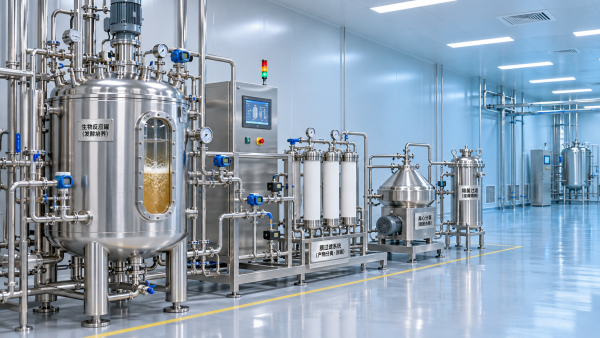
Bioprocess engineering in Europe turns biological activity into products that can be made consistently at useful scale. Fermentation may produce an enzyme for food processing, while a carefully controlled cell culture may produce a therapeutic protein. The engineering principles overlap, but the acceptable materials, purification steps and evidence of quality depend heavily on what the product will be used for.
That distinction is the starting point for understanding the field. A successful laboratory culture is only one part of the process: manufacturers must also obtain suitable raw materials, control the environment inside a vessel, recover the desired product and demonstrate that each batch meets its intended specification.
From fermentation to a finished product
A bioprocess uses living cells, microorganisms or biological components such as enzymes to make or transform a material. The organism or catalyst does the biological work; engineers design the conditions that make that work practical, reproducible and economical.
Fermentation is a familiar example. Yeasts, bacteria or fungi consume nutrients and produce a desired substance, which may be released into the liquid or remain inside the cells. In industrial use, the term often covers aerobic processes as well as the oxygen-free reactions described as fermentation in basic biology.
A typical process begins with a selected organism or cell line and a suitable nutrient mixture. It then moves through two connected stages:
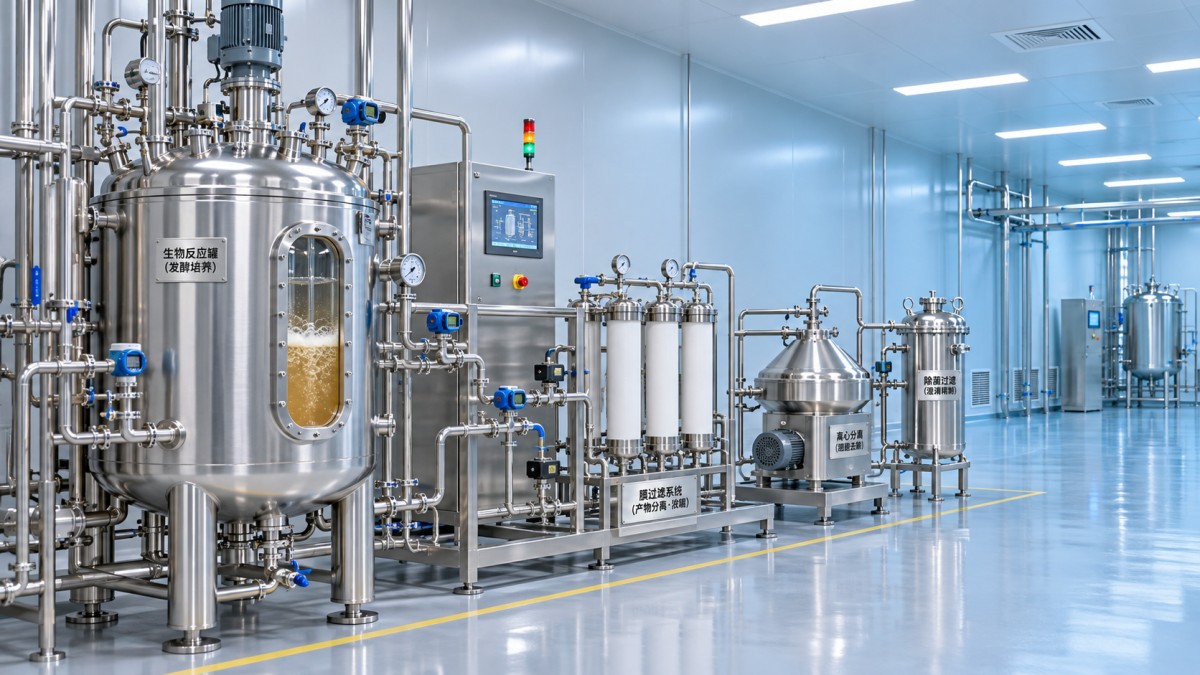
- Upstream processing prepares the culture and grows it under controlled conditions. This includes preparing the medium, expanding the culture and operating the production vessel.
- Downstream processing separates and purifies the desired material. Depending on the product, it can involve removing cells, filtering, concentrating, using chromatography or preparing the product for storage.
The boundary between the two stages is useful for planning, but they cannot be designed independently. A culture that produces a high concentration of material may also create impurities that are difficult to remove. Conversely, a simpler recovery method may only work if the upstream process keeps certain contaminants low.
What changes between industrial fermentation and biopharmaceuticals?
Industrial fermentation covers a broad range of products, including enzymes, organic acids, food and feed ingredients, and materials used in chemical manufacturing. The production organism might be a bacterium, yeast or fungus, and the final product may be an ingredient, a purified molecule or the biomass itself.
Biopharmaceutical manufacturing often uses engineered cells to produce complex biological medicines, including therapeutic proteins. Microorganisms can be used for some medicines, while mammalian cells are commonly used when the molecule requires forms of processing that those cells can provide. Cell-based production is sometimes discussed separately from fermentation, although both rely on controlled biological systems.
The main practical difference is the relationship between the product and its quality requirements. An industrial enzyme may need to meet a defined activity level and purity suitable for its application. A therapeutic protein requires a detailed understanding of its identity, purity, potency and other characteristics relevant to its clinical use. Small changes in a biological process can alter the mixture of molecules produced, so manufacturers must understand which process conditions influence those characteristics.
Purification also varies. An enzyme preparation may be sold with other components from the production process if they are acceptable for its intended use. A medicine generally requires extensive purification and testing to control process-related impurities, such as material originating from the production cells. Neither approach is inherently better: the right level of control follows from the product’s use and the risks associated with it.
Inside the bioreactor: controlling a living process
A bioreactor provides an environment in which cells or microorganisms can perform a desired task. Operators monitor and adjust conditions such as temperature, acidity, nutrient supply and, when needed, dissolved oxygen. Mixing helps distribute nutrients and heat, while gas transfer supplies oxygen or removes gases produced by the culture.
These controls are connected. Feeding more nutrients may increase growth, but it can also increase oxygen demand or encourage the formation of unwanted by-products. Stronger mixing may improve oxygen transfer while exposing sensitive cells to forces that affect their performance. Process development therefore involves finding a workable range of conditions, rather than maximising every setting independently.
Contamination control is another central concern. An unwanted microorganism can compete for nutrients, change the product or make a batch unusable. Facilities use combinations of equipment design, cleaning, sterilisation or other contamination-control measures according to the process and product. A closed system can reduce exposure to the surrounding environment, but connections, sampling and material transfers still need careful design.
Bioprocesses may operate in batches, with nutrients added over time, or continuously. Batch operation can make it easier to separate production runs and investigate a problem within one run. Fed-batch operation allows nutrient supply to be adjusted during production. Continuous operation can maintain production over longer periods, but it also demands sustained control and a clear strategy for handling deviations. The best choice depends on the biology, equipment and quality requirements.
Why a successful lab process can struggle at commercial scale
Scaling up is not simply a matter of filling a larger vessel with the same recipe. A small laboratory vessel and a large production bioreactor behave differently: oxygen may take longer to reach cells, mixing can be less uniform, and heat generated by the culture must be removed across a different equipment surface.
As a result, cells in a large vessel may experience changing conditions as they move through it. A process that performs well in the laboratory can produce a different yield or impurity profile when those variations become significant. Engineers use measurements and intermediate-scale studies to understand which conditions need to remain comparable and where the process can tolerate change.
Downstream capacity can be just as limiting as the bioreactor. If a larger culture produces more liquid than the filtration or purification equipment can handle within a suitable time, the overall process may slow down or product quality may suffer. For sensitive biological products, the time between harvest and purification can matter as much as the production step itself.
Raw material availability also becomes more consequential at scale. An agricultural feedstock may be attractive because it is renewable or locally available, but its composition can vary with source and processing. That variation can affect microbial growth, impurities and purification. A lower purchase price is only useful if the process can accommodate the material consistently and the supply meets the requirements of the final product.
Quality and regulation depend on the intended use
European bioprocessing operates across several regulatory contexts. A process making an industrial chemical, a food ingredient or a human medicine does not face an identical set of requirements. The intended use, product classification, place of manufacture and markets where the product will be supplied all shape the applicable obligations.
For medicines, good manufacturing practice, or GMP, provides a framework for consistent production and quality control. In practical terms, this involves more than testing the finished batch. Manufacturers need documented procedures, suitable facilities and equipment, control of materials, investigation of deviations and evidence that processes can reliably produce material meeting the required quality.
Within the European Union, medicines oversight involves both European-level and national authorities, with responsibilities varying by procedure and activity. Other European countries have their own regulatory arrangements. Companies supplying multiple markets may also need to account for requirements outside Europe, including those of the US Food and Drug Administration where applicable.
Environmental controls form a separate part of the picture. Water use, energy demand, emissions and the treatment of biological waste or spent fermentation broth can affect facility design and operating choices. A process that looks efficient inside the reactor may be less attractive once wastewater treatment, solvent recovery or disposal is included.
Choosing equipment and partners for a process
Equipment decisions should start with the biology and the intended output. A facility producing one high-volume ingredient may value durable equipment designed for repeated operation. A facility handling several products or smaller campaigns may place more value on flexibility and rapid changeover.
Single-use bioreactor systems, which use disposable product-contact components, can reduce some cleaning and changeover demands. They also create a continuing need for consumables and require attention to waste handling, supply reliability and the suitability of materials in contact with the process. Reusable stainless-steel systems avoid routine disposal of the vessel itself, but require cleaning, maintenance and the infrastructure to support them. The better choice depends on campaign size, product mix and facility design.
When comparing a manufacturing site or development partner, a useful discussion begins with a few practical questions:
- Can the site handle the production organism or cell line? Relevant experience includes the organism’s growth needs, containment considerations and sensitivity to handling.
- Does its equipment suit the whole process? Fermentation capacity alone says little about harvest, purification, formulation or storage.
- Can it meet the intended quality requirements? Documentation, testing capabilities and material controls should fit the product’s destination and use.
- How will the process be transferred? Clear records of operating ranges, analytical methods and critical materials help the receiving site understand what must be reproduced.
- Are the supply and waste streams workable? Media ingredients, filters, packaging, utilities and waste treatment all affect whether routine production is feasible.
For an early-stage project, the most useful next step is to define the intended product and its required quality before selecting a vessel or production route. That definition makes later choices about the organism, feedstock, purification and manufacturing site easier to compare—and reveals which laboratory results will matter when the process moves beyond the bench.
Related Intelligence
- APIs & IntermediatesBioprocessing Equipment Investment Costs: Budgeting Beyond Purchase PriceExplore bio processing equipment investment cost beyond purchase price. Budget for installation, utilities, validation, and lifetime expenses with confidence.
- APIs & IntermediatesPlanning for ISO Standards in Aquaculture: Where Should Farms Start?Aquaculture ISO planning starts here: choose the right standard, assess farm risks and build an audit-ready system with practical steps for your team.
- APIs & IntermediatesTraceable Chemical Intermediates: How to Verify Batch History Before PurchaseTraceable chemical intermediates start with a verified batch history. Learn what to check before purchase and reduce sourcing risks.
The Morning Broadsheet
Daily chemical briefings, market shifts, and peer-reviewed summaries delivered to your terminal.