

The Authority in Global Agricultural Chemistry & Bio-Resources
Trade Compliance for Grain Exports: Required Documents, HS Codes, and Common Delay Risks
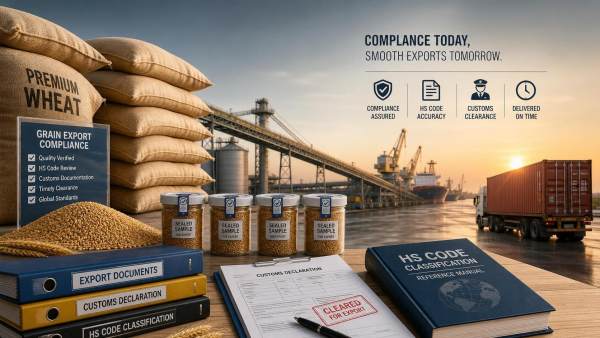
Why does trade compliance for grain exports now shape shipment reliability?
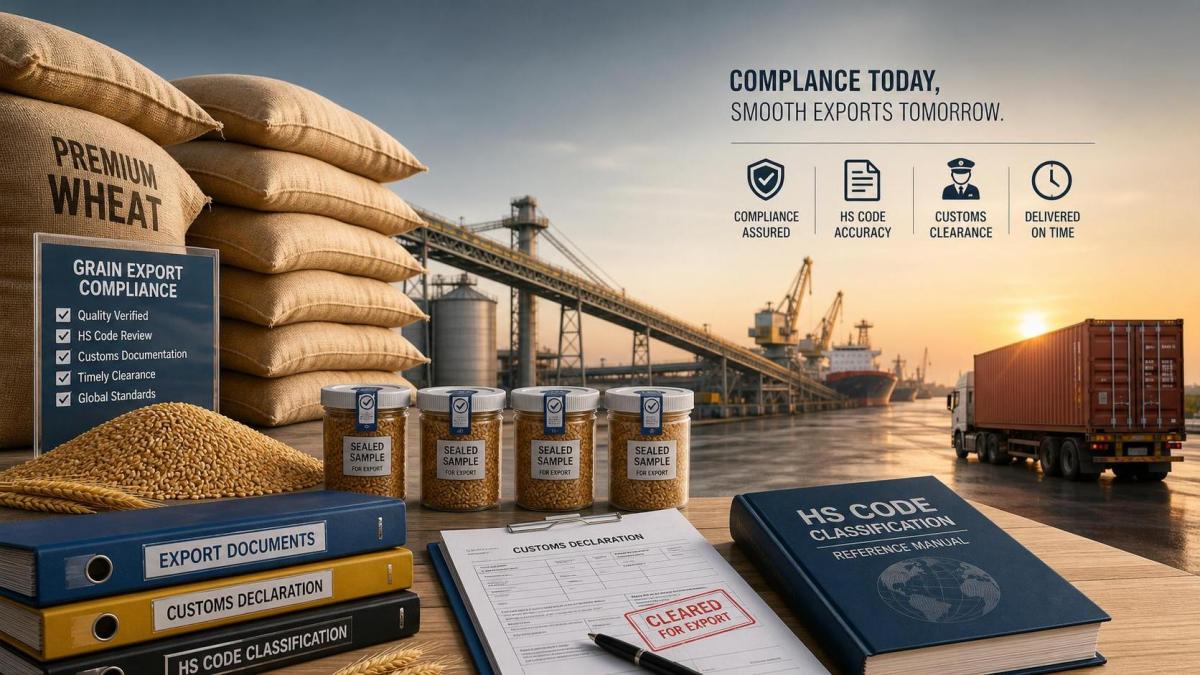
Trade compliance for grain exports has moved far beyond routine filing. It now affects transit time, demurrage exposure, customer trust, and final landed cost in measurable ways.
That shift is especially visible in grain, where consignments face plant health controls, origin checks, sanctions screening, and product classification review at several checkpoints.
In practice, a shipment can be commercially ready yet still fail to move because one certificate conflicts with the invoice, or the HS code triggers the wrong control regime.
This is why trade compliance for grain exports matters in commercial assessment. It reveals whether an exporter can support predictable customs clearance, contract performance, and traceable documentation.
Across primary industries, the same pattern appears in feed ingredients, bio-extracts, and regulated chemical inputs. Documentation quality increasingly acts as a proxy for operational maturity.
Editorial analysis from AgriChem Chronicle often treats compliance discipline as a supply chain signal, not just a legal necessity. That lens is useful when comparing grain export partners across markets.
Which documents are usually required before grain can clear export and import controls?
The exact set depends on origin, destination, grain type, and contract terms. Still, most compliant grain movements rely on a core document stack that should align line by line.
A commercial invoice and packing list are the starting point. They must match the physical cargo, sales contract, and declared tariff classification.
A bill of lading or sea waybill confirms shipment details. For rail or truck corridors, the transport document changes, but the control function remains similar.
Most destinations also require a phytosanitary certificate. This document is often decisive because grain is a plant product and may carry pest, disease, or contamination concerns.
A certificate of origin may be mandatory under free trade rules, quota systems, or buyer banking requirements. Missing origin proof can eliminate duty preferences overnight.
Inspection certificates are common as well. These may cover moisture, foreign matter, protein, fumigation status, or cargo condition before loading.
More sensitive routes may require export permits, chamber certification, insurance evidence, sanctions screening records, or importer registration references tied to food and feed controls.
A practical way to review trade compliance for grain exports is to test whether every document answers the same five questions: what, where from, where to, how much, and under which code.
A quick document check that usually prevents avoidable holds
The table looks simple, yet most delay cases start exactly here. Errors are rarely dramatic. They are usually small inconsistencies that multiply across agencies and banks.
How should HS codes be checked for grain, feed grain, and processed cereal products?
HS classification is not a clerical detail. It determines duty treatment, admissibility, quota use, licensing needs, and sometimes whether the cargo is reviewed as food, feed, or seed.
Many grain shipments fall within Chapter 10 of the Harmonized System. Wheat, maize, barley, oats, rice, and sorghum each have distinct headings and product-specific subdivisions.
The complication begins when the product is cleaned, treated, milled, cracked, pelleted, or blended. At that point, classification can shift into processed cereal or feed categories.
Trade compliance for grain exports therefore requires a product-level review, not a habit-based code. The same commercial name may sit under different tariff lines depending on treatment and use.
A reliable review normally checks four points:
- Whether the goods are whole grain, broken grain, milled output, or feed preparation.
- Whether the grain is intended for sowing, food processing, or animal nutrition.
- Whether national tariff schedules add local subdivisions affecting duty or licensing.
- Whether supporting specifications match the declared code description exactly.
In actual transactions, customs officers often compare the HS code with lab reports, phytosanitary wording, and invoice descriptions. If one source suggests feed grade and another suggests milling grade, review risk rises.
That is why a code should be documented with technical rationale. A short internal classification memo can reduce repeated disputes across future shipments.
Where do grain export delays usually start, and which ones are most expensive?
The costliest delays rarely come from one missing paper alone. They usually result from timing gaps between cargo readiness, inspection slots, booking deadlines, and destination filing requirements.
Phytosanitary timing is a common example. If inspection occurs too early, certificate validity may expire. If it happens too late, the vessel cut-off is missed.
Another frequent problem is inconsistent product description. One document says “yellow corn,” another says “feed maize,” and the destination system flags a classification review.
Sanctions and restricted party screening now create additional friction. Even when grain itself is low risk, counterparties, banks, insurers, or transit jurisdictions may trigger secondary review.
Ports also watch contamination and fumigation declarations closely. Grain that moves through multiple storage points may generate questions about treatment records and cargo integrity.
The most expensive cases often involve preventable rework:
- Reissuing origin or phytosanitary certificates after departure.
- Cargo rollovers caused by late customs pre-filing.
- Demurrage and storage during document correction.
- Duty reassessment after HS code challenge.
- Contract claims when specification wording differs from import approval terms.
For trade compliance for grain exports, delay risk should be treated as a system issue. Documents, timing, and product data need one coordinated control path.
What is a practical way to evaluate whether an exporter’s compliance process is dependable?
A dependable process is visible in records, escalation logic, and revision control. It is not proven by a single successful shipment or a polished claim of experience.
One useful test is to ask how the exporter validates the document stack before loading. Strong operators can explain checkpoints, owners, and exception handling without hesitation.
Another test concerns HS classification governance. If code selection depends on memory alone, classification risk remains high. If it relies on specifications and written rationale, confidence improves.
It also helps to review destination knowledge. Grain flows are highly country-specific, especially where quota administration, fumigation wording, or GMO declarations apply.
The following checklist is often more revealing than broad capability statements.
This kind of evaluation aligns with the broader analytical approach seen in AgriChem Chronicle, where compliance quality is tied directly to operational credibility and supply chain resilience.
What should be done next if trade compliance for grain exports looks weak?
The next step is not always to reject the route or supplier. Often the better move is to define a tighter control framework before commercial exposure increases.
Start by mapping the exact shipment path, from inland loading to destination clearance. This usually reveals where document ownership becomes unclear.
Then test the required document set against one real product, one origin, and one destination. Abstract compliance discussions often miss country-specific wording and timing risks.
It is also worth building a simple decision file for HS codes, certificates, and destination triggers. That creates a repeatable standard instead of relying on email memory.
A sensible action plan for trade compliance for grain exports usually includes:
- Confirming product specifications used for tariff classification.
- Reconciling invoice language with phytosanitary and origin documents.
- Checking destination import notices for recent plant health or feed rule changes.
- Assigning document owners and cut-off times before vessel booking.
- Reviewing past delay cases for recurring data errors.
When grain exports are evaluated this way, compliance becomes easier to measure. It turns from a vague administrative concern into a concrete indicator of shipment readiness and commercial reliability.
The core question is straightforward: can the exporter prove that documents, HS codes, and timing controls will hold up under border scrutiny? That answer should guide the next comparison, approval, or market entry decision.
Related Intelligence
- Grain Silos & StorageHow Modular Feed and Grain Systems Support Scalable Storage and Processing ExpansionModular feed and grain systems enable smarter, scalable expansion across storage, conveying, processing, and loadout. Discover how to eliminate bottlenecks, protect future capacity, and keep operations moving.
- Grain Silos & StorageHow to Size a Grain Pre-Cleaner for Capacity, Crop Type, and Impurity LoadGrain pre cleaner machine sizing guide: match capacity, crop type, moisture, and impurity load to improve flow, separation quality, and downstream performance.
- Grain Silos & StorageHow Can You Verify That a Grain Handling System Meets Export Standards?How do I know if a grain handling system meets export standards? Explore practical checks for traceability, sanitation, quality control, and export-ready compliance.
The Morning Broadsheet
Daily chemical briefings, market shifts, and peer-reviewed summaries delivered to your terminal.
