

The Authority in Global Agricultural Chemistry & Bio-Resources
Pellet Mill Vendor Comparison: Evaluate Capacity, Energy Use, and Support
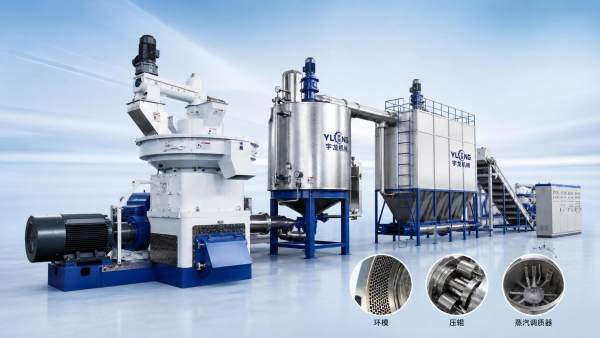
A pellet mill vendor comparison should begin with the production duty that the machine must sustain, not the capacity printed on a quotation. Two mills described as suitable for the same tonnage can behave very differently when feed formulation, conditioning quality, die specification, ambient conditions, and planned operating hours are introduced. A sound evaluation asks whether the proposed system can produce the required pellet quality at the expected rate without excessive power draw, frequent die changes, unstable amperage, or dependence on specialist intervention.
Headline capacity is useful only when its test conditions are visible. A vendor should be able to explain the material used for the rating, its moisture range, particle size, bulk density, fat addition, conditioning temperature, die hole diameter, die compression ratio, and target pellet durability. If those conditions differ materially from the intended formulation, the quoted figure is a reference point rather than a production commitment.
Read capacity as a process result
Pellet mill output is created by the interaction of upstream preparation, the press itself, and downstream cooling. A high-capacity press cannot compensate for poorly ground material, uneven mixing, inadequate steam quality, weak retention in the conditioner, or a cooler that restricts discharge. Comparing only the main motor size or die diameter can therefore lead to an oversized press connected to an undersupplied process line, or a nominally efficient mill forced to run below its stable load range.
Ask each vendor to state the expected throughput against a defined product specification. The request should distinguish between average sustainable production and a short demonstration run. It should also identify whether the figure is based on a clean die, a new die, a standard die pattern, or a die design tailored to the stated formula. Capacity commonly changes as the die wears, as roll-to-die clearance drifts, or as raw-material variation affects conditioning and friction.
Die area deserves closer attention than catalog capacity. Usable die area depends on hole layout, effective track width, open area, and the material’s resistance through the hole. A formula with fibrous ingredients or a higher added-fat level can require a different die design from a dense cereal-based ration. Small changes in hole diameter, inlet relief, and working length affect both throughput and pellet integrity. A vendor that asks detailed questions about formulations before proposing a die is providing more useful engineering evidence than one that simply matches a model to a requested output.
For facilities making several products, the evaluation should identify the limiting product rather than relying on the easiest grade. The most difficult formula often reveals whether feeder control, conditioning, roll adjustment, and die selection are adequate. A mill that runs one formula smoothly but requires repeated adjustment for another may still fit the operation, but that constraint should be visible in staffing, scheduling, and output assumptions.
Energy use needs a boundary, not a single number
Specific energy consumption is often expressed as energy per tonne, yet this value becomes misleading when suppliers define the boundary differently. One figure may cover only the pellet press motor. Another may include feeder, conditioner, liquid addition, cooling fans, conveying equipment, and aspiration. Neither is inherently wrong, but they do not answer the same question.
Request a load profile rather than a single efficiency claim. The profile should show normal operating load, expected motor current range, power during start-up, response to formulation changes, and any period required to reach stable production. Stable loading is valuable because large amperage swings can indicate inconsistent feed, poor conditioning, roll slippage, blocked die holes, or control logic that reacts too slowly. The source of instability matters: a press problem can resemble an upstream moisture or particle-size problem.
Mechanical configuration affects energy demand in ways that are easily obscured by the press model. The condition of rolls and die, bearing preload, transmission design, lubrication arrangement, and roll-to-die setting all influence friction. A high compression die may improve durability for one product but raise resistance and energy use beyond what the drive can sustain comfortably. Conversely, selecting a low-resistance die only to preserve throughput can create soft or friable pellets that produce excess fines after cooling and handling.
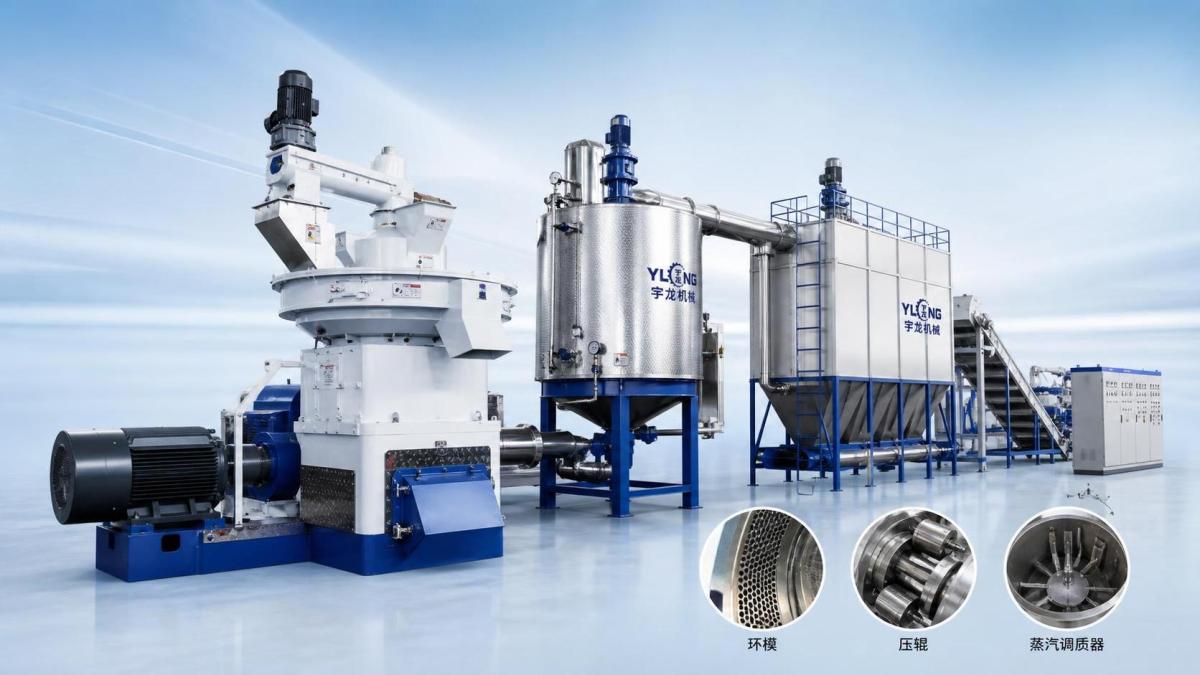
Steam and conditioning should be included in the discussion even when their energy use is managed outside the pellet mill package. Inadequate heat transfer or poor moisture distribution forces the die to do work that should have occurred in the conditioner. The result may be higher press load, inconsistent pellet texture, and more frequent adjustment. A credible proposal explains the assumed conditioner retention time, steam injection arrangement, mixing action, and available process controls. It also identifies whether the quoted output depends on preconditioning equipment that is excluded from the base scope.
Compare the control strategy under changing load
Automatic roll adjustment, feeder control, steam dosing, and motor-load control are often presented as standard features, but their practical value varies with how the controls are integrated. The important question is what happens when material flow changes: does the feeder reduce rate before the press overloads, does steam control follow a measured condition or a fixed setpoint, and can alarms show the event that triggered a trip? A control system that records trends for motor load, feeder rate, temperature, and relevant conditioning variables makes troubleshooting substantially faster after commissioning.
Energy evaluation should also account for idle time, changeovers, and cleaning. A mill with a modestly lower running demand may lose that advantage if die changes are slow, access is restricted, or cleanout leaves large quantities of product in the system. Those losses are especially relevant where recipes change frequently or contamination between products must be controlled.
Pellet quality is part of the vendor comparison
Throughput and energy numbers have limited value if the finished pellets do not survive cooling, conveying, bagging, or bulk loading. Pellet durability, hardness, fines level, moisture after cooling, and size consistency should be reviewed against the actual downstream route. A product intended for short transfer to a nearby bin has different tolerance from one that passes through several conveyors and is shipped over long distances.
Do not treat hardness and durability as interchangeable. A hard pellet can still fracture under handling if its internal structure is uneven, while an excessively hard pellet may be unsuitable for the intended animal or downstream use. The vendor’s technical discussion should connect formulation properties to die compression, conditioning, cutter arrangement, and cooling. Generic claims about producing “high-quality pellets” do not establish that relationship.
Sample trials are most useful when they follow an agreed protocol. The material should represent routine supply rather than a specially prepared batch. Measurements should be taken after cooling and after a defined handling simulation where relevant. The trial record should include settings, die details, observed power draw, production rate, pellet appearance, fines, and any adjustments made during the run. Without that record, a successful demonstration can be difficult to reproduce after installation.
Support begins with the proposed scope
Lifecycle support is often evaluated too late, after the equipment selection has narrowed. It should be examined alongside capacity because installation quality, commissioning discipline, and access to wear parts directly affect sustained output. The first questions are practical: who supplies the foundation loads, electrical drawings, interconnection details, lubrication requirements, lifting points, and process utility requirements? Gaps between mill supplier, contractor, and upstream equipment provider are a frequent source of delayed start-up.
Clarify what the vendor means by commissioning. Some offers include mechanical inspection and a brief start-up presence; others include process tuning with the actual product range. The distinction is significant. Bringing a press to rotation is not the same as establishing repeatable feeder settings, conditioning parameters, die selection, roll adjustment, and cooling performance. The scope should state the expected site preparation, available utilities, personnel needed for trials, and the conditions that would require an additional visit.
- Wear-part strategy: identify the recommended initial stock of dies, rolls, bearings, seals, shear pins, lubricants, and critical electrical components. Ask for part numbers and compatibility rules, especially where multiple die designs are planned.
- Response path: establish how a fault is triaged, which diagnostic information must be supplied, whether remote support is available, and how escalation works when production is interrupted.
- Service documentation: review maintenance intervals, torque values, lubrication points, die installation procedures, and fault descriptions. Vague manuals transfer too much interpretation to the site.
- Local capability: distinguish between a sales presence and a service resource able to diagnose drives, bearings, die wear, and process-related performance issues.
Spare-parts availability should be assessed by criticality rather than by a generic statement that parts are stocked. A damaged die may be operationally more urgent than a component that is inexpensive but easily sourced locally. Lead-time questions need to cover the actual die material, hole pattern, and compression ratio proposed for the product. Interchangeability also matters: a replacement roll shell that fits mechanically but produces a different nip condition can change the press behavior.
Use the commercial comparison to expose engineering assumptions
A well-structured quotation separates the pellet mill from included auxiliaries, controls, erection support, commissioning, recommended spares, tooling, and optional performance testing. This prevents an apparently low capital figure from concealing items necessary for a working line. Electrical panels, variable-speed feeders, conditioner drives, safety devices, die lifting equipment, and local piping connections can materially alter both project cost and start-up effort.
Performance guarantees require the same discipline as technical specifications. The agreement should define the product, raw-material characteristics, operating hours used for assessment, sampling method, measurement equipment, allowable adjustment period, and treatment of utilities outside the supplier’s scope. A guarantee based on an undefined “standard feed” has limited protection when the actual operation uses a broader or more demanding formulation range.
Transport and installation constraints should be checked before a model is selected. Press dimensions, maintenance clearance, die extraction route, floor loading, crane coverage, and access through existing openings can change the preferred configuration. A compact machine may reduce footprint but create difficult maintenance access; a larger layout may simplify roll service and die handling. Neither is automatically preferable without examining the building and maintenance method.
Where comparisons commonly go wrong
The most common error is treating unlike capacity statements as equivalent. A second error is accepting a specific-energy estimate while leaving the process boundary undefined. A third is assuming that a familiar mill design will perform identically with a new formula, different grind, or altered moisture. These issues are connected: when the stated duty is unclear, energy, wear, pellet quality, and support requirements cannot be evaluated on the same basis.
Shortlisting becomes more defensible when every vendor responds to one operating brief containing the product range, planned output, raw-material condition, utilities, site limits, pellet quality target, control requirements, and expected support scope. Differences then become visible as engineering choices rather than marketing language. The strongest proposal is the one that states its assumptions plainly, shows how output and energy were derived, and defines the support needed to maintain that performance over time.
Related Intelligence
- Milling MachineryCan Agricultural Scientists Validate Grain Processing Machinery?Can agricultural scientists validate process machinery performance? Discover how grain equipment testing verifies throughput, quality, and efficiency before you invest.
- Milling MachineryGrain Processing Explained: From Cleaning and Milling to Finished Product QualityGrain Processing explained: discover how cleaning, conditioning, milling, and quality control turn raw grain into safe, consistent flour, feed, and food ingredients.
- Milling MachineryGerman Grain Processing Plants: Evaluating Automation and Energy-Efficiency UpgradesGrain processing Germany: evaluate automation and energy-efficiency upgrades to improve throughput, quality, safety, and lifecycle value.
The Morning Broadsheet
Daily chemical briefings, market shifts, and peer-reviewed summaries delivered to your terminal.
