

The Authority in Global Agricultural Chemistry & Bio-Resources
Grain Processing Explained: From Cleaning and Milling to Finished Product Quality
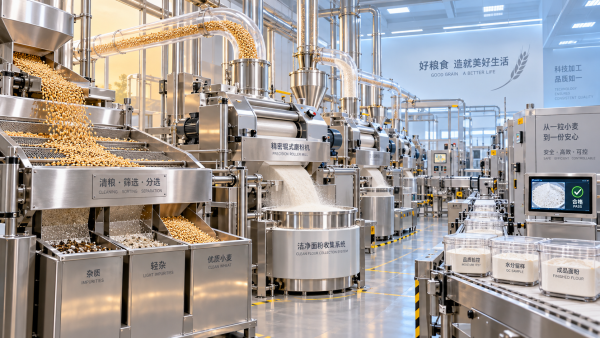
Grain processing is not a single operation performed after harvest. It is a controlled sequence of physical, mechanical, and sometimes thermal transformations that determines whether grain becomes safe flour, stable feed, brewing material, starch, grits, or another ingredient with predictable performance. The central challenge is that grain arriving at a plant is a biological raw material: its moisture, kernel condition, contaminant load, variety, storage history, and chemical composition can vary significantly from one delivery to another.
A well-designed process does more than remove visible dirt and reduce kernel size. It separates material by relevant physical properties, manages moisture to make the grain behave consistently during milling, protects valuable fractions where needed, and verifies that the finished product meets its intended functional and safety requirements. A mill producing bakery flour, for example, is managing different quality variables from a plant producing animal feed or a dry-milled maize ingredient for snacks.
Processing begins with defining the required finished product
The same grain can be processed into products with very different specifications. Wheat may be converted into white flour, wholemeal flour, semolina, bran, vital wheat gluten feed fractions, or ethanol feed co-products. Maize can become grits, meal, flour, starch, germ, oil-bearing fractions, or feed. Rice can be sold as brown rice, polished rice, broken rice, flour, or bran-based ingredients.
This is why “milling yield” alone is not a sufficient measure of performance. A high extraction rate may be commercially attractive, but it can also increase ash content, darken flour, alter particle-size distribution, introduce more bran specks, or reduce suitability for a particular end use. Conversely, aggressive removal of outer layers can improve appearance and consistency while lowering recovery of fiber, minerals, and other nutrients.
Finished-product specifications therefore shape the entire processing route. The relevant questions include:
- Which anatomical fractions must be retained, removed, or recovered separately?
- What particle-size range is required?
- How much variation in color, moisture, protein, ash, damaged starch, or fat content can be tolerated?
- Will the product be baked, extruded, fermented, pelleted, cooked, or used as an industrial raw material?
- What microbiological, chemical, and foreign-material controls are required for the intended market?
A process should be assessed against these output requirements, rather than against equipment capacity in isolation.
Cleaning is a food-safety and yield-control operation
Raw grain may contain field debris, dust, straw, chaff, stones, metal fragments, weed seeds, insects, damaged kernels, and grains from other crops. Some contaminants are obvious; others resemble sound grain closely enough that they require more selective separation methods.
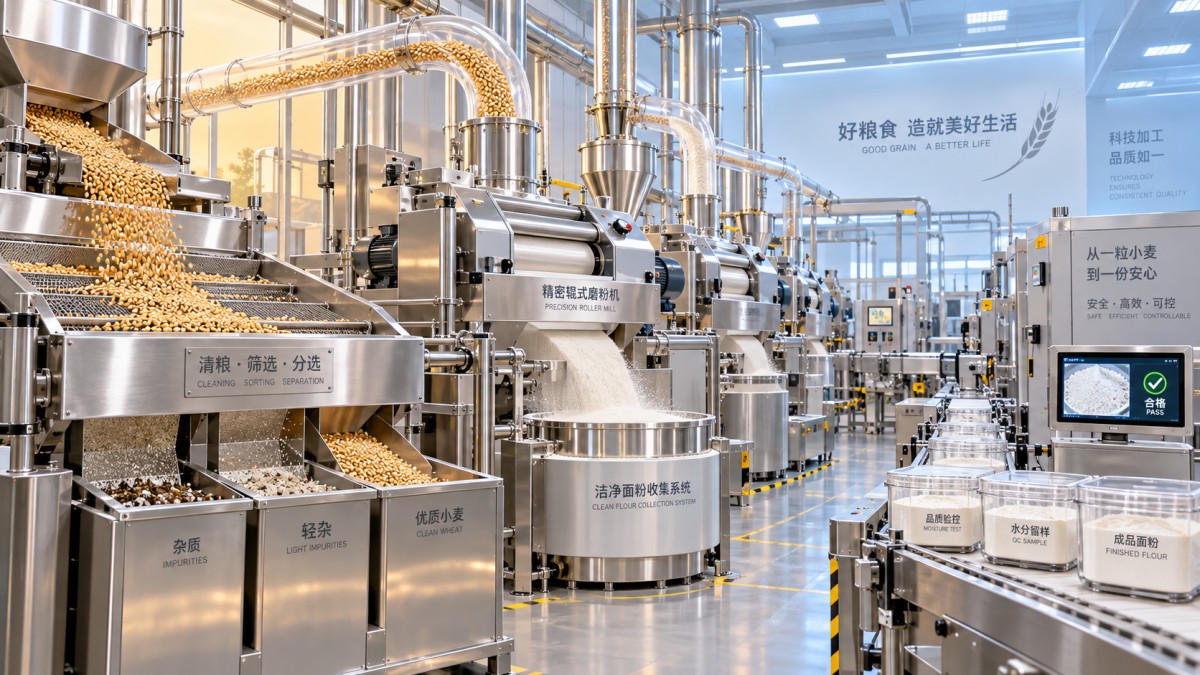
Cleaning lines commonly combine several principles because no single machine removes every contaminant effectively. Screens separate materials by size. Aspirators use airflow to remove lighter particles such as dust, husk, and chaff. Destoners separate dense stones from grain of similar dimensions. Magnets remove ferrous metal, while optical sorters can identify kernels that differ in color or surface appearance. Scourers and brush machines may remove adhering dust or surface contamination before milling.
The sequence matters. Removing coarse and fine material before more sensitive equipment reduces wear and improves separation efficiency. Dust extraction is equally important: it protects product hygiene, improves the working environment, and reduces the accumulation of combustible particulate matter. Grain dust can present a serious explosion hazard when suspended in air at an ignitable concentration, so dust-control systems, housekeeping, equipment grounding, and ignition-source management are core process-safety functions rather than optional additions.
Cleaning also influences downstream economics. Stones and metal can damage rollers, screens, conveyors, and pneumatic systems. Unremoved weed seeds or discolored kernels can create quality defects that appear only after milling, when they are much harder to isolate from the product stream.
Conditioning changes how kernels break apart
After cleaning, many cereal grains are conditioned, also called tempered. Water is added in a controlled amount and allowed time to redistribute within the kernel. The objective is not simply to raise moisture. Proper conditioning changes the mechanical relationship between the bran, endosperm, and germ.
In wheat milling, tempering helps toughen the bran while making the endosperm more friable. This supports cleaner separation during roller milling: bran is less likely to shatter into fine particles, while endosperm can be reduced into flour more efficiently. If the grain is under-conditioned, bran may fragment excessively and contaminate flour streams. If it is over-conditioned or held under unsuitable conditions, the milling behavior can become less stable, and moisture management becomes more difficult.
Conditioning targets depend on grain type, initial moisture, hardness, kernel size, storage condition, and the desired product. Hard wheat and soft wheat do not respond identically. Maize, rice, barley, oats, and pulses also use different preparation approaches. Some processes include dehulling, debranning, pearling, or degerming before fine grinding because the outer layers or germ fraction materially affect flavor, shelf life, color, fat content, and end-product behavior.
The critical point is that conditioning is a controlled residence-time operation. Adding water without sufficient equilibration time does not produce a uniform kernel response. The relevant measure is consistency across the grain mass, not merely the average moisture reading at the point of addition.
Milling separates structures before it reduces particle size
Milling is often described as grinding, but modern grain processing is more accurately understood as staged size reduction and separation. The goal is to release useful components while limiting unwanted mixing between them.
Roller milling is the standard route for many wheat flour systems. Grain passes through successive pairs of corrugated or smooth rolls. Early “break” passages open the kernel and release endosperm particles from the bran. Intermediate passages separate and gradually reduce semolina-like particles. Later “reduction” passages mill purified endosperm streams into flour. Between grinding stages, plansifters classify material by particle size through multiple sieves, while purifiers use sieving and controlled air to separate lighter bran particles from denser endosperm fractions.
This repeated cycle of grinding, sifting, and purification is why flour quality cannot be judged by roller configuration alone. Roll gaps, roll condition, differential speed, sieve selection, airflow, feed rate, and stream blending all affect the result. A mill may produce several flour streams with distinct ash, protein, particle-size, and color characteristics before blending them into commercial grades.
Hammer mills, pin mills, disc mills, and other impact-based systems are common in feed grinding, wholegrain flour production, and applications where fraction separation is less important than rapid particle-size reduction. These systems can be effective, but they typically generate a broader particle-size distribution and may create more heat than carefully staged roller systems. Heat can affect fat stability, flavor, and certain functional properties, particularly in products containing germ or high oil content.
Dry milling and wet milling serve different material-value strategies
Dry milling retains the grain in a relatively low-moisture state and separates or grinds physical fractions. It is used for flour, meal, grits, semolina, feed ingredients, and many wholegrain products. Its value lies in efficient fractionation and relatively direct conversion of cleaned grain into shelf-stable dry products.
Wet milling uses steeping, wet grinding, screening, centrifugation, and other separation steps to isolate components such as starch, protein, fiber, and germ more distinctly. It is associated especially with maize starch processing, where the aim is not simply a milled meal but a set of purified ingredient streams. The process is more complex and involves water management, process control, and treatment of associated streams, but it can support applications that require more refined component separation.
Neither route is inherently superior. The relevant distinction is whether the market requires a functional whole or partial grain ingredient, or separately recovered biochemical fractions with tighter purity requirements.
Quality is measured across several linked dimensions
Finished grain products are judged not only by appearance. A product may look clean and still perform poorly in baking, extrusion, storage, or feed formulation. Quality control begins with incoming grain and continues through each major process stage.
Moisture is among the most important variables. Excess moisture can shorten storage life and increase the risk of microbial activity; overly dry material may mill differently, generate more fines, or create unnecessary yield loss. Moisture control must account for both the bulk average and variation within a lot.
Protein content is especially relevant for wheat products because it influences gluten-forming potential, although protein percentage alone does not fully define baking behavior. Grain hardness affects milling energy and particle characteristics. Ash content is commonly used as an indicator of mineral-rich outer-layer inclusion in flour: higher ash generally indicates greater bran contribution, though interpretation depends on flour type and local specifications.
Particle-size distribution affects water absorption, dough handling, texture, mixing behavior, cooking properties, and feed digestibility. Damaged starch, created partly during milling, can increase water absorption and influence enzymatic activity. In maize and rice processing, color, broken-kernel percentage, germ removal, fat content, and granulation may be especially important depending on the product.
Safety testing addresses hazards that cannot be solved merely by milling. These may include mycotoxins, pesticide residues, heavy metals, pathogenic microorganisms, insect contamination, and foreign materials. Mycotoxins deserve particular attention because they are produced by certain fungi before or after harvest under favorable conditions. Cleaning can reduce contamination associated with damaged or lightweight kernels, but it does not guarantee removal when toxins are already present within the grain. A robust control program therefore combines supplier controls, sampling plans, storage discipline, testing, and segregation decisions.
Storage and transport can undo earlier process control
Grain quality continues to change after harvest. Temperature, moisture migration, insect activity, mold development, and mechanical handling all affect the material reaching the mill. Poorly managed storage can increase breakage, create hot spots, encourage insect infestation, and elevate the risk of quality loss before processing begins.
Segregation is often as important as storage capacity. Lots with different moisture levels, varieties, protein profiles, or quality risks should not automatically be blended merely for logistical convenience. Once incompatible material is mixed, restoring a consistent milling blend becomes difficult. Traceability records should connect incoming lots, cleaning and milling runs, rework streams, test results, and finished-product dispatches. This is essential for investigating deviations and managing recalls where applicable.
Transport requires similar discipline. Grain and finished products must be protected from water ingress, cross-contact with incompatible cargoes, pests, and odor contamination. For export-oriented supply chains, documentation of lot identity, test results, fumigation or phytosanitary status where required, and packaging integrity may have as much commercial significance as the physical product specification.
Automation improves control only when measurement is meaningful
Modern grain-processing plants increasingly use automated dosing, inline moisture measurement, optical sorting, load monitoring, digital batch records, and process alarms. These tools can reduce variation, but automation does not eliminate the need for sound process logic. A sensor must be calibrated and located where the measurement represents the material being controlled. An automated moisture addition system cannot correct for poor intake sampling or inadequate tempering time. An optical sorter cannot compensate for a cleaning line that allows excessive foreign material into the sorting stage.
The most useful digital systems link process data to real decisions: adjusting a blend, changing roll settings, diverting an out-of-specification stream, scheduling sanitation, or preventing a questionable lot from entering a food-grade line. Data collection without defined operating limits and response procedures adds limited value.
The practical way to assess a grain-processing operation
When evaluating a grain-processing system, the key issue is whether its design matches the variability of the raw material and the tolerance of the finished product. A plant handling relatively uniform grain for coarse feed does not require the same degree of fraction control as a mill producing tightly specified food ingredients. Yet both need reliable intake inspection, effective contaminant removal, moisture management, preventive maintenance, sanitation, dust control, and traceability.
Quality failures commonly arise at the interfaces between stages: grain accepted without representative sampling, cleaning capacity that does not match intake volume, conditioning that is measured but not equilibrated, milling settings that are not aligned with grain hardness, or finished-product checks that identify problems only after large volumes have been produced.
Grain processing is therefore best understood as controlled separation under variable raw-material conditions. Cleaning protects the system and removes hazards. Conditioning prepares kernels for predictable breakage. Milling creates and classifies usable fractions. Quality assurance verifies that the product is safe, stable, and fit for purpose. When those functions are aligned, the final product reflects deliberate process control rather than the accidental outcome of grinding grain.
Related Intelligence
- Milling MachineryGrain Processing Explained: From Cleaning and Milling to Finished Product QualityGrain Processing explained: discover how cleaning, conditioning, milling, and quality control turn raw grain into safe, consistent flour, feed, and food ingredients.
- Milling MachineryGerman Grain Processing Plants: Evaluating Automation and Energy-Efficiency UpgradesGrain processing Germany: evaluate automation and energy-efficiency upgrades to improve throughput, quality, safety, and lifecycle value.
- Milling MachineryGrain Processing in the UAE: Designing Facilities for Heat, Ports, and StorageGrain processing UAE insights for designing resilient facilities that manage heat, port logistics, storage quality, dust control, and reliable grain flow.
The Morning Broadsheet
Daily chemical briefings, market shifts, and peer-reviewed summaries delivered to your terminal.
