

The Authority in Global Agricultural Chemistry & Bio-Resources
Can Agricultural Scientists Validate Grain Processing Machinery?
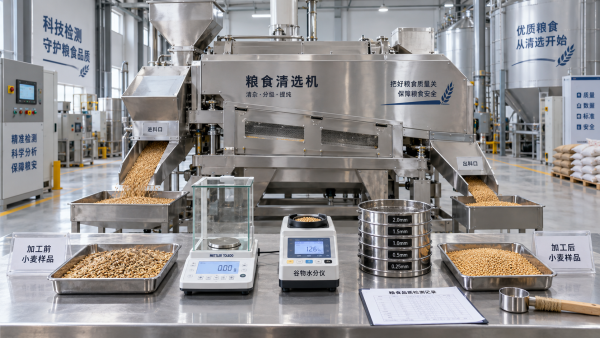
Yes—agricultural scientists can validate grain processing machinery when they have relevant expertise in grain properties, postharvest handling, and experimental design. Their work can establish whether equipment achieves its claimed throughput, preserves grain quality, and produces consistent results under defined operating conditions. Mechanical integrity, electrical safety, and other engineering questions may require additional specialists.
The useful question is therefore: can agricultural scientists validate process machinery performance under the conditions in which the machine will actually operate? A credible answer depends on representative grain, reliable measurements, repeatable trials, and acceptance criteria agreed before testing. A successful demonstration with carefully selected material provides much narrower evidence than a documented evaluation covering the intended operating range.
What can an agricultural scientist validate?
An agricultural scientist with experience in grain processing can investigate how a machine affects the material passing through it. This includes the relationship between operating settings, processing capacity, grain damage, separation efficiency, moisture changes, and final product quality.
That expertise matters because grain is a variable biological material. Moisture, kernel size, hardness, variety, impurities, and previous handling can change its behavior. Equipment that performs well with one batch may produce more broken kernels, poorer separation, or unstable output with another.
The scope should match both the machine and the scientist’s specialization. A specialist in postharvest grain quality may be well suited to evaluating a dryer or cleaner. Validating milling performance may also require cereal science expertise, particularly when flour properties or downstream processing behavior determine whether the output is acceptable.
A professional title alone does not establish competence for every evaluation. Relevant methods, suitable instruments, and experience interpreting the particular process are stronger indicators.
Does performance validation mean the machine is certified?
Performance validation establishes evidence for defined claims. It might show that a cleaner removes specified impurities while limiting usable grain losses, or that a mill produces an acceptable particle size distribution at a stated production rate.
Certification is a separate process involving a particular scheme, authority, and scope. A scientist’s performance report does not automatically establish conformity with machinery safety requirements, electrical requirements, food safety obligations, or contractual certification conditions.
Mechanical and electrical engineers may be needed to assess drive systems, guarding, controls, structural loads, and installation. Grain dust hazards require appropriate specialist assessment. Where laboratory accreditation matters, its scope should cover the relevant analytical method; accreditation for unrelated testing adds little to the result being assessed.
The practical approach is to define which decisions the report must support, then assign each part to someone qualified to evaluate it.
Which measurements reveal whether grain machinery performs well?
Useful measurements connect production rate with output quality and resource use. Throughput alone can reward a machine for processing grain quickly even when too much output is damaged or outside specification.
The details depend on the process. For cleaning equipment, impurity removal should be assessed alongside sound grain lost in the reject stream. For milling, particle size distribution and usable product yield may matter more than total discharge weight. For dryers, inlet and outlet moisture, moisture uniformity, temperature exposure, and grain quality should be considered together.
Drying also changes the basis of comparison. Removing water reduces grain mass without necessarily losing grain solids. Yield comparisons therefore need an appropriate moisture basis, or normal water removal can be mistaken for product loss.
What makes a performance trial credible?
A credible trial begins with a written protocol. This identifies the claim being tested, grain characteristics, operating conditions, measurements, sampling locations, and pass criteria. Agreeing these points beforehand prevents acceptance limits from shifting after results are known.
Representative material is essential. Testing should reflect the grain types and conditions expected in service, including relevant variation in moisture and impurity load. There is no universal test matrix: the appropriate range depends on the machine’s intended use and the consequences of poor performance.
Measurements must also be fit for purpose. Weighing equipment, moisture instruments, and energy meters need suitable accuracy and documented calibration or verification. Samples should represent the material stream across the trial, rather than a convenient handful collected once.
Sampling before and after processing helps separate incoming defects from damage introduced by the machine. When testing alternative settings, changes in feed material must be controlled or recorded so they do not obscure the effect of the adjustment.
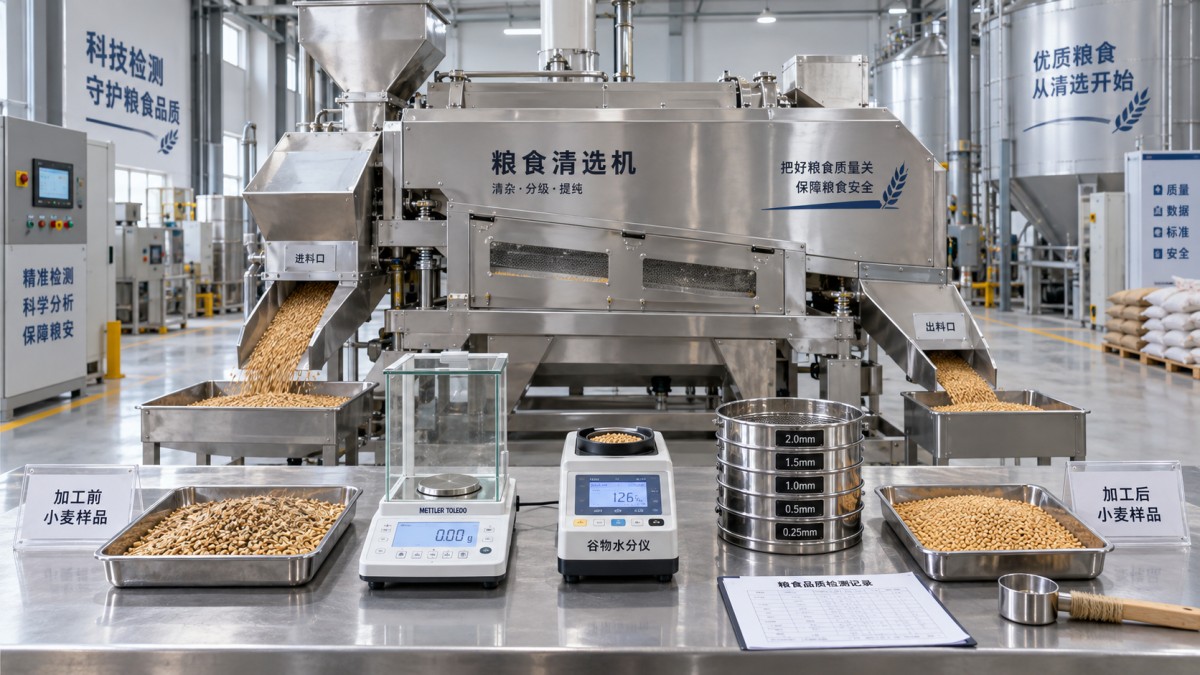
Repeated runs reveal whether a favorable result is reproducible. The number and duration should reflect process variability and the decision being made. Closely spaced samples from one run can describe variation within that run, but they do not establish reproducibility across different runs or grain lots.
Startup, shutdown, blockages, and manual adjustments should be documented. Stable operation can be evaluated separately, while a production assessment may also need to account for these events because they affect usable daily capacity.
How should supplier claims become acceptance criteria?
A claim such as “high capacity with low grain damage” leaves too much open to interpretation. Acceptance criteria should specify the grain condition, required processing rate, quality limits, allowable losses, and operating configuration.
These conditions need to apply simultaneously. Meeting the capacity target at one setting and the quality target at another does not demonstrate that the required combination is achievable.
Consider a cleaner that reaches its advertised feed rate only when airflow is reduced. If that adjustment leaves excessive light impurities in the product, the feed rate does not establish satisfactory cleaning performance. Likewise, stronger aspiration may improve cleanliness while carrying valuable grain into the rejects.
The accepted operating point should deliver the required output quality at the required rate. The report should identify the settings that achieved it and explain how sensitive the result was to changes in feed conditions.
Measurement uncertainty also matters near an acceptance limit. The protocol should define how borderline results will be treated, including when further testing is appropriate. This avoids deciding the rule after seeing which outcome favors one party.
Can a laboratory or factory test predict site performance?
Laboratory testing is useful for understanding grain behavior and comparing process settings under controlled conditions. Factory testing can demonstrate the supplied machine’s operation before shipment. Neither fully reproduces an installed production line.
At the site, performance may depend on feed consistency, upstream conveyors, available power, aspiration, discharge restrictions, ambient conditions, and controls. A machine can perform well independently yet struggle because the surrounding system cannot supply or remove material at the required rate.
Scaling up introduces further questions. Residence time, airflow distribution, heat transfer, and material movement may change between a small test apparatus and commercial equipment. A favorable small trial supports technical feasibility; it does not establish every aspect of full-scale performance.
For a significant equipment purchase, a sensible sequence is controlled process testing where needed, factory evaluation of the supplied equipment, and site acceptance under representative conditions. Each stage resolves a different uncertainty.
How can two machines be compared fairly?
Use comparable grain and equivalent output requirements. A machine processing cleaner, drier, or more uniform input has an advantage that may have little to do with its design.
Where practical, divide a well-characterized grain lot between trials and record remaining differences. Both machines should have an appropriate setup period, with operating settings documented. Supplier adjustments can be legitimate, provided they remain within the configuration being purchased.
Compare energy using the same boundary. Including fans, feeders, and dust extraction for one machine while measuring only the main motor for another produces a misleading result.
Also distinguish between immediate performance and longer-term behavior. A short trial can establish processing results under tested conditions. It offers limited evidence about wear, maintenance frequency, or sustained availability. Those questions need longer observation, inspections, or service records relevant to comparable operating conditions.
Does validation need to be independent?
Supplier testing is useful for development, setup, and initial evidence. Independent oversight becomes more valuable when results determine a major purchase, payment milestone, or disputed claim.
Independence should be visible in how the work is conducted. The evaluator should disclose relevant relationships, control or witness important measurements, retain access to underlying data, and report unsuccessful runs as well as favorable ones.
A supplier-funded test can still provide credible evidence when the protocol is agreed in advance and the evaluator can report without commercial interference. Conversely, describing a report as independent adds little if the evaluator sees only selected supplier data.
Scientific analysis is most useful when someone can trace each conclusion back to the recorded conditions, measurements, and samples.
What should a useful validation report contain?
The report should make clear what was tested, what passed, and where the conclusions apply. An executive conclusion is helpful, but it needs enough supporting detail to explain the result.
- Equipment identification: model, configuration, relevant components, and control settings.
- Input characterization: grain type, moisture, impurities, and other properties affecting the process.
- Test conditions: duration, sampling plan, instruments, and surrounding equipment.
- Results: measured performance, variability, losses, and departures from the protocol.
- Acceptance decision: comparison with agreed criteria and the operating range supported by the evidence.
Unexpected stoppages, excluded measurements, and adjustments should remain visible. Photographs and demonstration videos can explain the setup, but they cannot replace measurement records.
For technical reporting in AgriChem Chronicle, this distinction between a manufacturing claim and evidence supporting it is especially relevant. A useful machinery assessment connects stated capability with documented test conditions and measurable outcomes.
When should machinery be tested again?
Retesting is appropriate when a change could materially affect the validated result. Examples include a different grain type, a wider moisture range, altered screens or rollers, revised controls, or a major change to feed and aspiration systems.
The scope should follow the change. Replacing a component with an equivalent item may require a focused check, while a substantial process modification may justify broader testing. Earlier results remain useful for comparison, provided their original conditions are preserved in the record.
What should happen before commissioning validation?
Write down the decision the testing must support: accepting a new machine, comparing alternatives, diagnosing losses, or assessing a modification. Then define acceptable output and the grain conditions the equipment must handle.
Use those requirements to select the evaluation team and agree the protocol. The strongest outcome is a documented answer to a practical question: can this equipment consistently deliver the required grain quality and production rate within the operating conditions it will face?
Related Intelligence
- Milling MachineryCan Agricultural Scientists Validate Grain Processing Machinery?Can agricultural scientists validate process machinery performance? Discover how grain equipment testing verifies throughput, quality, and efficiency before you invest.
- Milling MachineryGrain Processing Explained: From Cleaning and Milling to Finished Product QualityGrain Processing explained: discover how cleaning, conditioning, milling, and quality control turn raw grain into safe, consistent flour, feed, and food ingredients.
- Milling MachineryGerman Grain Processing Plants: Evaluating Automation and Energy-Efficiency UpgradesGrain processing Germany: evaluate automation and energy-efficiency upgrades to improve throughput, quality, safety, and lifecycle value.
The Morning Broadsheet
Daily chemical briefings, market shifts, and peer-reviewed summaries delivered to your terminal.
