

The Authority in Global Agricultural Chemistry & Bio-Resources
What Are Common Pitfalls in Fine Chemical Supplier Audits?
What Are Common Pitfalls in Fine Chemical Supplier Audits?
A supplier’s polished documentation can conceal weaknesses that threaten product purity, regulatory compliance, and supply continuity. For procurement and quality teams asking what are common pitfalls in fine chemical supplier audits, the biggest risks often lie beyond the checklist: unverified data integrity, poorly controlled process changes, incomplete impurity assessments, and limited visibility into subcontractors.
The problem is not necessarily a missing procedure. It is the gap between what a procedure promises and what happens when a batch fails, a raw material changes, or production moves to another site. A useful audit follows those events through records, people, equipment, and release decisions—not just through a quality manual.
AgriChem Chronicle’s coverage connects fine chemicals and APIs with bio-extracts, agricultural inputs, and primary processing. Across these sectors, buyers face a shared challenge: distinguishing documented capability from repeatable performance. The applicable standards differ, but the need to verify evidence does not.
Starting with the wrong audit scope
“Fine chemical” describes a broad commercial category, not a single regulatory status. An API, a pharmaceutical intermediate, an analytical reagent, and an agricultural processing ingredient cannot automatically be evaluated against identical requirements. Intended use, destination market, manufacturing stage, and customer specifications determine the appropriate scope.
For APIs, ICH Q7 provides a recognized GMP framework. It should not be treated as a universal certification requirement for every specialty chemical. Likewise, environmental permits and chemical-handling obligations need separate verification against the relevant jurisdiction; an acceptable quality system does not establish environmental compliance.
Before scheduling the visit, identify the legal manufacturer, production address, product grade, intended application, and outsourced activities. Confirm whether the supplier is a manufacturer, distributor, or both. Otherwise, a thorough audit may approve the wrong facility or miss the operation that actually determines product quality.
Treating certificates and clean paperwork as proof
Certificates are useful starting points, but their scope matters more than their appearance. Check the issuing body, validity, site address, covered activities, and exclusions. An ISO 9001 certificate is not equivalent to API GMP compliance. FDA establishment registration, where applicable, is not FDA approval or an endorsement of product quality.
The same caution applies to inspection history. A historical inspection outcome does not establish that today’s production line, ownership, or process remains unchanged. Request relevant inspection findings and corrective actions, then assess whether those actions were implemented and shown to work.
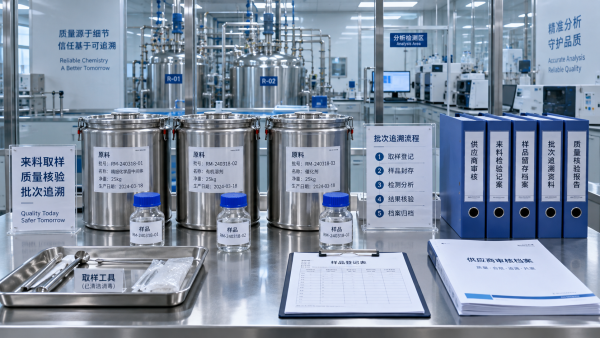
A stronger test is to select a recently released batch and trace it backward: certificate of analysis, release authorization, laboratory results, production record, equipment status, and incoming material lots. Let the auditor select the batch rather than relying entirely on examples prepared by the supplier. Add a deviation-affected batch if one is available.
This record-by-record review reveals inconsistencies that separate document reviews can miss: dates that do not align, unexplained yield differences, or a release decision made before an investigation was completed.
Reviewing reported results without testing data integrity
A signed certificate of analysis shows reported results. It does not, by itself, establish how those results were generated. Auditors need access to relevant raw data, methods, calculations, and review records—not just selected chromatograms or exported PDFs.
In electronic laboratories, examine user permissions, administrator access, audit trails, backup arrangements, and control of data changes. For paper systems, review contemporaneous recording, corrections, reconciliation of worksheets, and retention of original observations. Hybrid systems deserve particular attention because information can disappear between an instrument, spreadsheet, and final report.
Ask how unexpected or out-of-specification results are investigated. Retesting can be justified, but repeated testing until a passing result appears is not a defensible substitute for understanding the original failure. Review the rationale for invalidated results and whether quality personnel approved the investigation before release.
Confidentiality is legitimate, especially for proprietary chemistry. However, confidentiality controls should enable appropriate evidence review, not replace it. If essential records cannot be examined, document the limitation and its effect on the qualification decision.
Accepting purity claims without understanding impurities
A high assay value can distract buyers from a poorly understood impurity profile. Assay, chromatographic area purity, water content, residual solvents, and inorganic residues answer different questions. A specification should make the measurement basis clear rather than presenting these values as interchangeable.
The synthesis route helps explain what could be present. Starting materials, catalysts, reagents, degradation pathways, and recycled solvents can introduce impurities that a routine method does not adequately detect. Ask whether analytical methods are suitable for the relevant matrix and whether sensitivity supports the required acceptance limits.
For pharmaceutical applications, residual solvents, elemental impurities, and potentially mutagenic impurities may require assessment under applicable guidance, depending on the material and its use. Nitrosamine risk should be considered where the chemistry and process create plausible formation or contamination pathways, rather than added as an indiscriminate testing checkbox.
For bio-extracts and agricultural ingredients, different risks may dominate: variable source material, pesticide residues, microbiological contamination, or adulteration. The practical question remains the same: does the control strategy address credible hazards, or merely the substances easiest to measure?
Missing changes behind an unchanged product code
A supplier can retain the same product name and specification while changing the raw material source, solvent recovery practice, production scale, drying conditions, or manufacturing site. Those changes may affect impurity profiles, particle properties, stability, or downstream processing even when routine release results remain acceptable.
Review actual change-control records, not only the procedure. Look for technical risk assessment, qualification or validation where appropriate, updated documentation, and customer notification when required. A change classified as minor internally may still be significant for the buyer’s registered process or application.
Quality agreements should define which changes require notification or prior approval, the expected notice period, and how emergency changes are handled. “We notify customers of significant changes” is too ambiguous unless both parties share a workable definition of significance.
Stopping at the supplier’s front gate
The audited company may outsource a reaction step, milling, testing, repacking, or storage. A distributor may source equivalent-looking material from more than one manufacturer. Without supply-chain mapping, the buyer may approve one operation while receiving material influenced by several others.
Trace one material flow from critical inputs to the delivered container. Identify who performs each activity, who holds the original records, and who has authority to approve changes or release material. Supplier qualification should extend to subcontractors in proportion to their effect on quality.
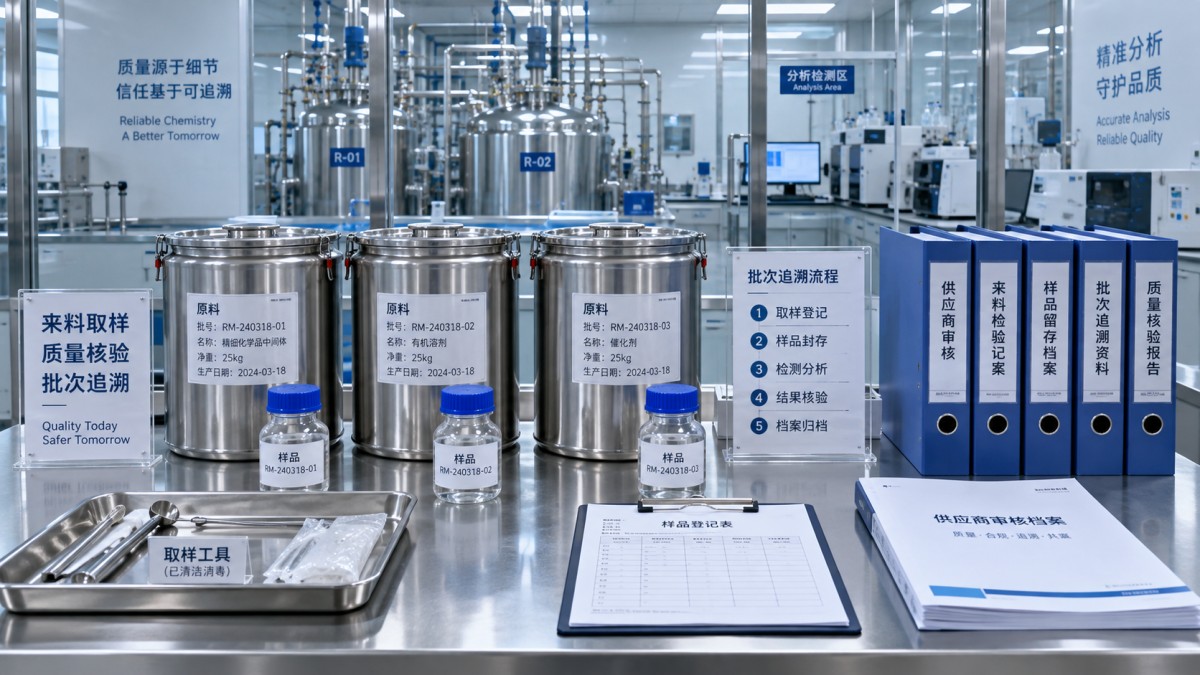
Recovered solvents and reprocessed material deserve explicit attention. They are not automatically unacceptable, but their use needs defined controls, traceability, and appropriate evaluation. Also check relabeling and repacking: manufacturing dates, retest dates, storage conditions, and original manufacturer identity should remain traceable through distribution.
Overlooking shared equipment and realistic delivery capacity
Multipurpose plants are common in fine chemicals. The audit should examine how previous products, cleaning methods, equipment design, and campaign scheduling influence cross-contamination risk. A clean-looking reactor does not establish that residues are adequately controlled.
Ask how cleaning acceptance criteria are established and how difficult-to-clean locations are assessed. Where cleaning validation is required, sampling recovery, analytical sensitivity, and equipment coverage should support the conclusion. Where a different assurance approach applies, the supplier should explain why it is appropriate for the material and application.
Capacity requires a similarly practical review. Reactor volume is not delivery capacity. Drying, filtration, laboratory release, utilities, waste treatment, maintenance, and competing campaigns can become bottlenecks. Confirm which constraints govern the promised lead time and whether contingency options are qualified, rather than merely available.
A backup site has limited value if transferring production would require unresolved customer approval, process qualification, or regulatory work.
Closing findings before corrective actions are effective
Audit scores can conceal serious issues. Numerous minor documentation findings should not outweigh one failure that undermines batch traceability or the reliability of release data. Classification needs to consider product impact, systemic extent, and detectability—not simply the number of observations.
Corrective and preventive action should distinguish immediate correction from removal of the underlying cause. Revising a procedure or retraining staff may be appropriate, but neither proves that the problem will stop recurring.
- Require evidence of implementation, with named owners and completion dates.
- Define effectiveness checks that examine subsequent records or production activity.
- Set approval conditions, including restricted use or additional testing where justified.
- Establish re-audit triggers for major changes, recurring failures, or unresolved critical concerns.
Additional incoming testing can reduce some risks, but it cannot repair unreliable records or establish the absence of every possible contaminant. Conditional approval must state what remains uncertain and who accepts that risk.
Turn the audit into a purchasing decision
A useful audit conclusion explains which products, sites, and activities are approved; what limitations apply; and what evidence is still outstanding. Procurement needs a realistic delivery assessment. Quality needs confidence in release controls. Technical teams need assurance that the material will behave as expected in its intended application.
Before the next audit, align those needs in a product-specific evidence request. Prioritize batch traceability, raw analytical data, relevant impurity assessments, recent process changes, subcontractor controls, and demonstrated corrective-action effectiveness. If a supplier cannot support an essential claim, keep it unresolved until evidence is available—rather than treating a polished presentation as sufficient proof.
Related Intelligence
- Custom SynthesisThird-Party Testing of Chemical Synthesis Impurities: Methods and Detection LimitsExplore chemical synthesis impurities third party testing methods, detection limits, and reporting essentials to verify supplier claims and make confident sourcing decisions.
- Custom SynthesisWhat Are Common Pitfalls in Fine Chemical Supplier Audits?What are common pitfalls in fine chemical supplier audits? Discover hidden risks in data integrity, impurity controls, and process changes—and learn how to qualify suppliers with confidence.
- Custom SynthesisWhat Data Should a Chemical Manufacturer Provide for a GMP Audit?What data should a chemical manufacturer provide for GMP audit readiness? Explore the essential records for traceability, validation, data integrity, and confident compliance.
The Morning Broadsheet
Daily chemical briefings, market shifts, and peer-reviewed summaries delivered to your terminal.
