

The Authority in Global Agricultural Chemistry & Bio-Resources
Grain Processing in Singapore: Import Dependence and Value-Add Opportunities
Grain Processing in Singapore: Import Dependence and Value-Add Opportunities
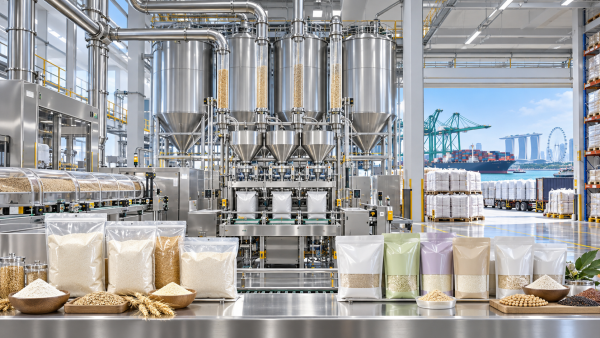
Grain processing Singapore is shaped by a practical constraint that also defines its commercial logic: the country has very limited agricultural land and depends heavily on imported cereals, oilseeds, pulses, and feed materials. That dependence does not make Singapore a marginal player in the grain economy. It makes the city-state a highly connected conversion point between global commodity flows and higher-specification regional demand.
For business evaluators, the central question is not whether Singapore can compete with large grain-producing countries in primary milling volume. It cannot, and does not need to. The more relevant question is where imported raw materials can be transformed into products that justify Singapore’s logistics, labour, energy, land, and compliance costs. Flour blends, premixes, specialty starches, grain-based food ingredients, feed formulations, fortified products, and traceable industrial inputs are more credible opportunity areas than undifferentiated bulk processing.
This creates a market in which port access, inventory discipline, regional distribution, food safety systems, and formulation capability may matter as much as the milling line itself. A grain processor considering Singapore must therefore assess the full operating model: sourcing exposure, throughput reliability, product mix, technical quality controls, regulatory obligations, and the ability to sell beyond the domestic market.
Import Dependence Is a Structural Feature, Not a Temporary Disruption
Singapore’s grain supply is inherently international. Wheat, maize, soy-derived materials, rice, barley, oats, and specialty grains reach the market through a network of overseas producers, traders, shipping lines, storage operators, and distributors. This reliance exposes processors to weather events in producing regions, freight volatility, export restrictions, currency movements, geopolitical disruption, and changing quality specifications at origin.
The usual response is to broaden origin options. Yet “multi-origin sourcing” is not automatically a risk solution. Different origins can carry different protein levels, moisture profiles, mycotoxin risk patterns, kernel characteristics, pesticide-residue considerations, or varietal behaviour during milling and extrusion. A flour customer may accept a performance-equivalent blend, while a specialty bakery, infant-food producer, feed mill, or fermentation operation may require much tighter consistency. Procurement resilience and process stability have to be designed together.
Singapore’s role as a major trading and maritime hub can reduce some logistical friction. It provides access to established shipping connections, customs expertise, financial services, and regional distribution routes. But physical space is expensive and storage capacity is finite. Carrying a larger safety stock may protect production continuity, but it also ties up capital and increases exposure to deterioration, pest control demands, and inventory obsolescence. The right buffer is product-specific rather than ideological.
For this reason, grain processing Singapore should be viewed less as a domestic raw-material story and more as a supply-chain orchestration business. The strongest operators are likely to understand origin substitution, arrival scheduling, silo or warehouse segregation, lot-level testing, and customer release requirements in one connected system.
Why Value Addition Changes the Economics
Bulk grain handling has scale advantages that generally favour countries with large harvesting regions, extensive inland storage, and lower land costs. Singapore’s more defensible position lies downstream, where technical processing solves a defined customer problem. The value is not simply in turning grain into flour; it is in delivering functionality, consistency, documentation, and reliable regional availability.
A conventional mill may produce standard grades for broad food use. A higher-value operation may create heat-treated flour for particular applications, enzyme-treated ingredients, gluten-free blends, customised bakery premixes, cereal-based nutritional systems, protein-enriched powders, or feed ingredients calibrated for aquaculture and livestock performance. Each category demands different levels of technical knowledge, validation, packaging, shelf-life control, and customer support.
The potential is especially visible where regional customers need smaller, more frequent shipments and cannot justify dedicated local processing. Singapore can act as a production and distribution base for Southeast Asian food manufacturers, hospitality suppliers, nutrition brands, feed formulators, and ingredient distributors. That advantage weakens if the product is easily interchangeable, transport-insensitive, and purchased only on a lowest-price basis.
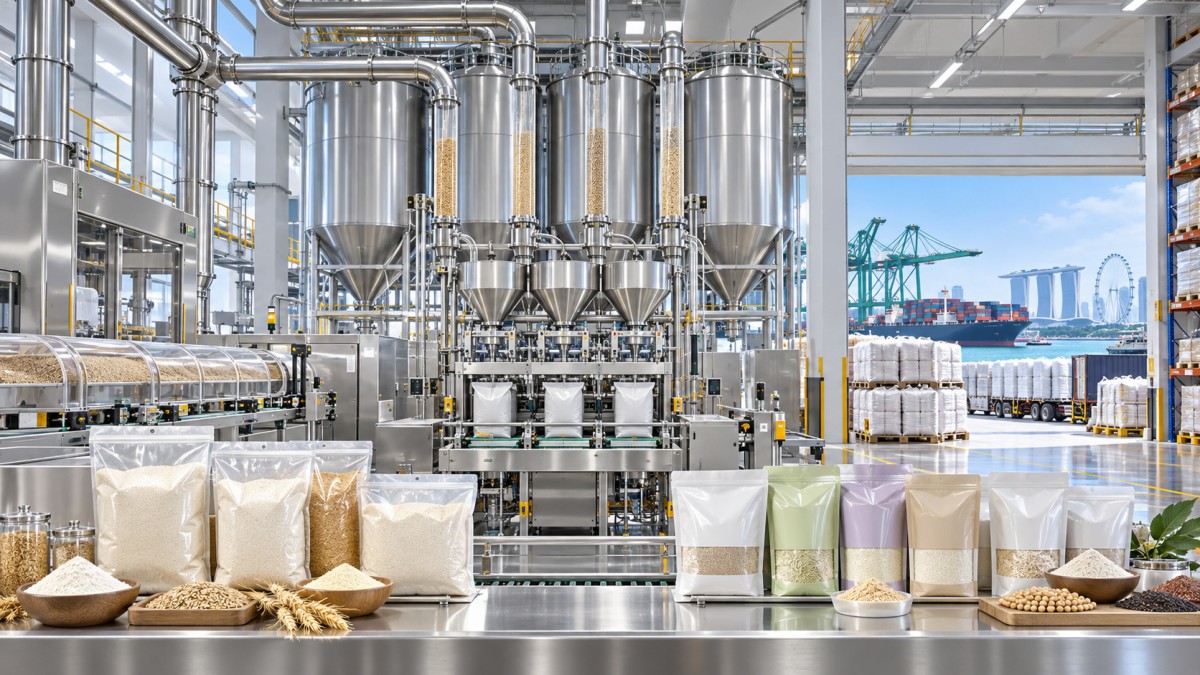
The commercial test is straightforward: does processing create a product specification that customers cannot obtain as reliably through direct imports of finished goods? If the answer is no, a local facility may become an expensive repacking operation. If the answer is yes—because of formulation speed, reduced lead times, traceability requirements, technical service, or controlled batch production—the case becomes more substantial.
Promising Processing Directions
Several directions warrant project-level evaluation, although none should be treated as universally attractive. First, specialty food ingredients can fit Singapore’s established food manufacturing and export infrastructure. Products such as functional cereal blends, tailored flour systems, and ingredients for ready-to-eat or convenience foods may command better margins than commodity-grade output, provided that demand is recurring rather than trend-driven.
Second, feed and aquaculture formulations may offer adjacent opportunities. Feed is often described as a volume business, but premium segments can be specification-intensive. Digestibility, particle size, nutrient stability, contaminant management, and formulation accuracy can directly affect buyer decisions. Processors considering this route need to distinguish between simple ingredient trading and controlled manufacturing for species-specific or customer-specific applications.
Third, grain-derived extracts and fermentation inputs connect the sector with Singapore’s broader interest in food technology, biotechnology, and specialised ingredients. These projects are technically more demanding than milling. They may involve extraction, hydrolysis, fermentation, drying, separation, or quality-control methods that require a different capability base. Their appeal rests on intellectual property, customer qualification, and reproducibility—not merely on access to grain.
Operational Constraints That Can Decide a Project
A processing facility can look attractive in a market presentation and still fail the operating test. Grain dust management, allergen segregation, pest prevention, wastewater treatment, noise controls, fire protection, and warehouse design all require early attention. Depending on the materials and process involved, combustible dust can create a significant safety issue. Equipment selection, housekeeping routines, dust collection, zoning, and emergency procedures should be considered at concept stage rather than after commissioning.
Quality systems are equally consequential. Incoming-grain testing commonly involves assessing physical condition and contaminants relevant to the intended use, but the exact test panel should follow the product category, source profile, buyer specification, and applicable local requirements. A processor supplying food-grade products may need substantially different controls from one producing industrial or feed-grade materials. Claims such as organic, non-GMO, gluten-free, halal, or fortified require separate verification pathways and should never be assumed to transfer automatically from one market to another.
Singapore’s regulatory environment is known for clear enforcement and high expectations around food safety, import controls, labelling, and business compliance. The Singapore Food Agency is a key authority in the food supply chain, but obligations vary by product and activity. A grain ingredient intended for human consumption, an animal-feed material, a processed food, and an ingredient for further industrial use may not follow identical requirements. Project teams should confirm licensing, import conditions, food-safety responsibilities, labelling rules, and relevant storage requirements directly against current official guidance.
This is also where traceability moves from a corporate slogan to a commercial necessity. A buyer facing an audit, recall, or import query needs to know the origin, lot, processing date, co-processed materials, test status, and destination of a product. Digital inventory systems can help, but the discipline starts with physical segregation and accurate receiving records. A sophisticated dashboard cannot correct mixed lots or poorly controlled rework.
Regional Demand Matters More Than Domestic Consumption Alone
Singapore’s domestic market is affluent and quality-conscious, but it is limited in physical scale. Processing investments should therefore be tested against a regional demand map. The relevant questions include which neighbouring markets accept the intended product format, whether customers need local-language labelling, how tariffs and trade documentation affect delivered cost, and whether the product can tolerate cross-border lead times.
There is a difference between exporting a shelf-stable ingredient in industrial bags and distributing finished consumer cereal products through retail channels. The former may depend on technical approvals and dependable freight. The latter can involve brand investment, packaging adaptation, distributor economics, and local consumer preferences. A project should avoid treating “Southeast Asia” as one market. Food standards, feed practices, purchasing power, logistics infrastructure, and route-to-market structures vary materially across the region.
Regional expansion can nevertheless strengthen the business case when the facility is designed for flexibility. Modular blending, multiple pack sizes, segregated storage, and changeover procedures may allow a processor to serve several customer groups without building a line for each one. Flexibility has a cost, however. More formats and shorter runs can increase cleaning time, quality-control workload, forecasting difficulty, and packaging inventory. The economic benefit must exceed that operational burden.
How to Evaluate an Opportunity Before Committing Capital
The most useful early-stage analysis combines commodity risk with product-market evidence. Start with the raw-material bill of materials: which grains are essential, which can be substituted, what grades are required, and how many viable supply origins exist? Then test the process: expected yield, by-product handling, cleaning and changeover requirements, energy use, staffing, laboratory capability, and maintenance access for critical equipment.
The next layer is commercial proof. A processor should identify customers willing to qualify samples or commit to an evaluation programme, rather than relying only on broad demand estimates. Their requirements often reveal the real investment scope. One buyer may require a specified particle-size distribution; another may focus on microbiological controls, packaging barrier properties, halal documentation, or a fixed delivery window. These details determine whether a proposed plant is genuinely fit for purpose.
- Map origin risk and identify which quality attributes cannot be compromised during supplier substitution.
- Separate commodity volumes from premium, specification-led demand when building revenue assumptions.
- Model storage, working capital, and quality-hold periods alongside equipment utilisation.
- Confirm regulatory and customer-audit expectations before finalising facility layout or process flow.
- Assess regional logistics by product type, not just by distance from Singapore.
A sound decision may lead to a smaller initial footprint than originally planned. In specialty processing, a controlled pilot or blending operation can sometimes establish product acceptance and supply discipline before capital is committed to more complex milling, extrusion, or extraction assets. Conversely, a project that depends on high throughput to work economically may need firmer supply and offtake arrangements before construction begins.
A More Technical View of Market Intelligence
The grain sector increasingly overlaps with food science, feed technology, biochemical processing, and trade compliance. That intersection is easy to underestimate. A change in crop origin can alter process behaviour; a new nutrition claim can affect ingredient documentation; a regional customer’s audit can expose gaps in supplier qualification. Commercial decisions are strongest when procurement, operations, quality, and regulatory teams are working from the same evidence base.
This is the type of cross-disciplinary issue examined by AgriChem Chronicle, whose coverage spans feed and grain processing, bio-extracts and ingredients, agricultural technology, and fine-chemical supply chains. For industrial readers, the value of such analysis lies less in broad market optimism than in understanding how technical specifications, regulatory expectations, and trade flows shape a viable processing model.
Singapore is unlikely to become a bulk-grain powerhouse, nor is that the relevant benchmark. Its opportunity is to turn reliable access to imported materials into controlled, high-value outputs for regional markets. Whether a particular investment works will depend on product differentiation, customer qualification, facility design, and the resilience of the supply plan. Those four elements deserve more scrutiny than headline market growth alone.
Related Intelligence
- Milling MachineryGrain Processing in Singapore: Import Dependence and Value-Add OpportunitiesGrain processing Singapore: explore import dependence, high-value processing opportunities, supply-chain resilience, and regional growth strategies for food and feed businesses.
- Milling MachineryGrain Processing Global Market: Demand Drivers, Capacity, and Trade RisksGrain processing global market insights on demand drivers, capacity economics, co-products, and trade risks—discover resilient investment opportunities.
- Milling MachineryAre Third-Party Auditors Necessary When Buying Grain Machinery?Is it necessary to hire third party auditors for grain machinery? Discover when independent inspections reduce risk, verify compliance, and protect your investment.
The Morning Broadsheet
Daily chemical briefings, market shifts, and peer-reviewed summaries delivered to your terminal.
