

The Authority in Global Agricultural Chemistry & Bio-Resources
China Launches Largest Single-Line Large-Tow Carbon Fiber Line
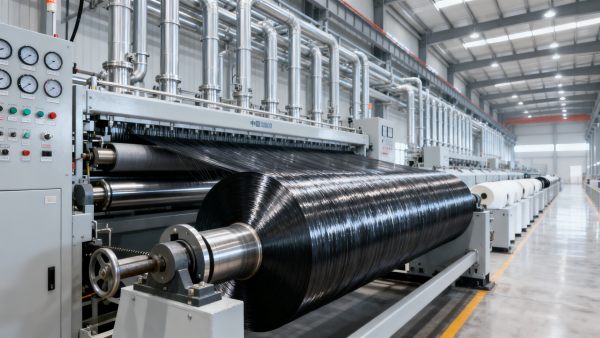
China has commissioned the first phase of its largest single-line large-tow carbon fiber production facility — a 30,000-ton-per-year line operated by Sinopec Shanghai Petrochemical. Though the exact commissioning date is not publicly specified, the line is now operational and its output meets internationally advanced standards. This development is particularly relevant for manufacturers and suppliers in precision agriculture equipment, smart greenhouse infrastructure, and modular livestock farming systems — sectors where structural lightweighting, corrosion resistance, and extended service life are increasingly critical.
Event Overview
Sinopec Shanghai Petrochemical’s annual 30,000-ton large-tow carbon fiber production line has entered initial operation. The product quality is confirmed to meet international advanced standards. The line is designed to supply high-performance carbon fiber suitable for structural components in advanced agricultural applications, including lightweight frames for high-end agricultural machinery, load-bearing skeletons for smart greenhouses, and structural elements in modular aquaculture and livestock housing systems.
Impact on Specific Industry Segments
Direct Trade Enterprises (Export-Oriented Distributors & Importers)
These firms may experience shifts in sourcing dynamics for structural composite materials used in agricultural equipment exports. With domestic large-tow carbon fiber now available at scale and certified to international benchmarks, overseas procurement from China becomes more viable — especially for buyers previously reliant on Japanese or European suppliers. Impact manifests in shorter lead times, improved order flexibility, and potential for region-specific customization.
Raw Material Procurement Entities (Agricultural Equipment OEMs & System Integrators)
OEMs integrating carbon fiber into farm machinery frames or greenhouse frameworks may reassess long-term material qualification pathways. The availability of domestically produced, large-tow carbon fiber meeting international performance criteria reduces dependency on imported precursors or finished laminates. Impact includes reduced import-related logistics risk, simplified customs compliance for composite subassemblies, and opportunities to revise BOM cost structures.
Contract Manufacturing & Component Fabricators
Fabricators producing structural parts for smart greenhouses or modular barns may face revised technical specifications from clients — particularly regarding fiber architecture, resin compatibility, and certification documentation. The new line’s output supports standard tow sizes (e.g., 24K–48K), which align with common pultrusion and filament winding processes. Impact centers on updated material data sheets, possible requalification of existing tooling, and tighter alignment with upstream supplier QA protocols.
Supply Chain Service Providers (Logistics, Certification, Technical Support)
Third-party providers supporting cross-border agri-tech hardware deployments may see increased demand for carbon fiber–specific handling guidance (e.g., moisture control, static management during transit) and localized technical documentation (e.g., EN/ISO-compliant test reports). Impact includes need for updated training modules and expanded capacity to support material traceability requirements tied to structural safety claims.
What Relevant Enterprises or Practitioners Should Monitor and Do Now
Track official technical documentation and export classification updates
Monitor Sinopec Shanghai Petrochemical’s public release of material property datasheets, ISO/IEC 17025-accredited test reports, and HS code clarifications — especially regarding whether the product falls under dual-use export controls for structural composites.
Assess applicability for priority product lines — not broad categories
Focus evaluation on specific high-value use cases: e.g., greenhouse arch supports exposed to high-humidity environments, or robotic harvester chassis requiring fatigue-resistant lightweighting — rather than general ‘carbon fiber adoption’.
Distinguish between technical readiness and commercial scalability
While the first phase is operational, confirm current production volume allocation, minimum order quantities, and lead time commitments directly with the supplier. Early-stage output may prioritize domestic strategic users; international order fulfillment capacity remains subject to ramp-up timelines.
Update internal material qualification workflows proactively
If your organization requires formal material approval (e.g., for CE-marked greenhouse systems or USDA-certified livestock modules), initiate preliminary engagement with your QA team and third-party certifiers to map required testing against the new material’s published specs — before placing trial orders.
Editorial Perspective / Industry Observation
Observably, this milestone signals maturation in China’s capability to produce high-volume, specification-grade carbon fiber for non-aerospace structural applications — not just as a raw material but as an enabler of system-level performance in precision agriculture. Analysis shows it functions less as an immediate market disruptor and more as a strategic inflection point: one that strengthens supply assurance for global agri-tech hardware producers while gradually reshaping expectations around regional sourcing feasibility. From an industry perspective, the significance lies not in displacement of incumbents, but in expanding the pool of technically credible, logistically responsive suppliers — particularly for mid-tier OEMs balancing cost, compliance, and time-to-market.
Current more appropriate interpretation is that this is a foundational capability upgrade — not yet a full-scale substitution event. Its real-world impact will unfold over the next 12–24 months, contingent on consistent output quality, transparent technical documentation, and demonstrated responsiveness to engineering feedback from end-application developers.
Conclusion: This development reflects progress in China’s industrial capacity to support advanced agricultural infrastructure with domestically sourced, high-performance structural materials. It does not eliminate reliance on established global suppliers overnight, but it does expand options for procurement resilience and application-specific optimization — particularly where corrosion resistance, weight reduction, and long service life are mission-critical. Currently, it is best understood as a supply chain diversification enabler, not a wholesale replacement signal.
Information Source: Official announcement by Sinopec Shanghai Petrochemical (publicly reported in Chinese-language state media and industry platforms); no independent third-party verification of performance metrics or export terms is cited. Ongoing observation is warranted regarding actual export order fulfillment timelines, international certification alignment, and downstream adoption rates in non-Chinese OEM systems.
Related Intelligence
- Milling MachinerySaudi Arabia Grain Processing: Assessing Local Milling Capacity and Supply GapsGrain processing Saudi Arabia: assess local milling capacity, storage, logistics, and supply gaps to identify resilient investment opportunities across the Kingdom’s import-dependent grain chain.
- Milling MachineryUK Grain Processing Compliance: Key Food Safety Controls for Mill OperatorsGrain processing UK compliance guide for mill operators: strengthen HACCP, intake controls, allergen management, traceability and foreign-body prevention for safer, audit-ready operations.
- Milling MachineryGrain Processing in Singapore: Import Dependence and Value-Add OpportunitiesGrain processing Singapore: explore import dependence, high-value processing opportunities, supply-chain resilience, and regional growth strategies for food and feed businesses.
The Morning Broadsheet
Daily chemical briefings, market shifts, and peer-reviewed summaries delivered to your terminal.
