

The Authority in Global Agricultural Chemistry & Bio-Resources
Should You Require Independent Lab Reports for Feed Additives?

Require independent laboratory reports for feed additives when an incorrect identity, potency claim, or contaminant result could materially affect feed safety or formulation—and when the supplier’s controls have not yet earned sufficient confidence. That does not mean commissioning a full third-party test panel for every shipment. A stronger approach is to require lot-specific supplier documentation, verify higher-risk purchases independently, and adjust testing frequency as evidence accumulates.
The crucial distinction is between receiving a laboratory report and obtaining reliable evidence about the material you will actually use. An independent report has limited value if it covers an old batch, an unrepresentative sample, or a method unsuitable for the additive. Testing requirements should therefore define the sample, analytical method, acceptance criteria, and release decision—not simply request “third-party certification.”
What a supplier’s certificate of analysis does—and does not—prove
A certificate of analysis, or CoA, records results against a specification. It may contain measurements from the manufacturer’s laboratory, an outside laboratory, or a combination of sources. Some reported characteristics may be tested on every batch; others may rely on periodic verification. These distinctions should be explicit.
A useful CoA identifies the manufacturer, product grade, batch number, relevant dates, specifications, methods, units, and actual results where appropriate. A document showing only “passes” provides less information for assessing variation or resolving discrepancies, particularly for potency and quantitative contaminants.
Independent testing adds a separate analytical check. It can help identify a biased assay, a mistaken identity, contamination, or a mismatch between the shipment and its documentation. However, independence does not automatically establish technical competence, and a supplier-selected sample does not independently establish what is inside the delivered consignment.
Neither document replaces supplier qualification. Manufacturing controls, traceability, change notification, storage conditions, and corrective-action records remain important because a laboratory examines selected properties of selected samples—not every hazard in every package.
When independent verification should be a purchasing condition
The strongest reasons to require testing arise where uncertainty and consequence overlap. A new supplier with limited traceability deserves greater scrutiny than an established manufacturing site with a verified history. Likewise, a concentrated additive used at a low inclusion rate can warrant close control because an assay or dosing error may materially change the finished feed.
Price alone is not evidence of adulteration. An unexplained discount becomes more significant when combined with a changed manufacturer, missing batch records, unusual packaging, or reluctance to permit independent sampling.
Regulatory and contractual obligations take priority over a discretionary testing schedule. Requirements depend on the destination market, additive category, intended species, and applicable authorization conditions. Do not assume either that every feed additive legally requires an independent report or that a satisfactory report establishes permission to import or use it.
Specify tests around the failure you need to detect
Requesting a broad “purity test” is not enough. Purity can mean active-content percentage, absence of selected contaminants, or a compositional profile. Those are different questions, requiring different methods.
Identity and potency need separate consideration
Identity testing asks whether the material is what it claims to be. Potency testing asks how much relevant activity or active substance it contains. A single assay does not necessarily answer both questions, particularly where related compounds can interfere with the measurement.
For an amino acid or vitamin preparation, specify the relevant chemical form and reporting basis. A result expressed on a dry-matter basis is not directly interchangeable with an as-received specification. For a mineral additive, total elemental content does not by itself establish the claimed chemical form or bioavailability.
Enzyme testing requires particular care: activity units depend on assay conditions, including substrate, temperature, and pH. Results from different methods may not be directly comparable. For live microbial additives, viable count, organism identity, and relevant microbiological purity are distinct attributes; a DNA-based identity result does not demonstrate viability.
Contaminant panels should follow source and process risks
Mineral-derived materials may justify testing for specified undesirable elements. Plant-derived additives may require assessment of relevant mycotoxins or pesticide residues. Extraction processes can introduce residual-solvent questions, while fermentation-derived products require attention to organism- and process-related hazards.
These are reasons to investigate, not instructions to apply the same panel to every additive. A standard package can spend money on irrelevant analytes while omitting the actual hazard. The specification should name each required analyte, its limit, the reporting basis, and a method capable of measuring below that limit.
A result reported as “not detected” does not mean zero. Check whether the detection or quantification limit is low enough to support the acceptance decision. A method that cannot measure reliably at the relevant threshold cannot demonstrate compliance with it.
A release assay cannot establish performance throughout storage
An acceptable potency result at manufacture does not prove the additive will retain that potency through shipment, warehousing, or feed processing. Heat, moisture, oxygen, and interactions with other ingredients can affect stability.
Where these exposures matter, request stability evidence relevant to the actual formulation and packaging. Incoming testing can assess present condition, but it cannot replace evidence supporting shelf life or retention of activity after pelleting. Nor does a potency report, by itself, prove animal-performance claims.
Check the laboratory’s scope, not just its accreditation logo
ISO/IEC 17025 accreditation is a useful indicator of laboratory competence, but it must be checked against the published scope. Accreditation for one chemical test or sample type does not establish competence for every feed-additive assay.
Confirm that the laboratory can handle the specific analyte, matrix, concentration range, and method. An approach suitable for a pure ingredient may not work without modification in a coated preparation or carrier-rich blend. Relevant method validation or verification should address matters such as specificity, recovery, precision, and matrix interference.
Ask whether any analysis will be subcontracted and which results fall within the accredited scope. For proprietary enzyme assays or specialized microbial methods, assess the technical basis directly rather than accepting a general assurance that the laboratory “tests feed products.”
Authenticity also deserves attention. Verify unfamiliar reports through the laboratory’s official contact channel or report-verification service, where available. Match the report number, sample description, batch identifier, and dates. A genuine report for a different product or batch is still unsuitable evidence for release.
Make the sample represent the shipment
A highly capable laboratory cannot correct a misleading sample. When a supplier submits a retained sample, the result establishes something about that sample; it does not automatically establish the condition of goods received after transport or repacking.
For higher-risk purchases, specify who samples, where sampling occurs, how packages are selected, and how the sample is sealed and transferred. Independent sampling offers greater separation from supplier control than independent analysis of a supplier-selected sample. Controlled sampling at receipt can also support a defensible verification program.
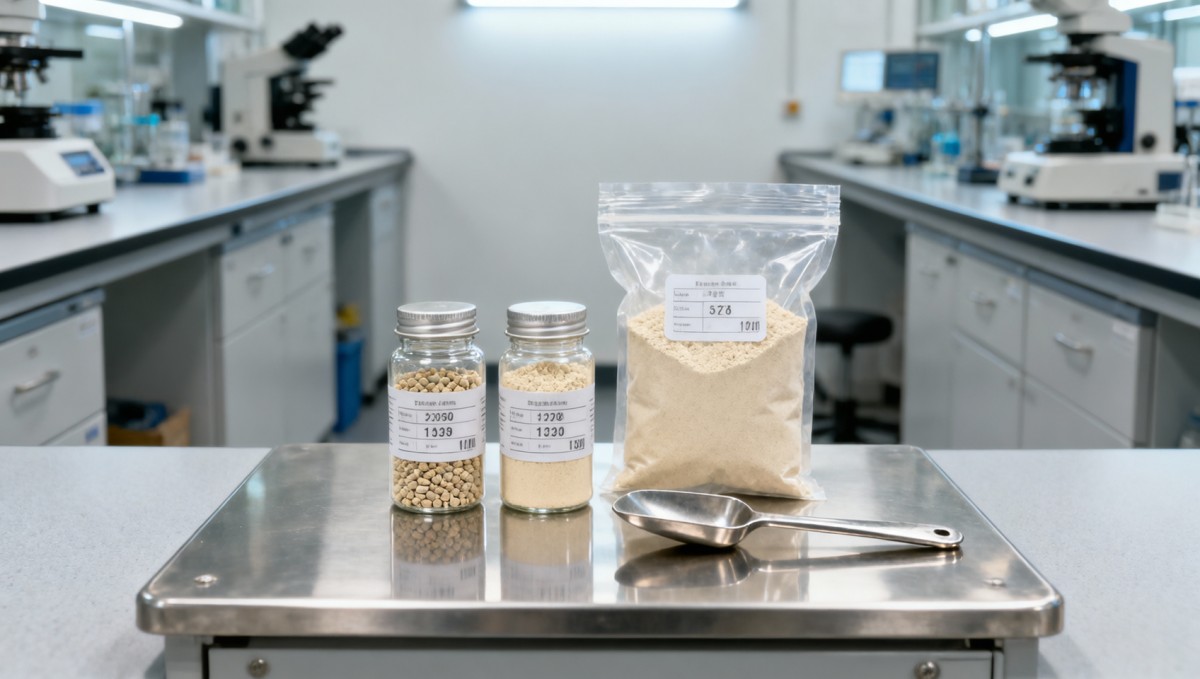
The sampling plan should reflect the material and hazard. A homogeneous powder, a segregating blend, and a localized microbiological contaminant present different problems. Composite samples can help estimate average composition but may dilute localized contamination. Use recognized sampling procedures applicable to the product and test objective rather than assuming one scoop represents a shipment.
Keep traceable retained samples under suitable conditions, with sealed portions for initial testing and potential investigation. Record lot numbers, package selections, sampler identity, dates, storage conditions, and transfers. Where several manufacturing lots share one shipment, do not treat a combined sample as proof that each lot conforms.
Agree on acceptance and disagreement rules before ordering
Testing becomes commercially useful when the contract connects results to an action. Define the specification and applicable method before shipment, including units, moisture basis, and whether limits arise from regulation or a contractual quality requirement.
Borderline results need a predefined decision rule. Measurement uncertainty means a reported value is not an infinitely precise boundary. Agree with the laboratory how uncertainty will be addressed when declaring conformity, especially near a maximum contaminant limit or minimum potency requirement. Contractual rules cannot override mandatory legal criteria.
The purchase agreement should also establish:
- Whether material remains on hold until required results are approved.
- Who pays for routine verification, investigation, and justified retesting.
- How discrepancies between supplier and independent results are investigated.
- Which retained sample and referee laboratory will be used if a dispute persists.
- What triggers rejection, replacement, corrective action, or renewed supplier qualification.
If results disagree, first check sample identity, reporting basis, method comparability, and sample handling. A discrepancy does not automatically prove supplier misconduct. Conversely, repeatedly testing new portions until one passes is not a defensible release process. Investigate the original failure and document the basis for disposition.
Set a testing frequency that responds to evidence
Every-lot independent testing can be justified when failure consequences are severe, source control is uncertain, or an applicable requirement demands it. For a well-characterized additive from a qualified site, periodic independent verification may provide proportionate assurance alongside supplier batch-release testing and incoming checks.
Reduced testing should follow a documented body of comparable results, not simply elapsed time or a favorable commercial relationship. Repeatedly matching potency results supports confidence in potency control; it does not demonstrate control of an unrelated contaminant that was never tested.
Increase verification after changes to the manufacturing site, process, raw-material source, carrier, or packaging where those changes affect the specification. Complaints, unexplained analytical shifts, damaged consignments, and traceability failures also justify reassessment.
Include turnaround time in the purchasing decision. A testing requirement is ineffective if material routinely enters production before results arrive. Compare laboratory and holding costs with the consequences of releasing unsuitable material: affected feed volume, traceability work, production disruption, and potential animal-health harm.
The most useful requirement is therefore not “an independent report with every delivery.” It is independently verified evidence, at a frequency justified by risk, tied to the purchased lot and an enforceable release decision. Where that chain is missing, another certificate adds paperwork rather than assurance.
Related Intelligence
- Commercial Feed PelletChoosing Feed Pellet Systems for Fish Farms: Capacity and Pellet RequirementsCompare feed pellet systems for fish farms by capacity, pellet quality and processing needs. Discover how to choose a reliable, efficient production line.
- Commercial Feed PelletLivestock Feed Formulation: Selecting Ingredients by Nutrient Value and DigestibilitySelect livestock feed formulation ingredients by nutrient value, digestibility, and cost. Discover how to compare options, manage variability, and build balanced, cost-effective diets.
- Commercial Feed PelletU.S. Brews to Barns Act Proposes Tax Credit to Strengthen Spent Grain Feed Supply ChainsBrews to Barns Act proposes a tax credit for spent grain donations. Explore how it could help brewers reduce handling costs and farmers strengthen local feed supply chains.
The Morning Broadsheet
Daily chemical briefings, market shifts, and peer-reviewed summaries delivered to your terminal.
