

The Authority in Global Agricultural Chemistry & Bio-Resources
How to Build a Sanitary Feed Production Plan That Reduces Cross-Contamination
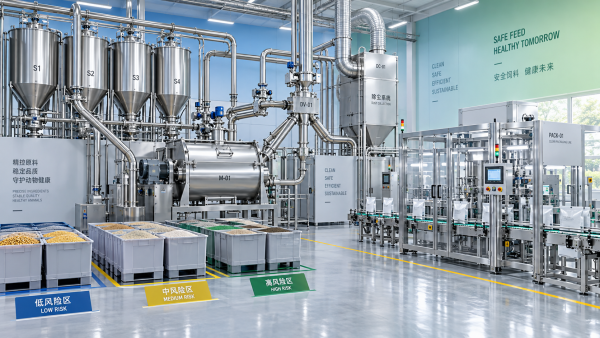
A sanitary feed production plan is not a cleaning schedule attached to a production calendar. It is the operating logic that determines which materials may enter a site, where they can move, what equipment they may contact, how runs are sequenced, and when a line must be released or held. Cross-contamination is reduced most effectively before production starts: through material segregation, controlled routing, realistic changeover rules, and evidence that sanitation actually removes the hazard of concern.
The critical distinction is between visible cleanliness and risk-controlled cleanliness. Dust on a conveyor, residual mash in a boot pit, a shared sampling probe, or an incorrectly returned rework tote may be insignificant in one formula but unacceptable in another. A robust sanitary feed production planning process therefore begins with a hazard map tied to the facility’s actual products, ingredients, process flow, and destination markets.
Start with the contaminants that matter at the site
“Cross-contamination” is often treated as one generic risk. In practice, its controls depend on what is being transferred and the consequence of transfer. Facilities producing standard livestock feed face a different risk profile from sites handling medicated feed, coccidiostats, high-copper formulations, ruminant materials subject to species restrictions, aquatic feeds, pet food, or formulas containing declared allergens.
A usable plan identifies hazards by product family rather than relying on a single plant-wide category. Relevant groups can include:
- Carryover of veterinary medicines or coccidiostats: residues can create animal-health, regulatory, and market-access consequences, especially where withdrawal requirements or maximum carryover limits apply.
- Microbiological contamination: pathogens may be introduced through raw materials, pests, wet cleaning failures, condensation, or post-process exposure. Heat treatment does not protect product from contamination after the conditioner, extruder, pellet cooler, or dryer.
- Chemical and formulation carryover: excess minerals, urea, additives, pesticides, cleaning chemicals, or unsuitable rework can affect the next batch even when no drug is involved.
- Species or market-specific restricted materials: feed intended for a particular animal class or export market may have ingredient restrictions that cannot be managed by informal segregation alone.
- Allergen and identity risks: where labeling, contractual specification, or downstream food-chain requirements apply, protein or ingredient carryover may require dedicated controls.
The point is not to classify every conceivable hazard. It is to define which materials require dedicated storage, dedicated equipment, validated flushing, wet or dry sanitation, production at the end of a campaign, or complete line isolation. A hazard that is not connected to a physical control will remain a statement in a risk assessment rather than an operational safeguard.
Map the real material path, including the places product is not supposed to remain
Most transfer risk occurs at interfaces: receiving pits, intake conveyors, elevator boots, distributor valves, surge bins, micro-ingredient systems, mixers, liquid application units, pellet presses, coolers, packing lines, and loadout equipment. The nominal process diagram is rarely sufficient because it may omit dust collection loops, aspiration systems, manual additions, sampling points, rework routes, floor sweepings, and shared transport assets.
A sanitary feed production plan should follow both the intended product route and the residual-material route. The second route is frequently more important. Material can remain in dead legs, screw conveyors, bucket elevator boots, magnets, scalpers, bag filters, mixer discharge zones, pellet coolers, and pneumatic conveying bends. A line that appears empty may still contain enough residual material to compromise a small subsequent batch.
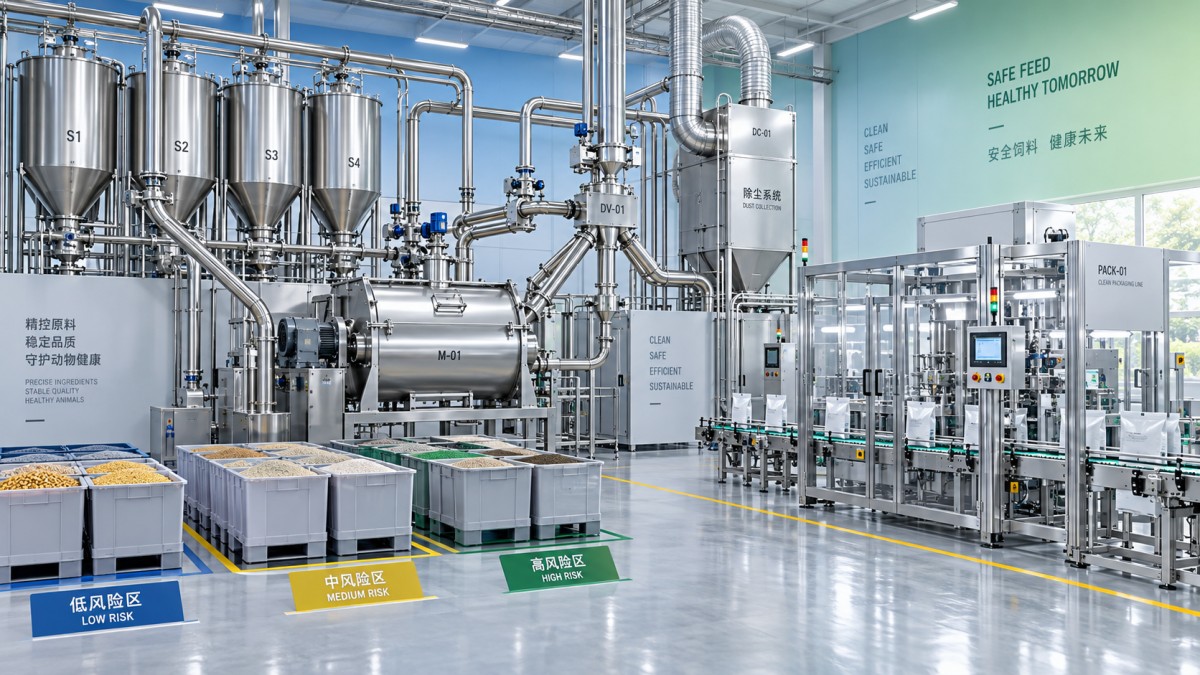
During the mapping exercise, each point should be assessed with practical questions: Can the equipment be fully emptied? Is it accessible for inspection? Does it collect fines or moisture? Is it connected to a shared dust system? Can a valve misdirect material? Is the component cleaned between campaigns, and can that cleaning be verified? These questions often expose a more significant risk than the main mixer itself.
Dust deserves particular attention. Fine particles migrate through aspiration, open transfer points, clothing, forklift traffic, and compressed-air misuse. A sanitary design does not treat dust only as a housekeeping issue. It treats dust as a potential carrier of medication, pathogens, allergens, or high-concentration micro-ingredients. Local extraction, enclosed transfer, controlled filter handling, and defined cleaning methods are generally more reliable than frequent dry sweeping or air blowing, which can redistribute contamination.
Receiving and storage controls set the limit of what production can achieve
No amount of downstream sequencing can correct poor material control at intake. Receiving procedures should confirm supplier identity, material status, vehicle cleanliness where relevant, seal integrity, documentation, sampling requirements, and the correct unloading destination. The risk is not confined to adulterated material. A correctly supplied ingredient can still be routed into the wrong bin, mixed with retained stock, or contaminated through a shared unloading system.
Storage planning should separate materials according to risk, not merely according to available bin space. Medicated premixes, concentrated additives, restricted materials, and materials with distinct microbiological or allergen controls need clearly defined storage, issue, and return rules. Physical separation is strongest where possible, but administrative controls also need to be unambiguous: bin identification, controlled access, electronic or manual status checks, and reconciliation between inventory records and production orders.
Micro-ingredient rooms require particularly disciplined design. Small dosing errors can create significant concentration changes, while open handling increases the potential for airborne transfer and wrong-material additions. Closed dispensing, labeled containers, dedicated utensils, weigh-up verification, and a formal process for unused portions reduce both contamination and traceability failures. “Temporary” containers and handwritten relabeling are recurring weak points because they bypass the normal identity controls.
Sequence production according to residual risk, not commercial convenience alone
Production sequencing is one of the most effective tools available when full equipment dedication is impractical. But a sequence only works if it reflects the residual risk in the line and the effectiveness of the chosen changeover method.
A common principle is to move from lower-risk to higher-risk formulations: unmedicated before medicated, lower inclusion before higher inclusion, and products with fewer restrictions before those with more restrictive materials. That principle needs refinement at each site. A batch containing a specific drug, a high level of a trace mineral, or a species-restricted ingredient may need to be treated as a separate campaign regardless of its commercial volume or formulation order.
Sequencing should not be used as a blanket excuse to avoid cleaning. It is suitable only when the residual risk is understood and the carryover control has been demonstrated. For example, a validated flush may be appropriate between compatible dry products, while a wet-cleaning procedure and documented release may be necessary after a product with a higher pharmacological or microbiological consequence. Where the line includes liquids, coating systems, or difficult-to-drain equipment, a dry-flush assumption may be inadequate.
Rework must fit the same logic. It should be assigned only to a compatible product or product family under a defined rule, with full identification and quantity control. Uncontrolled “return to process” practices can defeat carefully designed sequencing because they introduce an unknown composition into the next run. Rework from medicated, restricted, damaged, or questionable product should never be treated as ordinary material simply because it is economically valuable.
Define flushing as a validated control, not an informal habit
Flushing removes residual material by passing a compatible medium through a defined part of the process. It may be a grain, a finished feed, bran, or another approved material, depending on the facility and the hazard. Its effectiveness depends on the volume, route, equipment geometry, particle characteristics, and final disposition of the flush. A flush that does not pass through the same equipment path as the previous product cannot be assumed to control carryover at omitted points.
The plan should specify what triggers a flush, the material and quantity used, the exact route, how the flush is identified, and where it may be used afterward. Sending flush material to an inappropriate product can simply move contamination downstream. If it is retained for controlled use, its status and allowable destination must be traceable.
Validation answers whether the selected flushing or cleaning method can reduce the relevant residue to an acceptable level under defined conditions. Verification answers whether the method was actually performed as required on a given shift. These are not interchangeable. A signed sanitation record provides verification of completion; it does not validate that the selected procedure is capable of controlling a medicated-feed residue, an allergen, or a microbiological hazard.
For chemical carryover, validation may use representative sampling and analytical testing based on the specific active substance or marker. For physical residues, mass-balance studies, tracer studies, inspection, and retained-material assessments may support understanding of the system. For microbiological sanitation, environmental monitoring, product testing where justified, and inspection of post-process areas may be relevant. The method and acceptance criteria should match the hazard. A visual inspection alone cannot demonstrate removal of an invisible active ingredient.
Build sanitation around equipment condition and dry-versus-wet realities
Feed facilities often depend on dry cleaning because unnecessary water can create microbial growth, corrosion, caking, and difficult-to-dry harborage sites. Vacuuming, scraping, brushing, controlled disassembly, and removal of accumulated material are often more appropriate for dry-product areas than indiscriminate washdown. Dry cleaning is not automatically sufficient, however. It must reach the surfaces and voids where residue accumulates.
Wet cleaning may be justified after certain contamination events, in equipment handling wet materials, or where soil cannot be removed effectively by dry methods. It introduces its own release conditions: water quality, detergent compatibility, rinse control, drying, inspection, and prevention of microbial growth before restart. The plan should state who can authorize wet cleaning, what areas require it, how drying is confirmed, and what evidence is needed before the line returns to production.
Sanitary maintenance is part of contamination control. Worn seals, leaking gearboxes, damaged belt scrapers, cracked welds, degraded gaskets, and inaccessible cavities create persistent cleaning failures. Maintenance work can also introduce lubricants, metal fragments, tools, or incorrect replacement parts. A maintenance release should therefore confirm not only mechanical function but also removal of debris, restoration of guards and seals, cleaning completion, and correct product-contact materials where applicable.
Control people, tools, and information flow
Cross-contamination frequently bypasses process controls through human movement. Shared shovels, brushes, sampling spears, protective clothing, forklifts, and mobile maintenance equipment can carry material between areas. Color coding can help, but only if the color system has a defined meaning, tools are stored in their designated zones, and damaged or misplaced tools are removed from service. Labels without ownership and inspection become decoration.
Instructions must also work under production pressure. Operators need clear decision points for wrong-bin events, spills, equipment blockages, rejected loads, off-spec product, interrupted batching, and product returns. A vague instruction to “notify quality” is weaker than a hold-and-identify process that prevents material from re-entering normal flow before its status is assessed.
Traceability should connect incoming lots, bin locations, batch records, sanitation or flush records, rework identification, finished-product lots, and dispatch information. The practical test is whether the facility can reconstruct the material and cleaning history of a questioned lot without relying on memory. This capability supports investigations, targeted withdrawal or recall decisions, and root-cause analysis when a laboratory result or customer complaint indicates a potential carryover event.
Use deviations to improve the plan rather than merely close the record
A sanitation plan becomes fragile when deviations are recorded as isolated operator errors. Repeated wrong routing, failed swabs, unexplained residue, late sanitation, incorrect flush disposition, or recurring dust buildup usually points to a system condition: confusing layout, unsuitable equipment, unrealistic production scheduling, inadequate access, weak work instructions, or insufficient supervision.
Corrective action should distinguish between immediate containment and permanent prevention. Holding affected material, cleaning equipment, and documenting the event are immediate actions. Reviewing the sequence logic, changing a valve interlock, redesigning a rework route, revising a cleaning access point, or redefining validation frequency addresses the underlying vulnerability.
Regulatory frameworks differ by jurisdiction and product type, but the underlying expectation is consistent: feed businesses must control hazards through documented procedures, effective implementation, and evidence that controls work. Systems such as HACCP-based feed hygiene programs, the U.S. Food Safety Modernization Act requirements for animal food where applicable, and feed-hygiene obligations in other regulated markets all reinforce the importance of preventive controls rather than post-event correction.
The strongest sanitary feed production planning does not promise that contamination can never occur. It makes contamination pathways visible, limits where materials can travel, establishes defensible changeover controls, and creates records that allow rapid action when something fails. When those elements are integrated into daily scheduling and line release decisions, sanitation becomes a production control rather than a task performed after production has already created the risk.
Related Intelligence
- Commercial Feed PelletHow to Build a Sanitary Feed Production Plan That Reduces Cross-ContaminationSanitary feed production planning: reduce cross-contamination with smarter sequencing, validated flushing, material segregation, and traceable sanitation controls.
- Commercial Feed PelletFeed Pellet Mill Sourcing: How to Vet Suppliers for Capacity, Quality, and SupportFeed pellet mill sourcing made smarter: vet suppliers for proven capacity, pellet quality, lifecycle cost, factory controls, commissioning, and reliable after-sales support.
- Commercial Feed PelletFeed Production System Price Trends: Cost Drivers and Budgeting for New LinesFeed production systems price trend insights: compare cost drivers, automation, utilities, compliance, and total ownership costs to budget smarter for new feed lines.
The Morning Broadsheet
Daily chemical briefings, market shifts, and peer-reviewed summaries delivered to your terminal.
