

The Authority in Global Agricultural Chemistry & Bio-Resources
Feed Production System Price Trends: Cost Drivers and Budgeting for New Lines
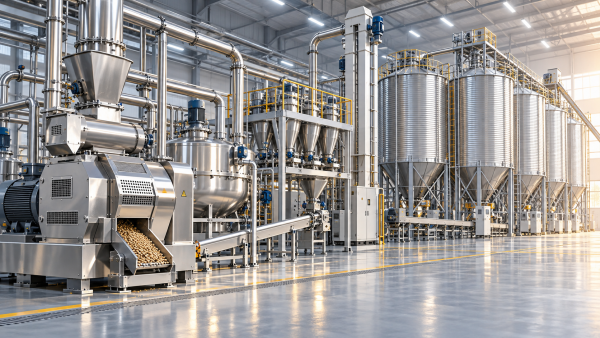
Understanding the feed production systems price trend is essential for procurement teams planning new lines, capacity upgrades, or replacement projects in volatile operating conditions.
Modern feed mill investment decisions cannot be based on equipment quotations alone, because installation scope, utility demand, automation, compliance, and lifecycle support materially affect total cost.
For buyers, the most useful question is not simply what a feed production system costs, but what production capability, operating risk, and long-term efficiency that investment delivers.
Recent market pricing reflects persistent pressure from steel, motors, controls, freight, electrical components, and specialist engineering labor across global feed and grain processing projects.
However, price movements vary substantially between simple mash-feed lines, pellet mills, aquatic feed plants, premix systems, and fully integrated automated facilities.
Procurement teams should therefore compare proposals through a common technical and commercial framework rather than relying on headline price, nominal capacity, or supplier reputation alone.
This guide explains the major cost drivers, budgeting methods, quotation risks, and evaluation criteria that help industrial buyers build more defensible investment cases.
Why Feed Production System Prices Differ So Widely
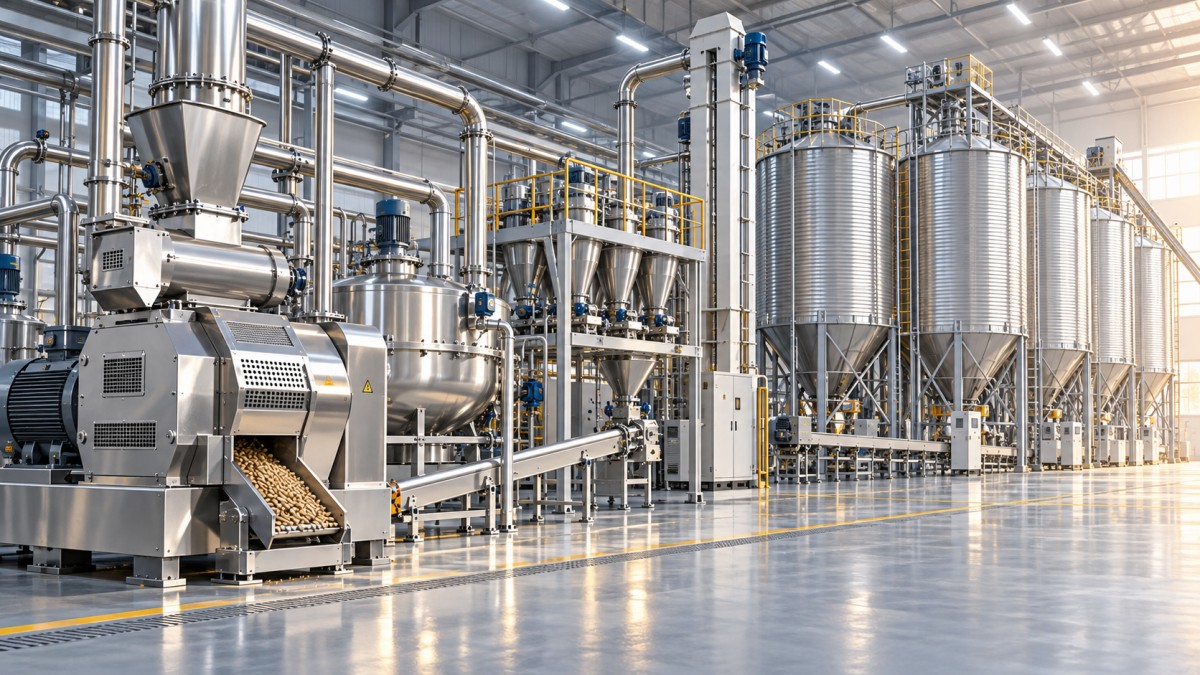
A feed production system is a connected process rather than one machine, so final pricing depends on how every handling, processing, control, and support element is specified.
At the lower end, a basic line may include receiving, grinding, batching, mixing, bagging, and limited conveying for relatively straightforward livestock feed production.
Higher-cost systems may add pelleting, conditioning, extrusion, coating, bulk loading, liquid dosing, storage silos, laboratory controls, dust collection, and central automation.
Two suppliers can quote similar hourly throughput while offering very different duty cycles, equipment metallurgy, energy performance, spare-parts packages, and site integration responsibilities.
Buyers should distinguish between rated capacity and sustained commercial output, especially when formulas contain high fiber, high fat, moisture-sensitive, or difficult-to-grind ingredients.
A line rated for ten tonnes per hour may produce considerably less when changing between poultry, ruminant, pig, pet-food, or aquaculture formulations.
The feed production systems price trend therefore reflects more than inflation; it also reflects a growing demand for consistency, traceability, sanitation, and lower operating intervention.
When reviewing budgets, procurement teams should first define the production objective, then establish which system features are genuinely necessary to meet that objective.
Capacity and Process Configuration Set the Starting Budget
Throughput is usually the largest initial cost driver because higher capacities require larger grinders, mixers, pellet presses, coolers, conveyors, storage systems, and electrical infrastructure.
Capacity should be specified as an annual output target supported by realistic operating hours, planned maintenance, product changeovers, and expected demand growth.
Using peak theoretical output to size a new line can create unnecessary capital expenditure, while undersizing equipment can produce chronic bottlenecks and costly expansion work.
Process configuration also matters because mash-feed production generally requires less thermal processing and downstream equipment than pelleted, extruded, crumbled, or coated feed.
Pellet lines require conditioning, steam systems, presses, coolers, screening, and often crumbling equipment, all of which increase both capital cost and utility requirements.
Aquafeed and pet-food installations typically command a premium because extrusion, precise moisture control, drying, vacuum coating, and recipe flexibility demand more specialized engineering.
Premix and micro-ingredient systems can appear compact, yet accurate dosing, contamination prevention, dust containment, and cleanability often raise their cost per tonne of capacity.
For budgeting, request separate pricing for base capacity, expansion-ready provisions, and optional process modules so future growth does not obscure current project economics.
Automation Is a Cost Driver, but Often a Financial Control Tool
Automation can significantly increase initial project cost, particularly when systems include recipe management, barcode traceability, PLC integration, remote diagnostics, and production reporting.
Yet the right automation level can reduce formulation errors, manual handling, inventory discrepancies, rework, and dependence on scarce experienced operators over the facility lifecycle.
Basic control systems may be suitable for smaller operations with stable formulations, limited shifts, and closely supervised manual processes.
Large commercial mills usually benefit from integrated batching and supervisory controls because recipe accuracy directly affects feed quality, animal performance, and ingredient-cost management.
Procurement teams should ask whether quoted software licenses, historian functions, cybersecurity provisions, annual support fees, and future expansion interfaces are included.
Automation proposals should also identify ownership of source code, data access rights, spare control hardware, and the supplier's response process during system failures.
A lower-priced control package can become expensive if it limits integration with enterprise resource planning, laboratory information, maintenance systems, or third-party equipment.
Rather than treating automation as an optional luxury, buyers should assess its return through labor savings, reduced losses, improved traceability, and faster production decisions.
Raw Material Handling and Storage Often Create Hidden Costs
Many budget estimates understate the cost of receiving, storage, conveying, and dispatch infrastructure, even though these systems determine the line's practical operating reliability.
Grain pits, truck unloading stations, bucket elevators, drag conveyors, silos, magnets, scalpers, sampling points, and aspiration systems can represent substantial project expenditure.
Ingredient diversity increases complexity because separate storage, dosing routes, liquid handling, and cleanout procedures may be needed to protect product quality.
High-volume mills may require bulk receiving and bulk dispatch, while regional producers may need flexible bagging, palletizing, and small-batch handling capabilities.
Buyers should map every material movement from truck arrival to finished-goods loading, including returns, rejected material, additives, packaging, and cleaning residues.
This process map exposes omitted equipment and prevents a supplier from presenting an attractive core-process price that excludes essential site functionality.
Storage capacity should reflect supply-chain risk, seasonal procurement patterns, commodity price exposure, inventory financing limits, and the physical characteristics of each ingredient.
In practice, insufficient storage can undermine the economics of an otherwise efficient mill by forcing unplanned purchasing, congestion, and excessive internal handling.
Energy Efficiency and Utilities Affect Total Cost of Ownership
Electricity, steam, compressed air, water, fuel, and ventilation requirements should be evaluated early because utility upgrades can materially change the delivered project budget.
Energy-efficient motors, variable-frequency drives, optimized grinding systems, insulated steam lines, and heat recovery options may raise capital cost but lower operating expenditure.
Grinding energy deserves particular scrutiny because raw-material hardness, screen selection, particle-size targets, and hammer wear influence both power consumption and output quality.
For pelleting projects, steam quality and boiler reliability affect pellet durability, production stability, sanitation performance, and the economic value of conditioning equipment.
Procurement teams should request guaranteed energy consumption ranges under clearly defined formulas, moisture conditions, production rates, and ambient operating assumptions.
Supplier claims should be compared on a consistent basis, such as kilowatt-hours per tonne, fuel use per tonne, and expected wear-part consumption.
It is also important to separate equipment efficiency from plant efficiency, since poorly designed conveying routes or oversized auxiliaries can erase savings elsewhere.
A credible lifecycle model should include local utility tariffs, expected annual throughput, maintenance downtime, consumables, labor requirements, and projected output mix.
Compliance, Safety, and Product Integrity Can Change the Price Structure
Feed facilities are increasingly expected to meet stricter requirements for dust control, worker safety, feed hygiene, traceability, environmental performance, and contamination prevention.
Explosion protection, fire detection, dust collection, noise control, guarding, access platforms, and electrical classification can add significant cost but should not be treated as afterthoughts.
Facilities producing medicated feed, specialty premixes, aquaculture diets, or export-oriented products may need enhanced segregation, validation, sampling, and cleaning arrangements.
Country-specific construction codes, electrical standards, emissions rules, and import requirements can also affect equipment selection, documentation scope, and installation planning.
Buyers should clarify whether the supplier's proposal covers compliance design, certification support, safety studies, commissioning documentation, and operator training.
It is risky to assume that a machine compliant in the supplier's home market will automatically satisfy requirements at the final operating location.
Clear specifications for food-contact materials, corrosion resistance, cleanout performance, and cross-contamination limits are particularly important for high-value or regulated feed products.
These requirements may increase the initial budget, but they protect market access, reduce recall exposure, and support more reliable customer and regulatory audits.
How to Compare Supplier Quotations Beyond the Headline Price
To interpret the feed production systems price trend correctly, procurement teams need quotations that are normalized to the same technical scope and commercial assumptions.
Create a comparison matrix covering capacities, product types, included equipment, civil works, electrical works, automation, commissioning, spares, warranties, and performance guarantees.
Ask suppliers to identify every exclusion explicitly, including local installation labor, foundations, cranes, cabling, utility connections, permits, and customs-related costs.
Freight and logistics require close attention because oversized equipment, shipping disruption, inland transport, insurance, and import duties can materially alter delivered costs.
Commercial terms should specify payment milestones, currency exposure, delivery dates, delay remedies, change-order rules, and warranty conditions before contract award.
Technical evaluation should include installed reference sites producing comparable formulas, not simply facilities using equipment with similar nominal capacities.
Reference checks should address uptime, operator experience, spare-parts availability, service response, output consistency, energy use, and actual maintenance requirements.
A detailed comparison often reveals that the cheapest quotation transfers more project risk to the buyer through exclusions, weak guarantees, or incomplete engineering.
A Practical Budgeting Framework for Procurement Teams
Start with a concept budget that separates process equipment, material handling, utilities, building works, controls, installation, commissioning, and contingency allowances.
Use a staged approach, moving from an order-of-magnitude estimate to a budget quotation, then to detailed technical and commercial proposals after specifications mature.
At the earliest stage, budget ranges are more useful than false precision because site conditions, product requirements, and scope responsibilities remain uncertain.
Once the process design is defined, establish a contingency that reflects project maturity, supplier location, construction complexity, regulatory uncertainty, and commodity-price exposure.
Procurement should model three scenarios: minimum viable scope, recommended scope, and expansion-ready scope, each with documented operational consequences and financial assumptions.
This structure helps management distinguish essential investment from optional features while preserving visibility into future capacity and technology decisions.
Total cost of ownership should be calculated over a realistic period, usually including depreciation, maintenance, energy, labor, quality losses, downtime, and spare-parts consumption.
Where suppliers offer performance guarantees, connect acceptance criteria to measurable throughput, product quality, energy consumption, availability, and completion of training obligations.
Making a Confident Investment Decision
The most reliable feed production system is not necessarily the lowest-priced or most automated option; it is the one aligned with product strategy and operational realities.
Buyers should prioritize a clearly defined scope, verified performance evidence, transparent lifecycle costs, and supplier accountability over simplified capacity-based comparisons.
Current feed production systems price trend movements make early specification discipline especially valuable, since late changes commonly trigger expensive redesign, procurement delays, and disputed scope.
A sound budget should show what is included, what remains uncertain, and which choices protect long-term output, quality, energy efficiency, and regulatory compliance.
For procurement teams, the strongest investment case combines commercial competitiveness with a realistic view of installation risk, operating economics, and future production flexibility.
When quotations are normalized and total cost of ownership is tested, decision-makers can select a feed line that supports dependable growth rather than creating avoidable operational constraints.
Related Intelligence
- Commercial Feed PelletFeed Production System Price Trends: Cost Drivers and Budgeting for New LinesFeed production systems price trend insights: compare cost drivers, automation, utilities, compliance, and total ownership costs to budget smarter for new feed lines.
- Commercial Feed PelletHow to Troubleshoot Common Feed Machinery BreakdownsHow to troubleshoot common feed machinery breakdowns with practical checks for blockages, pellet mills, mixers, motors, and preventive maintenance.
- Commercial Feed PelletHow Can Feed Pellet Quality Be Kept Consistent Across Batches?Learn how to ensure feed pellet quality consistency across batches with proven controls for ingredients, conditioning, milling, cooling, testing, and traceable process data.
The Morning Broadsheet
Daily chemical briefings, market shifts, and peer-reviewed summaries delivered to your terminal.
