

The Authority in Global Agricultural Chemistry & Bio-Resources
How Can Feed Pellet Quality Be Kept Consistent Across Batches?
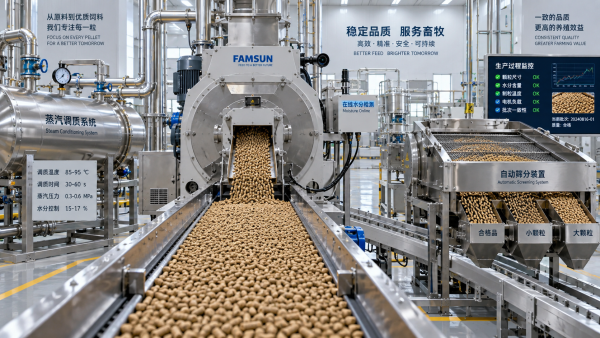
Feed pellet quality stays consistent across batches when variation is controlled before it reaches the pellet mill and when process data is interpreted as a connected system. A batch can meet a final moisture or protein target yet still differ in pellet durability, fines, density, nutrient distribution, or feed safety. Reliable output comes from defining the required pellet characteristics, holding incoming materials within workable limits, stabilizing the grinding and conditioning stages, and using timely tests to locate the source of drift.
The most useful approach is to treat every batch as a traceable process record. Ingredient lot, formulation version, particle-size distribution, mixer sequence, conditioner temperature and retention time, die configuration, pellet cooler performance, and laboratory results should be linked. Without that connection, a durability problem is often blamed on the pellet press even when it began with a change in cereal hardness, fat addition, or premix flow.
Set a practical definition of acceptable pellets
Consistency cannot be managed against a vague expectation such as “good pellet quality.” The target needs to cover the properties that matter in the intended feeding system: pellet diameter and length, proportion of fines, bulk density, hardness or durability, moisture after cooling, nutrient uniformity, and physical integrity during loading and transport. A pellet intended for pneumatic transfer faces a different handling burden from one discharged directly into short on-farm augers. Aquatic feeds add requirements for water stability and, in some applications, controlled float or sink behavior.
These properties should not be treated as interchangeable. A very hard pellet is not automatically a better pellet. Excessive compression or heat can impair heat-sensitive ingredients, increase energy demand, or create a product that animals consume less readily. Conversely, a low level of fines at the cooler does not prove that the product will remain intact after screening, bagging, truck loading, and delivery. Sampling points need to reflect the actual process and handling path.
Start with ingredient variation, not the finished pellet
Raw material variability is one of the largest hidden causes of batch-to-batch differences. Grain moisture, starch characteristics, protein level, fibre content, natural oil content, and particle hardness affect how a mash accepts steam and how it binds under pressure. A formulation may remain unchanged on paper while its pelleting behavior shifts because a new grain lot has a different milling response or a co-product carries more residual oil.
Incoming specifications should therefore include functional properties where they affect pelleting, rather than only nutrient values. A cereal or protein meal that meets a broad chemical specification can still produce a different particle-size profile, absorb water at a different rate, or alter die friction. Changes in ingredient origin, storage duration, particle condition, or bulk density deserve a controlled review before full production is released.
Microingredients require separate attention. Poor segregation, bridge formation in hoppers, static cling, and inaccurate low-rate dosing can create nutritional variation that is not visible in pellet appearance. Premixes should be added at a point where they can distribute effectively, and the mix sequence should be fixed unless it has been revalidated. Liquid additions are equally sensitive: a nozzle pattern, pressure change, or partially blocked line can create local wet spots and uneven binding.
Particle size is a distribution, not a single reading
Grinding settings strongly influence pellet strength and press behavior, but an average particle size alone can conceal a problematic distribution. A mash containing both excessive coarse fragments and a high fraction of very fine particles may report a reasonable mean while behaving inconsistently. Coarse particles weaken binding and contribute to variable pellet surfaces. Excess fines can increase energy consumption, reduce flow, and raise the risk of uneven conditioning or overcompression.
Sieve analysis should be compared by material class and formulation, not merely as a mill-wide average. The right target differs between a fibrous ration, a starch-rich formula, and a feed requiring a larger pellet diameter. What matters is repeatability within a validated range and a clear response when the distribution moves outside it. Worn screens, worn hammers, inconsistent feeder rates, and screen damage can all create gradual drift that is missed when samples are taken only after a complaint.
Make mixing uniform before steam is introduced
Pelleting cannot correct a poorly mixed mash. The press can compact material, but it cannot reliably redistribute nutrients that entered the conditioner unevenly. Mixer performance should be established with a tracer or another suitable uniformity method under real load conditions, including the normal liquid-addition rate. Testing an empty or lightly loaded mixer gives a misleading result because fill level changes the mixing pattern and discharge behavior.
Mix time is also easy to misread. A short cycle may leave local nutrient variation, while an extended cycle can promote segregation when ingredients differ substantially in particle size or density. The correct operating window includes both mixing and discharge. A mixer that produces a uniform sample internally may still separate ingredients in the surge bin, conveyor, or pellet-mill feeder.
Batch transitions need explicit controls. Formula carryover, rework additions, and residual material in conveying equipment can alter the first part of the next run. This is particularly important where medications, high-inclusion minerals, pigments, or sensitive additives are present. Defined sequencing, physical cleanout where required, and recorded flushing arrangements reduce the chance that transition material is mistaken for ordinary process variation.
Control conditioning as a moisture-and-heat balance
Conditioning determines whether the mash reaches the die with enough heat, moisture, and residence time to bind properly. Steam addition is often reduced to a temperature target, yet equal discharge temperatures can arise from different conditions. Wet saturated steam transfers moisture and energy differently from dry steam. A temperature reading taken at one point may also overlook uneven steam distribution, short retention, or a conditioner that is channeling material.
Steam quality, pressure stability, condensate removal, and injection position all affect the result. Water from condensate can create wet pockets without delivering the useful, evenly distributed heat associated with well-conditioned mash. Those pockets may lead to soft pellets, die slippage, or unstable production rates. A sudden fall in pellet durability after a steam-system change should prompt inspection of traps, separators, insulation, pressure regulation, and injection hardware before changing the formulation.
Retention time matters because starch gelatinization and moisture migration are not instantaneous. Faster production throughput can reduce effective residence time even when the conditioner speed display is unchanged. A fuller conditioner, altered paddle angle, or different mash flow behavior changes the real material path. When throughput is raised, the corresponding conditioner performance should be checked rather than assuming the original settings remain valid.
Keep the pellet mill in a known operating condition
The die and roll assembly establishes the mechanical conditions under which conditioned mash becomes a pellet. Die hole diameter, effective compression length, open area, hole condition, roll adjustment, and die speed affect throughput and product texture. A die suitable for one formula may be too restrictive for another, particularly where fibre, oil, or moisture differs. Changing dies without documenting the expected operating envelope makes later comparisons unreliable.
Wear should be tracked by performance indicators as well as visual inspection. Gradual loss of die condition may first appear as changing amperage, unstable throughput, rising fines, altered pellet length, or a need for unusual conditioning adjustments. Roll-to-die clearance also requires disciplined adjustment. Excessive clearance reduces grip; overly aggressive contact can increase heat, wear, and mechanical damage. The desired setting is the one that supports stable feed flow and pellet formation for the validated formula, not simply the tightest possible setting.
Rework is another source of avoidable variation. Fine screenings, broken pellets, and off-spec material change the physical and nutritional composition of the fresh mash. If rework is used, its permitted source, storage time, inclusion limit, and route back into production need clear controls. Wet or heat-damaged rework should not be treated as equivalent to dry fresh meal. Uncontrolled rework can create a feedback loop in which poor durability generates more fines, which then makes subsequent pellets less uniform.
Cooling, screening, and handling can undo a good pellet
Pellets leave the die warm and relatively vulnerable. Cooling must remove heat and bring moisture to the required stable condition without causing excessive surface drying or thermal shock. Uneven air distribution, restricted airflow, excessive bed depth, or inconsistent residence time can produce a batch that looks acceptable at the outlet while containing pellets with different internal moisture. Those differences become visible later as breakage, clumping, or unstable storage behavior.
Sampling immediately after pelleting gives useful process information, but it is not the final quality picture. Samples after cooling, after screening, and at loadout reveal whether damage is being created downstream. A sharp rise in fines between two points is a location-specific handling issue, not necessarily a formulation problem. Examine drop heights, chute angles, conveyor type, screen condition, transfer speed, and points where pellets impact metal surfaces.
Use testing to distinguish random noise from a real shift
Quality testing is most effective when the sampling plan is consistent. Grab samples from a single convenient point can overstate or hide variation. Incremental samples collected across a batch and combined appropriately provide a better representation, while retained individual increments help identify whether the issue occurred at startup, during steady operation, or near the end of the run.
Physical tests should be paired with process records. Pellet durability, fines, moisture, bulk density, pellet dimensions, and visual condition reveal different aspects of performance. Nutrient analysis confirms the formula has been delivered, but it is slower and may not explain a same-shift process deviation. Fast in-process measures provide an early signal; periodic laboratory verification confirms that the operating signals remain meaningful.
Trend charts are more valuable than isolated pass-or-fail results. A result still inside the accepted range may signal emerging equipment wear or raw-material change when it moves consistently in one direction. Investigation should begin with the most recently changed condition: ingredient lot, grind setting, liquid addition, steam condition, die maintenance, throughput, or cooler airflow. Altering several settings at once may restore output temporarily but removes the evidence needed to prevent recurrence.
Build repeatability into change control
Stable production does not require every batch to be identical in every measured property. It requires variation to remain within defined functional limits and to be explainable when it moves. Formula revisions, substitute ingredients, new suppliers, equipment repairs, die changes, and altered production rates should each have a recorded trial or release process. The record should state what changed, which variables were watched, and whether the expected pellet characteristics were achieved after cooling and handling.
When a deviation occurs, preserve the material and process evidence before making corrections. Retained mash and pellet samples, production timestamps, alarm history, steam readings, feeder records, and maintenance notes often identify the pattern. That discipline turns pellet quality from a final inspection problem into a controlled, repeatable manufacturing condition.
Related Intelligence
- Commercial Feed PelletHow Can Feed Pellet Quality Be Kept Consistent Across Batches?Learn how to ensure feed pellet quality consistency across batches with proven controls for ingredients, conditioning, milling, cooling, testing, and traceable process data.
- Commercial Feed PelletHow feed pellet machine wear rates vary with soybean meal inclusion and die temperatureFeed pellet machine die wear spikes with soybean meal—discover how real-time die temperature control cuts wear by up to 40%. Optimize now.
- Commercial Feed PelletHow to Build a Feed Mixing Plan That Improves Uniformity and Cuts WasteFeed mixing planning made practical: learn how to improve batch uniformity, reduce carryover, and cut feed waste with smarter sequencing, load control, and micro-ingredient handling.
The Morning Broadsheet
Daily chemical briefings, market shifts, and peer-reviewed summaries delivered to your terminal.
