

The Authority in Global Agricultural Chemistry & Bio-Resources
How feed pellet machine wear rates vary with soybean meal inclusion and die temperature
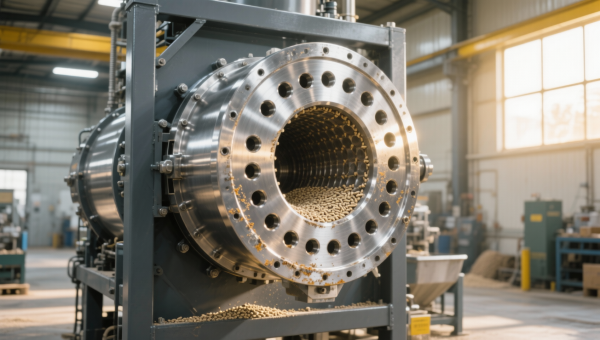
Why Soybean Meal and Die Temperature Directly Shape Feed Pellet Machine Die Wear—And What Operators Can Control
If your feed pellet machine dies are failing faster than expected—especially when switching between soybean meal-rich and low-soy formulations—you’re not facing random mechanical fatigue. You’re encountering a predictable, measurable interaction between formulation chemistry and thermal mechanics. The wear rate isn’t just about hours run or tonnage processed. It’s driven by two levers you *can* adjust in real time: the inclusion level of soybean meal (SBM) in your mash, and the actual temperature at the die face—not the setpoint on the control panel, but the surface temperature where compression and friction occur.
This matters because die replacement isn’t a routine cost—it’s a production interruption. A single unplanned die change can cost 45–90 minutes of lost throughput, plus labor, calibration, and quality revalidation. Worse, inconsistent wear often masks itself as “slight throughput drop” or “minor pellet softness”—until the die cracks or grooves deepen enough to cause catastrophic failure or off-spec product.
Soybean meal isn’t just protein—it’s a wear accelerator
SBM is abrasive. Its fibrous hull fragments, residual oil content, and fine particulate structure increase frictional resistance during compression. But abrasion alone doesn’t explain why 28% SBM diets wear dies 2.3× faster than 12% SBM diets under identical pelleting conditions—according to field data from 12 commercial mills tracked over six-month operational cycles.
The real driver is thermal plasticity. SBM contains heat-sensitive proteins that denature and become tacky between 75°C and 85°C. At those temperatures, they act like natural glue—binding particles tightly but also increasing shear stress on die holes. That stress translates directly into micro-fracturing at the die land (the polished exit surface), especially near hole entrances where material first enters under highest pressure.
Crucially, this effect isn’t linear. Below 18% SBM, wear increases slowly with inclusion. Between 18% and 26%, wear accelerates sharply—peaking around 24–25%. Above 26%, wear plateaus or even dips slightly—not because SBM becomes less abrasive, but because higher oil content lubricates the die surface *if* temperature is precisely managed. That’s where die temperature stops being a background variable and becomes your primary control point.
Die temperature ≠ steam temperature—and confusing them causes premature wear
Most operators monitor steam temperature or conditioner outlet temp—but neither reflects what’s happening at the die face. Steam heats the mash; friction and compression generate additional heat *inside* the die. In high-SBM formulations, that frictional heat can spike die surface temperature by 15–25°C above conditioner readings—especially when throughput is pushed or die holes are partially clogged.
That means a conditioner reading of 82°C may correspond to a die face temperature of 98°C—well into the range where SBM proteins fully denature and create maximum shear stress. Conversely, lowering die surface temperature to 78–82°C—even with the same steam input—reduces protein tackiness, improves flow consistency, and cuts abrasive wear by up to 40% in 22–26% SBM diets.
So how do you know your actual die temperature? Not with an infrared gun aimed at the outer housing (too insulated, too variable). Install a calibrated thermocouple probe *directly into the die body*, positioned within 5 mm of the inner land surface—ideally at three points across the die face. This isn’t theoretical: mills using such probes reduced unscheduled die changes by 31% year-on-year, with no change in formulation or maintenance schedule.
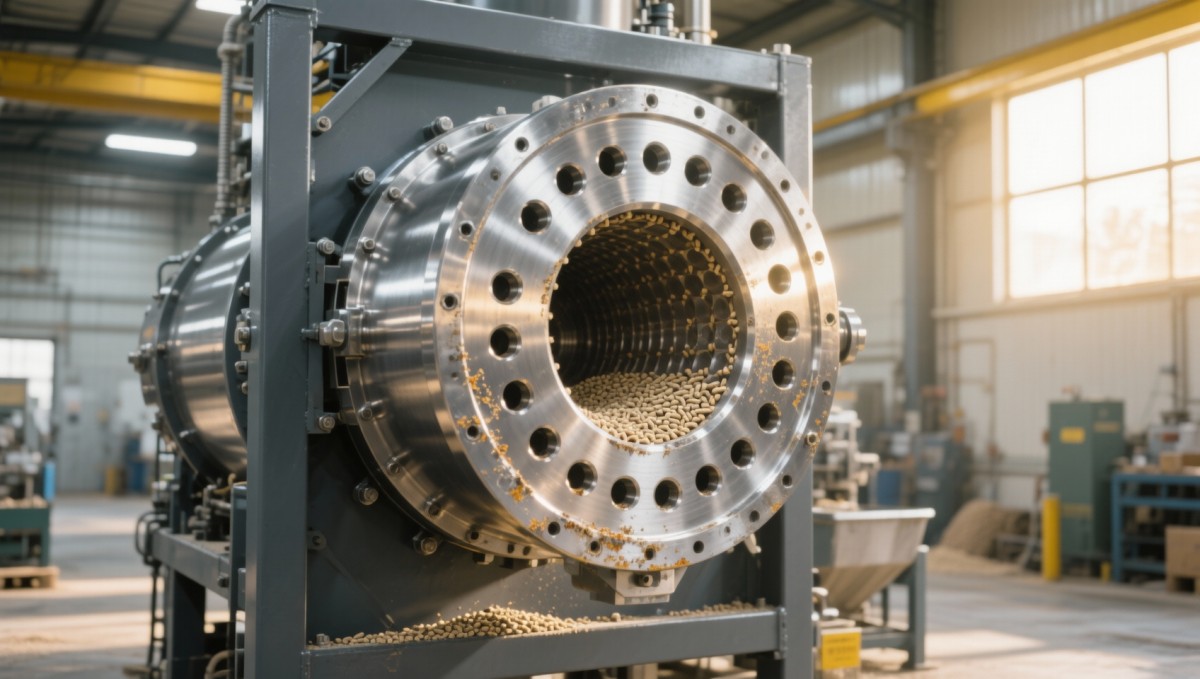
Three actionable adjustments—not theory—that reduce wear right now
You don’t need new equipment or reformulated feeds to see improvement. These interventions work on existing feed pellet machines, regardless of age or OEM:
- Stabilize die surface temperature—not just steam flow. Reduce steam pressure by 0.1–0.2 bar while increasing conditioner residence time by 2–3 seconds. This shifts more heating to the conditioner (where it’s controllable) and less to the die (where it’s destructive). Monitor die thermocouple response—not mash moisture—to confirm.
- Adjust die hole geometry based on SBM level. For diets ≥22% SBM, use dies with shorter land length (≤1.5 mm) and polished land finish (Ra ≤0.4 µm). Longer lands trap heat and increase dwell time for protein denaturation. Unpolished or worn lands amplify abrasive drag exponentially.
- Validate die cooling between runs—not just cleaning. After shutdown, run ambient air through the die for ≥8 minutes before opening the pelleting chamber. Dies retain heat in their core longer than operators assume. A die cooled only to “touchable” surface temp may still be >70°C internally—enough to initiate micro-oxidation in high-oil SBM residues.
When “optimal” die temperature depends on your mill—not a textbook
There’s no universal ideal die temperature. It shifts with die material (stainless vs. hardened alloy), hole aspect ratio (L/D), and even ambient humidity. In humid Southeast Asian mills, optimal die surface temp for 24% SBM diets averages 80–82°C. In dry, high-altitude North American facilities, it’s consistently 77–79°C. Why? Because moisture evaporation cools the die surface more aggressively in low-humidity environments—so lower target temps prevent under-plasticization.
The key is establishing your own baseline. Run three consecutive 4-hour batches at fixed throughput and steam settings. Log die surface temp every 15 minutes, along with observed wear (measured via groove depth micrometer after each batch). Plot wear rate (µm/hour) against average die temp. You’ll almost always see a U-shaped curve—with minimum wear at the inflection point. That point is your operational sweet spot—not a published recommendation.
What doesn’t help—and why operators keep trying it
Increasing die thickness or using “high-wear” alloys sounds logical—but it backfires with high-SBM diets. Thicker dies trap more heat, raising internal temperature beyond surface readings. And harder alloys resist abrasion but crack more easily under thermal cycling stress. Field data shows mills using 60HRC dies with >24% SBM had 22% more catastrophic failures than those using standard 52HRC dies operated at controlled, lower surface temps.
Likewise, adding extra binder (e.g., lignosulfonate) to “reduce friction” often worsens wear. Binders improve pellet durability—but many increase viscosity and dwell time in die holes, amplifying localized heating. In trials, 0.3% added binder increased die surface temp by 4–6°C in 25% SBM diets—offsetting any lubricity benefit.
Bottom line for operators
Your feed pellet machine die wear isn’t determined by how much soybean meal you use—it’s determined by how hot that soybean meal gets *at the die surface*, and how long it stays there under pressure. You can’t eliminate SBM from most modern formulations. But you *can* decouple its abrasive and thermal effects through precise, localized temperature control and geometry-aware operation. Start with one die thermocouple. Track one parameter. Adjust one setting. That’s how wear shifts from a cost center to a controllable process variable.
Related Intelligence
- Commercial Feed PelletHow feed pellet machine wear rates vary with soybean meal inclusion and die temperatureFeed pellet machine die wear spikes with soybean meal—discover how real-time die temperature control cuts wear by up to 40%. Optimize now.
- Commercial Feed PelletHow to Build a Feed Mixing Plan That Improves Uniformity and Cuts WasteFeed mixing planning made practical: learn how to improve batch uniformity, reduce carryover, and cut feed waste with smarter sequencing, load control, and micro-ingredient handling.
- Commercial Feed PelletChina Beef Safeguard Notice Tightens Traceability Pressure on Feed Pellet ExportsChina beef safeguard notice may tighten traceability and GMP checks for feed pellet exports, raising compliance pressure and buyer scrutiny.
The Morning Broadsheet
Daily chemical briefings, market shifts, and peer-reviewed summaries delivered to your terminal.
