

The Authority in Global Agricultural Chemistry & Bio-Resources
Feed Pellet Mill Sourcing: How to Vet Suppliers for Capacity, Quality, and Support
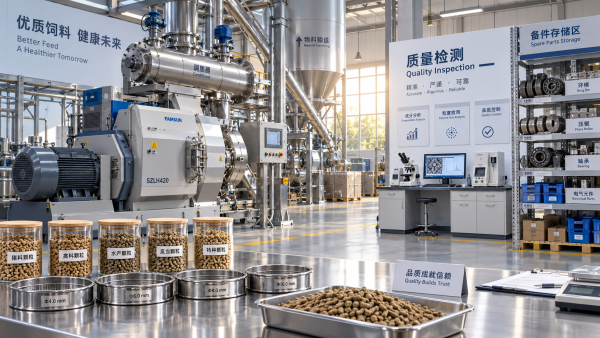
Feed Pellet Mill Sourcing: How to Vet Suppliers for Capacity, Quality, and Support
Feed pellet mill sourcing is a high-stakes decision for procurement teams balancing throughput targets, pellet quality, operating costs, and long-term service reliability.
Before comparing quotations, buyers need a disciplined framework for verifying a supplier’s manufacturing capacity, engineering standards, quality-control systems, installation expertise, and after-sales support.
The central procurement question is not which supplier offers the lowest initial price. It is which supplier can reliably deliver specified production performance throughout the equipment lifecycle.
For commercial feed producers, a poorly selected pellet mill can create expensive downtime, excessive energy use, inconsistent pellet durability, and recurring spare-parts dependency.
A capable supplier should demonstrate proven reference installations, transparent technical data, documented quality procedures, and sufficient service resources within the buyer’s operating region.
Start Feed Pellet Mill Sourcing With Supplier Verification
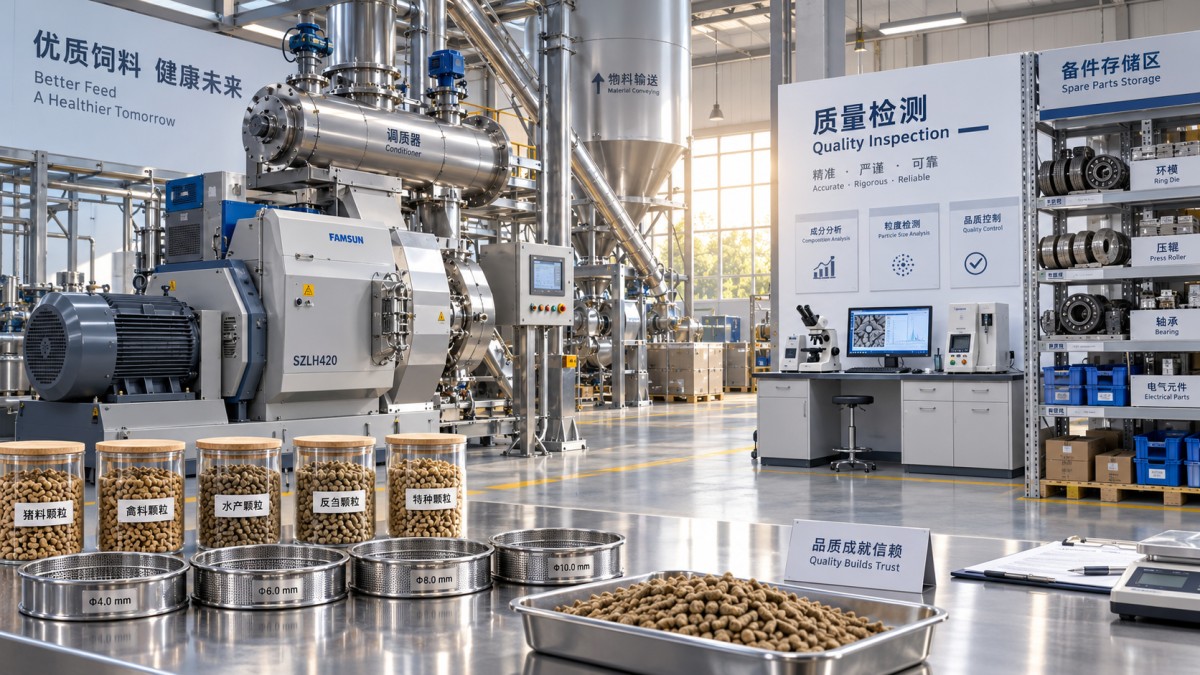
Effective feed pellet mill sourcing begins with verifying the supplier before evaluating individual machine models, production claims, or commercial discounts.
Procurement teams should establish whether the supplier is an actual manufacturer, an engineering integrator, a trading company, or a reseller representing third-party factories.
Each business model can be appropriate, but responsibilities for design, manufacturing defects, commissioning, warranty claims, and spare-parts supply must be explicit.
Ask for the legal manufacturing entity, factory address, export registration, ownership structure, and the names of facilities responsible for machining, fabrication, and assembly.
A supplier that avoids factory-level disclosure may lack direct control over component quality, delivery scheduling, technical revisions, or corrective actions after installation.
Request recent factory audit reports, certifications, organization charts, production photographs, and records showing which critical components are manufactured internally or externally sourced.
Critical items commonly include the main shaft, gearbox, die, rollers, bearings, feeder components, electrical panels, conditioning systems, and safety interlocks.
Outsourcing is not automatically a concern. However, suppliers should identify qualified subcontractors and explain how incoming materials and purchased parts are inspected.
Strong suppliers can provide traceability from steel grades and bearings through machining records, assembly checks, test-run documentation, and final inspection reports.
Buyers should also verify the supplier’s financial and operational stability. Long-term equipment support depends on a functioning business, not merely a successful sales department.
Review export history, major installed-base regions, annual production volume, available engineering personnel, and the supplier’s ability to maintain inventories of common consumables.
Reference checks are especially valuable when they involve plants with comparable formulations, climatic conditions, output volumes, automation levels, and operating schedules.
Ask references about actual throughput, pellet quality consistency, commissioning performance, response times, spare-parts lead times, and whether warranty commitments were honored.
Define Capacity Requirements Beyond Nameplate Throughput
Feed pellet mill capacity should be assessed against the buyer’s specific formula, raw-material condition, pellet diameter, moisture profile, and required production hours.
A supplier’s advertised hourly output often reflects favorable material characteristics, optimized conditioning, experienced operators, and a particular die configuration under controlled conditions.
Procurement specifications should state whether capacity means instantaneous output, average net output, guaranteed output, or annual production based on defined operating availability.
For example, a line processing poultry feed may perform differently when handling dairy rations, high-fiber formulations, aquatic feeds, or formulations containing higher oil levels.
Require suppliers to identify the exact feed formula assumptions behind their capacity statement, including ingredient particle size, moisture content, steam quality, and conditioning time.
Buyers should also account for upstream and downstream constraints. A pellet mill cannot achieve rated output if grinding, batching, cooling, screening, or packing capacity is undersized.
Review the complete process flow rather than treating the pellet mill as an isolated purchase. Production bottlenecks often occur outside the press itself.
Capacity calculations should include planned maintenance, die changes, sanitation requirements, product changeovers, shift patterns, seasonal demand, and reasonable downtime contingencies.
When sourcing for expansion, assess whether the line can accommodate future capacity increases through modular conditioners, parallel presses, additional cooling, or automation upgrades.
Suppliers should provide mass-balance calculations, utility consumption estimates, layout drawings, and clear explanations of the assumptions used to size each subsystem.
Do not accept broad statements such as “up to ten tons per hour” without a defined product basis. Unqualified capacity claims have limited contract value.
A practical approach is to specify guaranteed performance bands across several representative formulas rather than relying on a single peak-capacity production trial.
Evaluate Pellet Quality, Process Control, and Engineering Design
Throughput alone does not determine plant value. Pellet quality affects feed handling, animal intake, storage losses, transport durability, and customer confidence.
Procurement teams should define measurable pellet-quality requirements before supplier selection, including pellet durability index, fines percentage, moisture range, size consistency, and bulk density.
For aquaculture and specialty feeds, additional criteria may include water stability, density control, expansion behavior, oil coating uniformity, and contamination prevention.
The conditioning system deserves close attention because steam addition, retention time, temperature control, and mixing uniformity strongly influence pellet quality and mill performance.
Ask suppliers how they size the conditioner, select paddle arrangements, control steam pressure, manage condensate, and prevent uneven hydration of the mash.
Evaluate the pellet mill’s die design, compression ratio range, roll configuration, lubrication system, overload protection, and accessibility for routine maintenance.
Suppliers should explain how die-hole geometry will be selected for each intended feed category, rather than recommending one standard die for all formulas.
Examine material specifications for wear-intensive parts. Heat treatment, die metallurgy, roller-shell hardness, bearing quality, and gearbox design directly influence lifecycle cost.
A credible supplier will discuss limitations as well as capabilities. It should identify formulas that may require preconditioning changes, finer grinding, or lower operating rates.
Automation should support consistent production decisions. Review control-system functions for recipe management, steam control, motor-load monitoring, alarm history, and production reporting.
Clarify whether the electrical system uses internationally recognized components, whether software access is available, and who retains authority to modify control parameters.
For regulated or export-focused operations, assess food-safety design features such as cleanout access, contamination control, dust collection, metal detection, and traceable batch records.
Inspect Manufacturing Quality and Acceptance Testing
Claims about robust construction should be supported by documented manufacturing controls, inspection procedures, and test evidence specific to the proposed feed pellet mill.
During supplier evaluation, request quality manuals, incoming-material inspection standards, welding procedures, machining tolerances, calibration records, and nonconformance reporting processes.
Factory visits remain one of the strongest due-diligence tools. They reveal whether production conditions align with the supplier’s brochures, certificates, and sales presentations.
Inspect machining capability, assembly discipline, parts identification, storage conditions, testing areas, and whether critical equipment is visibly manufactured for active customer orders.
For large projects, buyers should define factory acceptance testing requirements before purchase order release. The test plan should be attached to the commercial contract.
Acceptance testing may cover no-load operation, vibration levels, motor current, gearbox temperatures, safety devices, controls, component traceability, and specified production performance.
If raw-material trials are included, both parties should agree on test formulation, moisture, conditioning settings, pellet dimensions, sampling methods, and acceptable performance limits.
Independent inspection agencies can help verify dimensions, materials, electrical compliance, packaging condition, and completion status before equipment is released for shipment.
Inspection scope should focus on risk. A standard visual inspection is insufficient when the project includes custom dies, automation integration, multiple presses, or high-value ancillary equipment.
Buyers should retain payment leverage until contractual documents, inspection records, manuals, spare-parts lists, and agreed corrective actions are complete.
Quality assurance is more effective when it is structured into the procurement process, rather than introduced only after shipment delays or commissioning failures emerge.
Compare Total Cost of Ownership, Not Equipment Price Alone
The lowest quotation can become the most expensive option if it produces excessive fines, consumes more power, requires frequent repairs, or lacks responsive technical support.
Total cost of ownership should include purchase price, freight, installation, civil works, utilities, energy consumption, labor, consumables, maintenance, and production losses during downtime.
Ask suppliers to provide a transparent list of recommended commissioning spares, two-year operating spares, wear parts, lubricants, dies, roller shells, and special tools.
Compare these costs across suppliers using equivalent quantities and specifications. Low initial equipment pricing is sometimes offset by expensive proprietary spare parts.
Energy analysis should consider motor efficiency, steam consumption, compressed-air demand, cooling requirements, and expected power use per ton for representative feed formulations.
Review the expected service life of dies and rollers, but treat supplier estimates carefully. Actual lifespan depends heavily on formula abrasiveness, operating practices, and maintenance quality.
Evaluate maintainability by asking how long routine tasks take, including die changes, roller adjustment, bearing replacement, lubrication checks, and blockage clearance.
Access doors, lifting points, service platforms, spare-part interchangeability, and diagnostic capability can materially reduce maintenance labor and unplanned shutdown duration.
Procurement should quantify the cost of one hour of lost production. This calculation often changes the relative value of stronger engineering and local service support.
Commercial comparisons should normalize currency terms, warranties, payment milestones, shipping scope, taxes, installation responsibilities, and exclusions for civil or utility work.
A detailed comparison matrix prevents suppliers from appearing comparable when their proposals actually differ substantially in scope, performance guarantees, and risk allocation.
Test Installation, Commissioning, and After-Sales Support
After-sales support is a core feed pellet mill sourcing criterion because equipment performance depends on correct installation, commissioning, operator training, and ongoing maintenance guidance.
Ask whether the supplier provides its own field engineers or depends on contractors. Confirm technician locations, language capability, travel arrangements, and regional service coverage.
Commissioning scope should specify mechanical supervision, electrical startup, control-system configuration, trial production, operator training, performance testing, and final handover documentation.
Supplier training should cover normal operation, formula transitions, steam management, die selection, lubrication, troubleshooting, safety procedures, and basic preventive maintenance tasks.
Request a response-time commitment for warranty issues and critical breakdowns. Define what remote support includes and when site attendance becomes mandatory.
Spare-parts strategy matters most during unexpected failures. Confirm warehouse locations, stock levels, order channels, shipping cutoffs, and realistic delivery times for critical components.
Suppliers should identify long-lead parts early, particularly gearboxes, shafts, dies, main bearings, variable-frequency drives, programmable controllers, and specialized sensors.
Check whether manuals, drawings, electrical schematics, and software backups are delivered in accessible formats. Missing documentation can extend even minor repair events.
Buyers should clarify warranty exclusions involving operator error, feed formulation changes, abrasive ingredients, utility instability, unauthorized modifications, and consumable wear.
A useful service agreement includes scheduled inspections, condition monitoring, operator refreshers, spare-parts forecasting, and periodic reviews of energy use and pellet-quality performance.
Support quality should be evidenced through references. Ask current users whether technical staff solve root causes or merely recommend replacement parts after problems occur.
Build a Procurement Decision Process That Holds Suppliers Accountable
A structured sourcing process converts broad supplier claims into comparable evidence, reducing the risk that purchasing decisions depend on presentation quality or price pressure alone.
Begin with an internal requirement document covering feed types, hourly output, annual volume, site constraints, utilities, quality targets, automation needs, and future expansion plans.
Issue the same technical questionnaire to shortlisted suppliers. Require detailed responses, supporting documents, exceptions, assumptions, and clear identification of excluded scope.
Score proposals using weighted criteria. Capacity guarantees, pellet quality, engineering quality, total ownership cost, service capability, and reference performance should outweigh marketing language.
Technical teams, operations leaders, maintenance personnel, quality managers, and finance representatives should participate because each group identifies different operational risks.
Conduct clarification meetings before final selection. Suppliers should explain deviations, demonstrate controls knowledge, and defend performance assumptions using evidence rather than generic assurances.
For higher-value projects, include site visits, reference calls, factory audits, and an independent engineering review before approving the preferred supplier.
The final contract should incorporate the agreed technical specification, drawings, acceptance criteria, warranty conditions, training plan, documentation requirements, and spare-parts commitments.
Commercial terms should link milestone payments to tangible deliverables, including approved drawings, factory acceptance results, shipment completion, commissioning, and final performance acceptance.
A supplier relationship should be managed after purchase order placement. Regular progress reviews help resolve design questions before they become installation delays or scope disputes.
Conclusion: Select Evidence, Not Assurances
Successful feed pellet mill sourcing depends on disciplined verification of supplier capability, not simply comparing machine specifications and quoted prices.
Procurement teams should prioritize proven capacity under defined operating conditions, measurable pellet-quality performance, documented manufacturing controls, lifecycle economics, and dependable technical support.
The most reliable supplier is one that clearly states assumptions, shares evidence, accepts measurable obligations, and remains accountable through commissioning and routine operation.
By converting requirements into contract-ready performance criteria, buyers can reduce technical uncertainty, protect production continuity, and make a stronger long-term capital investment decision.
Related Intelligence
- Commercial Feed PelletHow to Build a Sanitary Feed Production Plan That Reduces Cross-ContaminationSanitary feed production planning: reduce cross-contamination with smarter sequencing, validated flushing, material segregation, and traceable sanitation controls.
- Commercial Feed PelletFeed Pellet Mill Sourcing: How to Vet Suppliers for Capacity, Quality, and SupportFeed pellet mill sourcing made smarter: vet suppliers for proven capacity, pellet quality, lifecycle cost, factory controls, commissioning, and reliable after-sales support.
- Commercial Feed PelletFeed Production System Price Trends: Cost Drivers and Budgeting for New LinesFeed production systems price trend insights: compare cost drivers, automation, utilities, compliance, and total ownership costs to budget smarter for new feed lines.
The Morning Broadsheet
Daily chemical briefings, market shifts, and peer-reviewed summaries delivered to your terminal.
