

The Authority in Global Agricultural Chemistry & Bio-Resources
What Drives Industrial Enzyme Costs? Activity, Format, and Supply Risk Explained
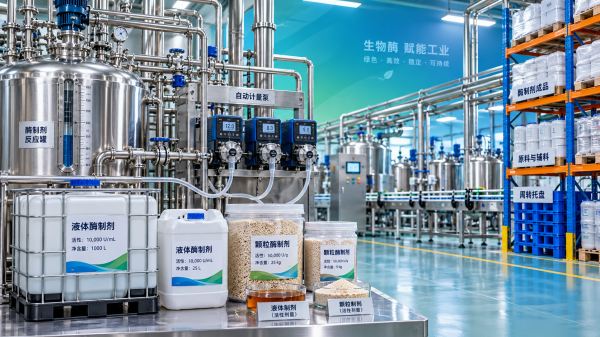
A low price per kilogram can conceal the more expensive enzyme. Industrial enzymes are purchased for the work they perform under defined process conditions: starch converted, protein hydrolyzed, viscosity reduced, fibers polished, oil released, or contaminants removed. The relevant comparison is therefore cost per usable unit of activity at the point of use, adjusted for yield, handling loss, quality requirements, and the consequences of an interrupted supply.
Two products described by the same enzyme name may differ sharply in potency, formulation, stabilizer system, recommended dose, and documentation. A drum with a lower unit price may require a larger addition rate or create more process variability. Conversely, a concentrated preparation can look expensive until its activity basis and delivered process result are normalized. Industrial enzyme cost factors should be examined as a connected set of technical and commercial variables rather than as separate line items.
Activity defines the meaningful price basis
Enzyme activity expresses the rate at which an enzyme catalyzes a specified reaction under stated test conditions. It is commonly reported in activity units per gram, milliliter, or kilogram. That number is useful only when the assay method is understood. Temperature, pH, substrate type, reaction time, dilution procedure, and the definition of one activity unit all influence the reported result.
A supplier may state that an amylase has a particular activity value, while another supplier uses a different substrate concentration or assay temperature. Dividing price by the stated activity figures in that situation creates false precision. Before comparing offers, establish whether the same unit definition, test method, and reference conditions apply. If they do not, require a side-by-side application trial or an agreed conversion based on a common performance test.
The working dose matters more than label potency alone. An enzyme with high assay activity may underperform in a process where it is poorly matched to the operating pH, residence time, substrate composition, or thermal profile. A lower-potency preparation with better stability at the actual process temperature can deliver more conversion per dollar. The appropriate measure is often the enzyme cost per tonne of treated substrate, per batch, or per unit of finished output, with the target quality result explicitly defined.
Batch-to-batch activity tolerance needs attention as well. A specification may allow a declared minimum activity while the actual release value varies within an acceptable production range. If dosing is based on a fixed volume rather than assay-adjusted activity, that variation can shift reaction outcomes. This issue is especially visible where the process has little spare residence time, a narrow quality window, or a substrate that already varies by season or source.
Ask whether each lot is released to a minimum activity, a nominal activity, or a target range. A certificate of analysis should identify the tested activity and the assay method, not merely confirm that the lot passed. For operations using automated dosing, it may be practical to adjust setpoints by lot potency, provided the control system and validation approach support that change.
Assay performance and plant performance are not interchangeable
Activity assays are controlled measurements designed for consistency. Production systems are not controlled in the same way. Feedstocks can contain inhibitors, suspended solids, salts, residual chemicals, microbial load, or natural composition changes that alter enzyme response. Shear, local mixing quality, and the time between dilution and addition can also change the effective dose.
Consider a protease used to reduce protein fouling. The quoted activity may be comparable across products, but one formulation may retain function in the cleaning solution for the full circulation period while another declines quickly after dilution. Their initial assay values reveal little about their exposure to oxidants, surfactants, water hardness, or elevated temperature. A similar distinction arises in feed processing, where enzyme survival through conditioning and pelleting can matter more than activity measured before processing.
Application testing should reproduce the narrow conditions that govern economic value. This does not require an elaborate trial for every transaction. A representative substrate, process pH, temperature profile, contact time, dose range, and acceptance measurement provide a far better comparison than a bench test designed only to show that a reaction occurs. Where a result is sensitive to mixing or order of addition, those details belong in the trial protocol.
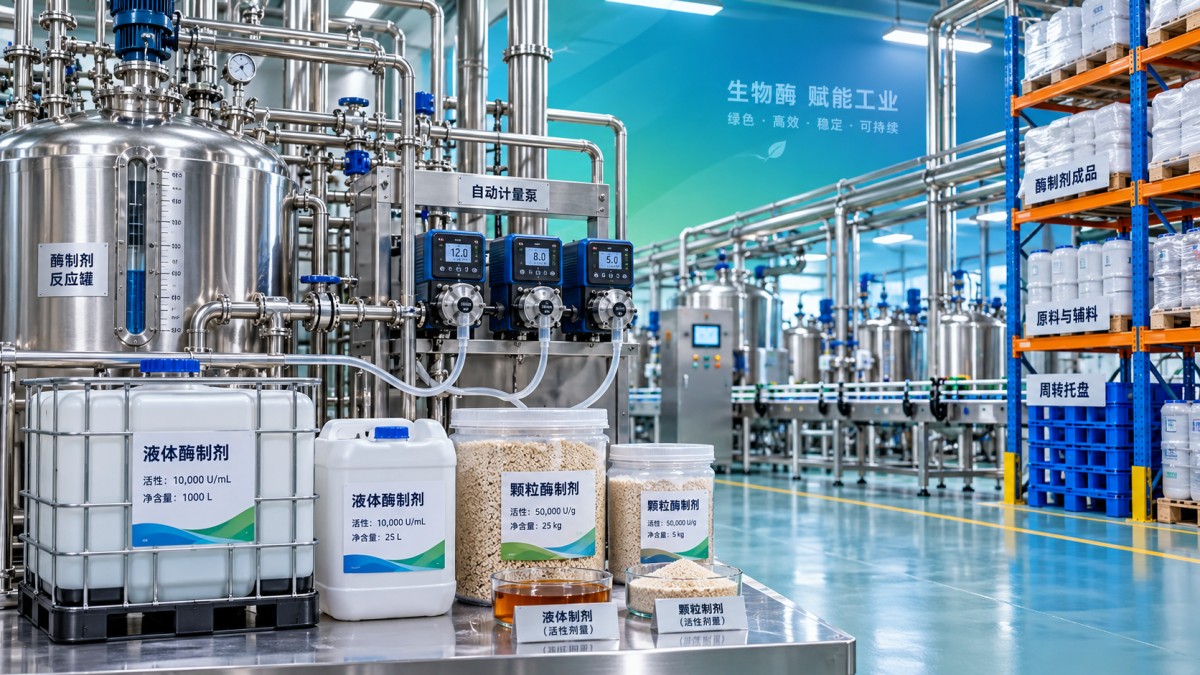
Format changes both the invoice and the operating burden
Industrial enzymes are supplied as liquids, powders, granules, coated particles, immobilized preparations, and sometimes as stabilized blends. Format influences concentration, shelf life, transport classification, dosing hardware, cleaning requirements, exposure control, and the risk of handling losses. It should not be treated as a packaging choice detached from process economics.
Liquid products are often simple to meter and disperse, particularly in wet processing. Their cost can include water, containers, freight volume, and temperature-management needs. Freezing, prolonged heat exposure, or repeated warming and cooling may reduce activity even though the seal remains intact. A liquid enzyme that arrives with acceptable activity but then sits near a heat source or is transferred through an incompatible line can create a discrepancy between incoming inspection and actual consumption.
Dry powders and granules can offer high concentration and easier storage in some settings, yet they require attention to dust control, segregation, moisture ingress, and dissolution. Coated granules may be selected to protect an enzyme through a demanding process stage, but coating material and controlled-release behavior affect both cost and response time. A product that disperses slowly may be unsuitable where immediate contact is required, even if it carries more activity per kilogram.
Immobilized enzymes usually involve a different economic model. The apparent price may be high because the enzyme is attached to a carrier designed for repeated use. Its value depends on retained activity over cycles, pressure drop, cleaning compatibility, product carryover, and the cost of replacing or regenerating the bed. Comparing an immobilized system with a single-use liquid enzyme solely by initial product price ignores equipment utilization and the possibility that one route simplifies downstream separation.
Concentration has practical limits
A highly concentrated formulation reduces storage volume and transport weight, but it may be more viscous, harder to pump accurately, or less forgiving during dilution. The cost of a new metering pump, heated line, agitation upgrade, or operator exposure control can erase a modest material saving. At the other end of the range, a dilute product may introduce enough water to disrupt solids balance or extend drying energy demand in a sensitive process.
Compatibility should be confirmed with seals, tubing, tanks, and cleaning agents. Preservatives or stabilizers included in a formulation can be harmless to the enzyme yet undesirable in a downstream application. That is particularly relevant where the final material has tight purity, sensory, residue, or microbial limits. The lowest delivered enzyme cost is not useful if it causes a separate qualification problem later in the process.
Quality documentation affects qualification effort and release risk
Documentation has a cost because gaps create additional testing, delayed release, and technical investigation. The required package varies by end use, but a useful starting point is clear product identity, activity assay, lot traceability, storage conditions, shelf-life basis, microbiological information where relevant, and a statement of formulation components or processing aids when they affect the application.
Claims should be read at the correct level. A statement about production controls is not the same as lot-specific test evidence. A general product specification is not evidence that every shipment meets a particular application requirement. When a process relies on the absence of certain allergens, animal-derived materials, residual antimicrobials, heavy metals, or unwanted side activities, those requirements should appear in an agreed specification rather than remain in an email exchange.
Side activities deserve particular scrutiny. Commercial enzyme preparations can contain related enzymatic functions from the production organism or from intentional blending. In one process, a small secondary activity is irrelevant. In another, it can change texture, molecular weight distribution, filtration behavior, or product stability. Two offers with similar primary activity may therefore have different true operating cost because one creates a harder downstream separation or lower product consistency.
Shelf life is an activity-retention question
Expiry dates alone do not establish how much active enzyme remains when the material is used. Storage instructions, transit duration, warehouse conditions, and the expected rate of consumption determine whether the purchased quantity will retain enough activity. A larger order may secure a better unit price while increasing the likelihood that later drums are consumed close to expiry or after repeated handling.
For temperature-sensitive products, define responsibility for the transport condition. The issue is not limited to refrigerated goods. Heat inside containers, exposure on loading docks, and delays at border points can matter even when ambient transport is permitted. Temperature indicators, insulated packing, route selection, and receiving inspection may be justified for products with a narrow stability margin. Their cost should be compared with the cost of testing, disposal, or emergency replacement after a questionable shipment.
Partial containers create another source of silent loss. Moisture entering a powder, contamination through a dispensing port, or repeated opening of a liquid container can shorten usable life. Smaller packs may cost more per kilogram but reduce exposure when consumption is intermittent. The right pack size follows the consumption pattern and handling method, rather than an arbitrary preference for large drums or bulk totes.
Supply risk appears as a cost when production cannot wait
Enzyme supply depends on fermentation capacity, purification equipment, formulation materials, packaging, quality release, and transport. A quoted lead time may describe normal replenishment rather than the time needed after a batch failure, a raw-material disruption, or a customs delay. A resilient source arrangement considers where activity is manufactured, where final formulation occurs, whether critical inputs have substitutes, and how long release testing takes.
Single-source supply can be rational when an enzyme has been extensively qualified or when performance is difficult to replicate. The exposure should then be visible: minimum stock coverage, batch reservation practices, notification rules for process changes, and a defined plan for expedited replacement. Holding extra inventory is not always the answer, especially for unstable products. Sometimes the more economical protection is a qualified alternative at a lower readiness level, with retained samples and an agreed protocol for rapid comparison.
Dual sourcing also has limits. Two products carrying the same broad enzyme label are not automatically interchangeable. Differences in activity basis, stabilizers, microbial profile, density, particle size, and side activities can require changes to dosing or quality controls. Qualifying a second source without defining these boundaries merely postpones the work until a disruption occurs.
Build the comparison around a common process scenario
A credible commercial comparison begins with one process scenario rather than a collection of supplier data sheets. State the substrate, throughput, operating window, dose basis, expected storage period, packaging configuration, incoming tests, and acceptance result. Then calculate material cost at the intended dose and add the costs that change between offers: freight, temperature protection, disposal of obsolete stock, quality testing, line modifications, and expected production losses from variability.
- Use the same assay reference where possible, and flag any value that cannot be directly converted.
- Separate declared activity from activity guaranteed at shipment and from activity expected at the end of internal storage.
- Record the formulation characteristics that affect pumps, dust containment, dilution, and cleaning.
- Place technical documentation requirements in the purchase specification, including lot-level evidence and change-notification expectations.
- Test substitute material against the actual failure mode that matters, such as poor conversion, filter blockage, low yield, or incomplete cleaning.
The strongest comparison is often modest in scope: a defined duty, a realistic material balance, and enough evidence to show whether activity survives the route from factory release to process addition. Once that basis is established, price differences become interpretable. Without it, a lower quote may simply shift cost into dosing, quality investigation, scrap, storage, or an avoidable interruption in production.
Related Intelligence
- Food Grade EnzymesWhat Drives Industrial Enzyme Costs? Activity, Format, and Supply Risk ExplainedIndustrial enzyme cost factors explained: compare activity, formulation, shelf life, documentation, and supply risk to reduce process costs and improve purchasing decisions.
- Food Grade EnzymesIs There a Global Standard for Biochemical Engineering Product Quality?Is there a global standard for biochemical engineering product quality? Explore GMP, ISO, traceability, and supplier checks for confident global sourcing.
- Food Grade EnzymesHow Enzymes for Cracker Formulation Improve Texture and Shelf LifeEnzymes for cracker formulation can enhance dough handling, crisp texture, and shelf life. Explore targeted enzyme strategies for consistent, high-quality crackers.
The Morning Broadsheet
Daily chemical briefings, market shifts, and peer-reviewed summaries delivered to your terminal.
