

The Authority in Global Agricultural Chemistry & Bio-Resources
How Enzymes for Cracker Formulation Improve Texture and Shelf Life
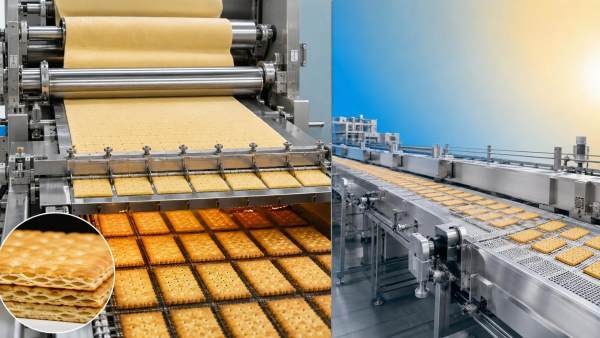
When a cracker line begins producing sheets that shrink after gauging, pieces that crack before packaging, or a bite that turns tough rather than cleanly crisp, the cause is often assigned too quickly to flour or oven settings. Those factors matter, but the dough’s enzymatic behavior can be equally decisive. Small changes in protein relaxation, starch conversion, or pentosan behavior may alter how the dough passes through laminators, how it blisters in the oven, and how the finished cracker retains its intended texture.
Enzymes for cracker formulation improve texture and shelf life when they are selected for a defined processing constraint rather than added as a general “quality improver.” In most applications, the practical objective is to create a dough that can be mixed, rested, sheeted, docked, and baked with less variability while producing a controlled snap and stable low-moisture eating quality. The correct enzyme system can reduce reliance on chemical reductants, improve sheetability, support more uniform color development, and limit some of the structural conditions that lead to breakage. It cannot, however, compensate for unsuitable flour, poor moisture control, or inadequate packaging.
Start with the defect, not the enzyme category
Cracker production places competing demands on dough. It must be cohesive enough to survive mixing and sheeting, yet relaxed enough to spread without excessive snap-back. After baking, the structure must fracture cleanly rather than feel leathery, dense, or overly fragile. Because crackers are typically low-moisture products, shelf life is closely tied to maintenance of crispness, control of rancid notes in fat-containing recipes, and protection from moisture uptake after baking.
The same visible defect can have different origins. For example, poor sheetability may result from strong flour, insufficient rest, low dough water, an aggressive mixing profile, or excessive oxidizing action. A soft initial bite may reflect incomplete bake-out, high residual moisture, a weak internal structure, or moisture migration from inclusions. Before evaluating enzymes, establish where the problem appears: during mixing, after resting, at the laminator, immediately after the oven, after cooling, or after storage.
Protease: useful when the dough is too elastic
Protease is often the most directly relevant enzyme for laminated and sheeted crackers because it modifies gluten proteins. By reducing the strength and elasticity of the gluten network, it can make the dough more extensible and easier to sheet at a consistent gauge. This is especially useful where flour strength varies between deliveries or where the production target requires a thin, well-relaxed sheet.
The operational benefit is not simply “softer dough.” Properly controlled proteolysis can reduce sheet retraction, lower edge tearing, and help dough conform more evenly through the reduction stages. A smoother sheet may improve docking consistency and contribute to a more predictable baked structure. It can also reduce the need to force relaxation through extended holding times, although any change to rest time should be validated against the full process.
Protease has a narrow practical boundary. Too little activity may leave the original handling problem unchanged; too much can produce slack, sticky dough that lacks strength at the laminator. Over-relaxed dough may spread unpredictably, create irregular piece geometry, and yield a fragile or open structure. Its response also depends on flour protein quality, pH, temperature, mixing energy, and time between mixing and baking. A dosage that works at one line speed or rest profile may be unsuitable when production is delayed.
Evaluation should therefore include dough behavior over time, not just immediate mix characteristics. Observe the dough after its normal rest period, at the final gauge roll, after cutting, and at oven entry. Finished-product assessment should include thickness variation, edge definition, fracture pattern, and breakage after cooling. A protease trial judged only by easier mixing can miss a later structural failure.
Amylase: managing starch conversion without losing control
Amylases act on starch and can generate smaller carbohydrates that influence fermentation, browning, and baked texture. In cracker systems that use yeast or fermentation, this can support a more consistent supply of fermentable sugars. Even in low- or non-fermented products, controlled starch hydrolysis may affect color development and the character of the baked matrix.
The important word is controlled. Excessive amylase activity can increase reducing sugars beyond the level needed for the process, potentially pushing color too far or creating unwanted variation across the oven band. Depending on the formula and storage conditions, excessive starch degradation may also contribute to an undesirably soft or less clean bite. Enzyme selection must account for activity profile and thermal inactivation behavior, not merely the product name on a specification sheet.
A useful trial compares color and texture by zone rather than treating the oven as a single step. Check the leading, center, and trailing portions of the bake profile. If an enzyme appears to improve color only by making the product darker, that is not necessarily an improvement. The desired result is even development at the target bake condition, with no need to over-bake one area to correct another.
Xylanase and hemicellulase: improving water distribution and sheet uniformity
Wheat flour contains non-starch polysaccharides, including arabinoxylans, that can bind water and influence dough viscosity. In some cracker formulations, xylanase or related hemicellulase activity can modify these components enough to improve water distribution and dough machinability. The result may be a smoother dough surface, more predictable sheeting, and reduced variation caused by differences in flour water absorption.
This category is most relevant when the dough appears inconsistent despite stable water addition and mixing conditions. One batch may feel tight and dry, while another shows drag at the rolls or roughness along the sheet. Such symptoms do not prove an arabinoxylan issue, but they justify comparison trials when flour analysis and process records indicate variable absorption or rheology.
As with protease, an apparent improvement in processability should not be accepted without checking the baked cracker. Too much degradation of water-binding components can alter the dough’s tolerance and affect final structure. Assess whether the sheet holds its shape through cutting, whether blistering remains controlled, and whether the fracture remains crisp rather than thin and brittle.
Oxidative enzymes require a different decision logic
Enzymes with oxidative effects, such as glucose oxidase, may be considered where dough strength or sheet integrity is inadequate. Their role is generally to support network strengthening through changes in dough redox conditions. This can be useful in specific formulations, particularly when weak flour or high levels of disruptive ingredients reduce cohesion.
For many crackers, however, excessive strengthening works against the main processing objective. A dough that becomes too elastic may retract after gauging, resist lamination, or require more mechanical force to achieve the intended thickness. The decision is therefore not whether stronger dough is inherently better. It is whether the dough has enough strength to travel through the line without losing the relaxation needed for the cracker style.
Oxidative support is best evaluated alongside, not independently from, the flour and mixing strategy. Changing flour protein quality, water level, dough temperature, or mix intensity can shift the response substantially. Where both relaxation and strength are needed, the balance may depend more on sequencing and processing time than on adding multiple enzymes at once.
Shelf life: distinguish structural support from moisture control
Enzymes can contribute indirectly to shelf-life performance by helping create a more uniform baked structure. A consistently thin, adequately baked cracker with controlled porosity is less likely to show piece-to-piece differences in initial crispness. Better dough handling may also reduce excessive breakage, which matters because broken edges expose more surface area and can make a product appear stale or damaged sooner in the supply chain.
Yet enzymes do not replace the primary controls for crispness retention. Once crackers leave the oven, moisture pickup is usually the dominant threat to texture. Cooling conditions, residual moisture, time before packing, seal integrity, package barrier properties, and moisture transfer from seasonings or fillings all need examination. In fat-rich formulations, fat quality and exposure to oxygen are also relevant to flavor stability. An enzyme may improve the starting structure, but it cannot correct a packaging system that allows moisture or oxygen ingress.
A practical way to separate these factors is to compare fresh product with product held in its intended package. If the cracker is already soft or leathery immediately after cooling, the focus should be bake-out, formula balance, and internal structure. If it is crisp at packing but deteriorates later, investigate package performance, storage exposure, and ingredient-related moisture migration before increasing enzyme dosage.
Build trials around line-relevant measurements
Enzyme trials are most informative when only one functional question is tested at a time. Introducing protease, amylase, altered water, a different flour, and a revised oven profile in the same trial may produce a better cracker, but it will not identify why the improvement occurred. Use a control formula and keep flour lot, mixing sequence, rest conditions, gauge targets, bake profile, and packaging conditions as stable as possible.
Record observations that reflect the actual decision point:
- Mixing time to target development, dough temperature, and visual homogeneity.
- Rest-time response, including whether the dough becomes easier to sheet or loses cohesion.
- Gauge-roll behavior, sheet retraction, edge tearing, sticking, and cut quality.
- Piece dimensions before and after baking, plus thickness consistency across the band.
- Color distribution, blister pattern, break strength, snap, and incidence of post-bake breakage.
- Fresh and packaged texture under defined storage conditions, evaluated alongside package integrity.
Supplier documentation should be reviewed with the same discipline. Confirm the enzyme’s declared activity basis, recommended processing range, expected pH and temperature behavior, compatibility with the formula, and handling requirements. “Food-grade enzyme” is not enough information to predict line performance. The relevant question is whether its activity profile matches the time-temperature path of the specific cracker process.
Common formulation mistakes that make enzyme results look worse than they are
One frequent mistake is treating dough water as fixed while introducing an enzyme intended to change water distribution or protein behavior. The enzyme may be judged ineffective simply because the formula has not been allowed to reach its new workable balance. Water adjustments should be small and documented, but they may be necessary to reveal the true processing response.
Another is evaluating crackers only after the oven. A formulation may produce an acceptable finished piece while creating increased drag, downtime risk, or inconsistent cutting upstream. Conversely, a dough that machines beautifully may bake into a product with poor snap. Both process and product evidence are required.
It is also risky to use enzyme dosage as the first remedy for a shelf-life complaint. Review residual moisture, cooling exposure, seasoning addition, filling water activity where applicable, and packaging performance first. Enzyme changes are justified when the product’s baked structure is contributing to instability, not when the root cause lies outside the dough.
Choosing a workable enzyme strategy
The strongest starting point is a single, defined problem statement. Select protease when excessive elasticity limits sheeting or causes retraction. Evaluate xylanase when flour-related water behavior and sheet inconsistency are the dominant concerns. Use amylase when starch conversion, fermentation support, or controlled color development needs adjustment. Consider oxidative activity only when dough strength is genuinely insufficient and the risk of increased elasticity has been addressed.
For cracker formulation, success is not measured by maximum enzyme activity or by the number of functions added to a premix. It is measured by a dough that remains stable through the line and a cracker that reaches the intended geometry, color, fracture, and packaged crispness with fewer corrective interventions.
Related Intelligence
- Food Grade EnzymesWhat Drives Industrial Enzyme Costs? Activity, Format, and Supply Risk ExplainedIndustrial enzyme cost factors explained: compare activity, formulation, shelf life, documentation, and supply risk to reduce process costs and improve purchasing decisions.
- Food Grade EnzymesIs There a Global Standard for Biochemical Engineering Product Quality?Is there a global standard for biochemical engineering product quality? Explore GMP, ISO, traceability, and supplier checks for confident global sourcing.
- Food Grade EnzymesHow Enzymes for Cracker Formulation Improve Texture and Shelf LifeEnzymes for cracker formulation can enhance dough handling, crisp texture, and shelf life. Explore targeted enzyme strategies for consistent, high-quality crackers.
The Morning Broadsheet
Daily chemical briefings, market shifts, and peer-reviewed summaries delivered to your terminal.
