

The Authority in Global Agricultural Chemistry & Bio-Resources
FDA Extends Food Enzyme Import Transition, Adds July Test Report Rule
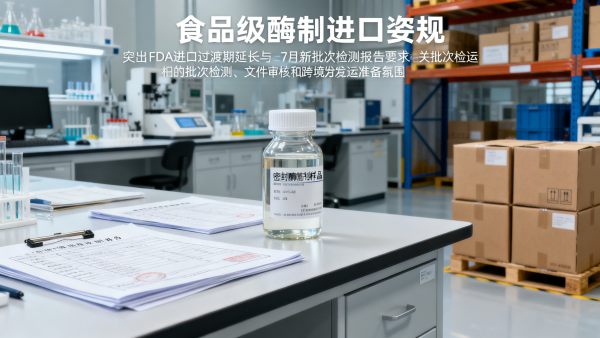
On June 28, 2026, the U.S. Food and Drug Administration released a new import compliance notice for food-grade enzymes, extending the import transition period to September 30, 2026 while also setting a stricter documentation requirement from July 1 for new batches. For exporters, importers, procurement teams, and supply chain operators involved in food enzyme trade, the update is worth close attention because it combines short-term regulatory flexibility with an immediate testing and documentation threshold that may affect shipment readiness and cross-border execution.

What the FDA Notice Confirms
According to the provided information, the FDA issued the Food Enzyme Import Compliance Notice on June 28, 2026. The notice extends the import transition period for food-grade enzyme preparations until September 30, 2026.
At the same time, the FDA stated that starting July 1, all newly imported batches must be accompanied by a quantitative enzyme activity test report issued by a laboratory accredited under ISO/IEC 17025. The stated units are KNU/g or DU/g.
The requirement applies to suppliers of enzyme preparations from major exporting countries, including China.
Where the Immediate Pressure May Appear
Export-facing suppliers may see documentation become a shipment gate
From an industry perspective, suppliers serving the U.S. market may be affected first because the new requirement is tied to new import batches. The practical pressure point is likely to be pre-shipment preparation: whether enzyme activity reports are available, whether the issuing laboratory meets the stated accreditation condition, and whether the report format aligns with the import documentation package.
Importers and procurement teams may need tighter batch-level checks
For importers and purchasing parties, the change may affect supplier onboarding, batch acceptance, and document review. What deserves closer attention is whether purchase and delivery arrangements now need to account for testing lead time and report completeness before cargo moves, especially for batches scheduled around the July 1 threshold.
Supply chain and customs-facing service providers may face timing risk
Observably, logistics coordinators and compliance service providers may be drawn into the issue because the rule links import clearance readiness with a specific laboratory document. The main area to monitor is execution timing: missing or non-compliant reports could create friction in documentation flow even though the broader transition period has been extended.
Downstream food manufacturers may need clearer supplier communication
Companies using imported food-grade enzymes may not be the direct filer, but they can still be affected through delivery schedules and supplier reliability. The relevant concern is not only whether supply continues, but whether incoming batches remain aligned with customer specifications and import-facing paperwork requirements.
What Companies Should Watch Now
Separate the extension from the new submission obligation
Analysis shows the extension to September 30 should not be read as a pause in compliance pressure. The more immediate operational issue is that a new supporting document becomes necessary from July 1 for new batches, which means the transition extension and the reporting requirement need to be managed as two different timelines.
Verify laboratory accreditation and report format early
For companies shipping to the U.S., a key practical focus is whether the testing laboratory holds ISO/IEC 17025 accreditation and whether enzyme activity is reported in the units specified in the notice, namely KNU/g or DU/g. This is a documentation issue, but it also affects shipment release planning and customer communication.
Review batch scheduling and handoff points across the chain
Businesses should pay close attention to batches that will be classified as new imports after July 1. In practice, this may require checking when testing is completed, when reports are issued, and when documents are transferred between supplier, exporter, importer, and customs-facing teams.
Keep watching for further official clarification
Because the provided information establishes the new reporting requirement and the revised transition deadline, current attention should stay on whether subsequent official language adds clarification on implementation details. For market participants, the distinction between headline policy language and how it is applied in routine import execution remains important.
Why This Looks Like More Than a Simple Deadline Change
Analysis shows this update is not just an extension notice. It also signals that batch-level technical documentation is becoming a more visible part of food enzyme import compliance. That does not by itself confirm a broader regulatory shift beyond the notice provided here, but it does indicate that companies should not interpret the extended transition period as reduced scrutiny.
It is more appropriate to understand this as a near-term operational change with possible longer-term compliance implications, while continuing to observe whether the FDA provides further detail or whether market practice adjusts around accredited testing and report submission.
How This Update Is Best Understood for Now
At this stage, the industry significance lies in the combination of limited timing relief and immediate documentary tightening. The extension to September 30 offers additional transition time, but the July test-report requirement creates a clear action point much sooner.
A neutral reading is that this is currently best understood as a short-term rule change with practical compliance consequences, rather than a fully settled long-term outcome. Companies involved in food-grade enzyme trade should therefore focus on execution readiness while keeping the policy direction under review.
Basis of This Article and What Still Needs Verification
This article is based on the user-provided news title, event date, and event summary concerning the FDA notice issued on June 28, 2026. For this type of development, commonly relevant source categories include official regulatory notices, company disclosures, industry association updates, authoritative media coverage, and standard-related documents.
A specific official source link was not provided in the input, so the exact original publication path still needs to be verified on an ongoing basis. Further attention should remain on any subsequent FDA clarification, implementation wording, and practical documentation expectations affecting new import batches.
Related Intelligence
- Food Grade EnzymesIs There a Global Standard for Biochemical Engineering Product Quality?Is there a global standard for biochemical engineering product quality? Explore GMP, ISO, traceability, and supplier checks for confident global sourcing.
- Food Grade EnzymesHow Enzymes for Cracker Formulation Improve Texture and Shelf LifeEnzymes for cracker formulation can enhance dough handling, crisp texture, and shelf life. Explore targeted enzyme strategies for consistent, high-quality crackers.
- Food Grade EnzymesWhat to Look for in Enzyme Blend Ingredients for Food and Supplement FormulasExplore enzyme blend ingredients for food and supplement formulas—learn how to assess activity, stability, compliance, and performance for smarter sourcing.
The Morning Broadsheet
Daily chemical briefings, market shifts, and peer-reviewed summaries delivered to your terminal.
