

The Authority in Global Agricultural Chemistry & Bio-Resources
FDA Adds GMP Declaration Rule for Food Grade Enzymes
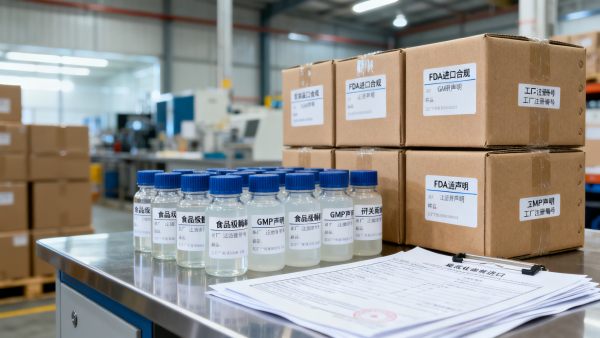
On July 15, 2026, a new U.S. import documentation requirement took effect for Food Grade Enzymes shipped to the United States. The change stems from an FDA industry notice issued shortly beforehand and centers on a manufacturer-signed GMP compliance declaration that must accompany affected products, together with the production facility registration number. This matters not only for exporters, but also for importers, procurement teams, contract manufacturers, and logistics providers, because the immediate consequence of missing paperwork is no longer a routine documentation gap but a customs handling outcome tied to high-risk classification, full inspection exposure, and possible delivery delay.
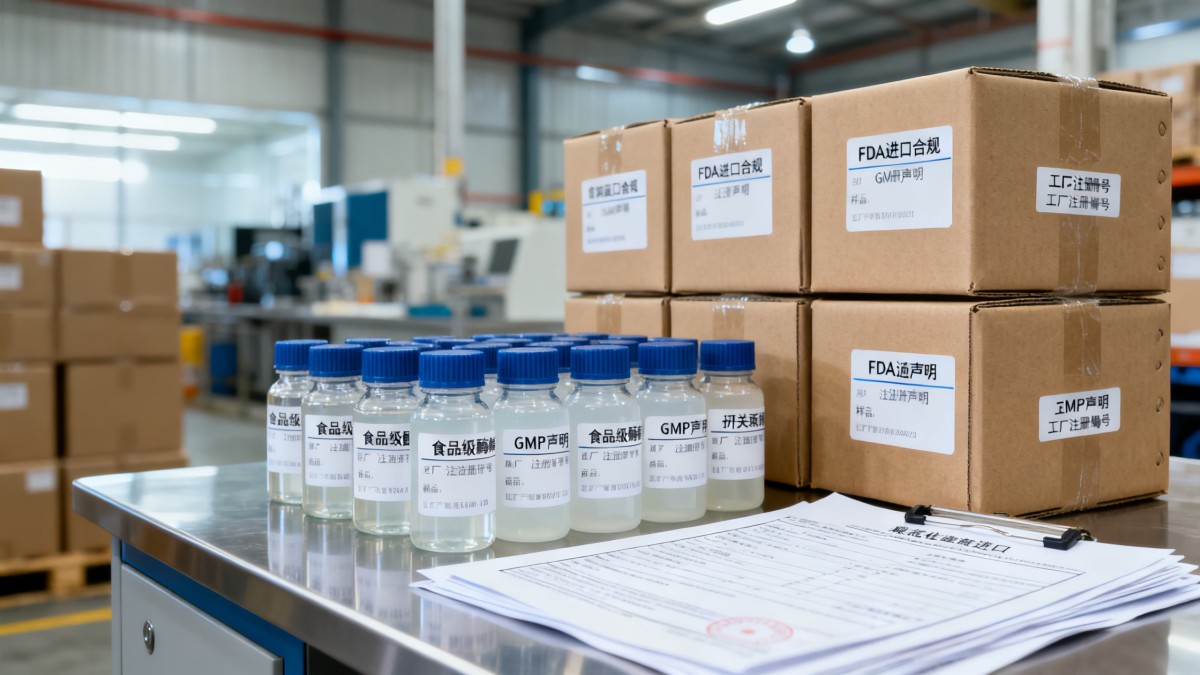
What the FDA notice formally changed
According to the information provided, the U.S. FDA issued industry notice FDA-2026-IM-071 on July 10, 2026. The notice requires all Food Grade Enzymes products exported to the United States to be accompanied, from July 15 onward, by a GMP compliance declaration signed by the manufacturer.
The declaration is required to follow the template available on the FDA website, and the production facility registration number must also be stated.
The same notice states that if the declaration is not submitted, the shipment will be automatically classified as an “undeclared high-risk product.” Under that treatment, the cargo may face 100% customs inspection and a port delay of up to 21 days.
Where the pressure is likely to appear first
For exporters, the issue shifts from product readiness to file readiness
From an industry perspective, exporters of Food Grade Enzymes are likely to be the first group directly affected because the new requirement sits at the shipment-document stage. The practical impact is not limited to preparing one additional form; it also means export files now need to include a manufacturer-signed GMP declaration and the relevant facility registration number before dispatch. What deserves closer attention is whether shipment release timing, document coordination, and pre-clearance preparation can keep pace with the short implementation window.
Importers and buyers may need tighter supplier document controls
Importers and procurement teams may be affected because the new rule changes what counts as a complete import file. Analysis shows that purchasing decisions, supplier onboarding, and shipment scheduling may now depend more heavily on whether a supplier can provide the required declaration in the expected format. For buyers, the main concern is less about interpreting the policy in theory and more about avoiding avoidable inspection exposure and delivery uncertainty tied to missing documentation.
Manufacturing sites and contract production arrangements face traceability questions
For manufacturers, including those working through contract production structures, the requirement to state the production facility registration number brings facility-level traceability into the shipment package more explicitly. Observably, this may affect internal document review, approval workflows, and coordination between the party producing the enzyme product and the party arranging export. Where manufacturing and exporting responsibilities are split, the completeness and consistency of declarations may become a specific point of operational risk.
Logistics and customs-facing service providers may see execution risk rise
Supply chain service providers, including teams handling customs preparation and shipment release coordination, may also feel the impact because the notice links missing declarations to automatic high-risk treatment. That increases the importance of pre-shipment file checks, document sequencing, and communication with customers on lead-time exposure. The immediate business effect may appear in planning, storage, and delivery commitments rather than in the product itself.
What companies should review now
Check whether declaration preparation is built into shipment workflow
Analysis shows that companies involved in U.S.-bound Food Grade Enzymes shipments should first verify whether the GMP compliance declaration is already embedded in their export documentation process. The key point is not only to have the document, but to ensure it is signed by the manufacturer and paired with the production facility registration number as required in the notice.
Review supplier qualification through a documentation lens
For procurement and sourcing teams, it is more appropriate to understand this change as a supplier-document capability issue as much as a regulatory issue. Companies may need to confirm which suppliers can issue the required declaration promptly, whether the declaration aligns with the FDA template referenced in the notice, and how document responsibility is assigned when production and export are handled by different entities.
Adjust delivery planning for inspection-related delay risk
What deserves closer attention is the stated consequence of non-submission: automatic high-risk classification, 100% inspection, and a possible delay of up to 21 days. Even without adding assumptions about broader market outcomes, this is enough to justify a review of delivery promises, inventory buffers, booking schedules, and customer communication for near-term shipments.
Continue watching for practical enforcement language
The provided information confirms the requirement and the stated consequence of failing to submit the declaration, but it does not add further execution detail. For that reason, companies should keep watching for any later official wording, operational clarifications, or market-side adoption in tender files, customer checklists, and routine trade documentation. At this stage, those follow-on points should be treated as items to monitor, not as settled outcomes.
Why this reads as an execution signal
Observably, this development is better understood as an immediate execution signal rather than a distant policy discussion. The effective date is close to the notice date, the document requirement is specific, and the consequence of omission is clearly tied to customs handling. At the same time, Analysis shows that the market still needs to watch how consistently the requirement is applied in day-to-day trade operations and whether additional explanatory language appears through official channels. In that sense, the change looks already operative in principle, while some practical interpretation may still need observation.
How to read the change at this stage
At this stage, the most reasonable reading is that the FDA notice introduces a concrete import compliance condition for Food Grade Enzymes entering the U.S. market, with immediate relevance for documentation, supplier coordination, customs handling, and delivery timing. It should not be overstated into a broader market conclusion, but it also should not be treated as a minor filing update. From an industry perspective, this is a rule change with direct operational consequences, and companies exposed to U.S.-bound enzyme shipments have reason to treat document completeness as a near-term control point.
Basis of this article and points that still need verification
This article is based on the user-provided title, event date, and event summary concerning the FDA notice on GMP compliance declarations for Food Grade Enzymes shipped to the United States. For events of this kind, relevant source types typically include official notices, regulator publications, customs or trade administration releases, industry association updates, standard-setting documents, and reporting by authoritative trade media.
A specific official source link was not provided in the input, so the exact official publication path still requires continued verification. Further observation is also needed regarding any detailed implementation wording, certification or documentation interpretation, changes in tender or procurement file requirements, market feedback, and how companies are handling execution in practice.
Related Intelligence
- Food Grade EnzymesWhat Drives Industrial Enzyme Costs? Activity, Format, and Supply Risk ExplainedIndustrial enzyme cost factors explained: compare activity, formulation, shelf life, documentation, and supply risk to reduce process costs and improve purchasing decisions.
- Food Grade EnzymesIs There a Global Standard for Biochemical Engineering Product Quality?Is there a global standard for biochemical engineering product quality? Explore GMP, ISO, traceability, and supplier checks for confident global sourcing.
- Food Grade EnzymesHow Enzymes for Cracker Formulation Improve Texture and Shelf LifeEnzymes for cracker formulation can enhance dough handling, crisp texture, and shelf life. Explore targeted enzyme strategies for consistent, high-quality crackers.
The Morning Broadsheet
Daily chemical briefings, market shifts, and peer-reviewed summaries delivered to your terminal.
