

The Authority in Global Agricultural Chemistry & Bio-Resources
Customs General Administration Adds 'Prohibition/Restriction ID' to Export Declarations

Starting 1 May 2026, the Customs General Administration of the People’s Republic of China will require exporters to declare a new 'Prohibition/Restriction Identification Code' and related 'Prohibition/Restriction Declaration Elements' on all export customs declarations. This change directly affects exporters of botanical extracts (e.g., ephedrine-related substances), natural ingredients (e.g., magnolol), and agrochemicals (e.g., paraquat derivatives), with implications for supply chain timelines—particularly for chemical components used in RAS systems, aeration & water treatment equipment, and similar technologies.
Event Overview
Effective 1 May 2026, the Customs General Administration mandates the inclusion of two new fields on export customs declarations: (1) 'Prohibition/Restriction Identification Code', and (2) 'Prohibition/Restriction Declaration Elements'. The requirement applies uniformly to all export consignments involving items subject to import/export control under Chinese regulations. No official exemption list or transitional guidance has been publicly released as of the announcement date.
Industries Affected by This Change
Direct Export Trading Enterprises: Entities that file export declarations directly—especially those handling botanical, natural, or agrochemical products—will bear primary compliance responsibility. Inaccurate or missing entries in the new fields will trigger automatic rejection of the entire declaration or escalation to physical inspection, delaying clearance.
Raw Material Sourcing Enterprises: Companies procuring controlled botanical or natural ingredients (e.g., magnolol, ephedrine alkaloids) for onward export must now verify whether their suppliers have assigned correct prohibition/restriction codes—and ensure traceability from origin to final export filing.
Manufacturers of Equipment-Integrated Chemicals: Firms producing chemicals embedded in RAS (Recirculating Aquaculture Systems), aeration, or water treatment equipment face indirect but material impact: customs delays at the component level may disrupt just-in-time assembly schedules and contractual delivery commitments.
Supply Chain Service Providers: Customs brokers, freight forwarders, and third-party compliance consultants must update internal checklists, training modules, and data validation rules to accommodate the new fields—especially where clients lack in-house regulatory expertise.
What Relevant Enterprises or Practitioners Should Focus On — And How to Respond
Monitor official updates and classification guidance
Analysis shows that the term 'Prohibition/Restriction Identification Code' is not yet defined in publicly available technical specifications. Enterprises should track subsequent announcements from the Customs General Administration—including potential release of a reference code table or sector-specific implementation notices.
Map current export SKUs against known controlled categories
Observably, the notice explicitly cites botanical extracts (e.g., ephedrine-related), natural ingredients (e.g., magnolol), and agrochemicals (e.g., paraquat derivatives). Companies should audit active export lines against these categories—noting that derivative forms or mixtures may also fall under scope even if not named verbatim.
Distinguish between policy signal and operational readiness
From an industry perspective, this requirement signals tighter integration of export control logic into routine customs processing—not merely a procedural add-on. However, actual enforcement thresholds (e.g., tolerance for minor coding discrepancies, phased rollout by HS code) remain unconfirmed and warrant verification prior to full-system deployment.
Prepare documentation and internal workflows ahead of 1 May 2026
Current best practice involves updating supplier questionnaires to collect prohibition/restriction classification data, revising internal declaration templates to include both new fields, and conducting dry-run submissions using representative SKUs to identify system or data gaps before go-live.
Editorial Perspective / Industry Observation
This measure is better understood as a structural tightening of export compliance infrastructure rather than a one-off regulatory adjustment. Analysis shows it reflects a broader trend toward embedding control logic earlier in trade documentation flows—aligning customs data with national dual-use and environmental regulation frameworks. Observably, it does not introduce new prohibitions per se, but significantly raises the cost of non-compliance for affected exports. From an industry angle, its operational weight will depend less on the novelty of the rule and more on how consistently and granularly the identification codes are applied across commodity classifications and regional customs offices. Continued monitoring is warranted—not only for clarifying documents, but also for any linkage to upcoming revisions of China’s Catalogue of Dual-Use Items and Technologies or the List of Controlled Chemicals.
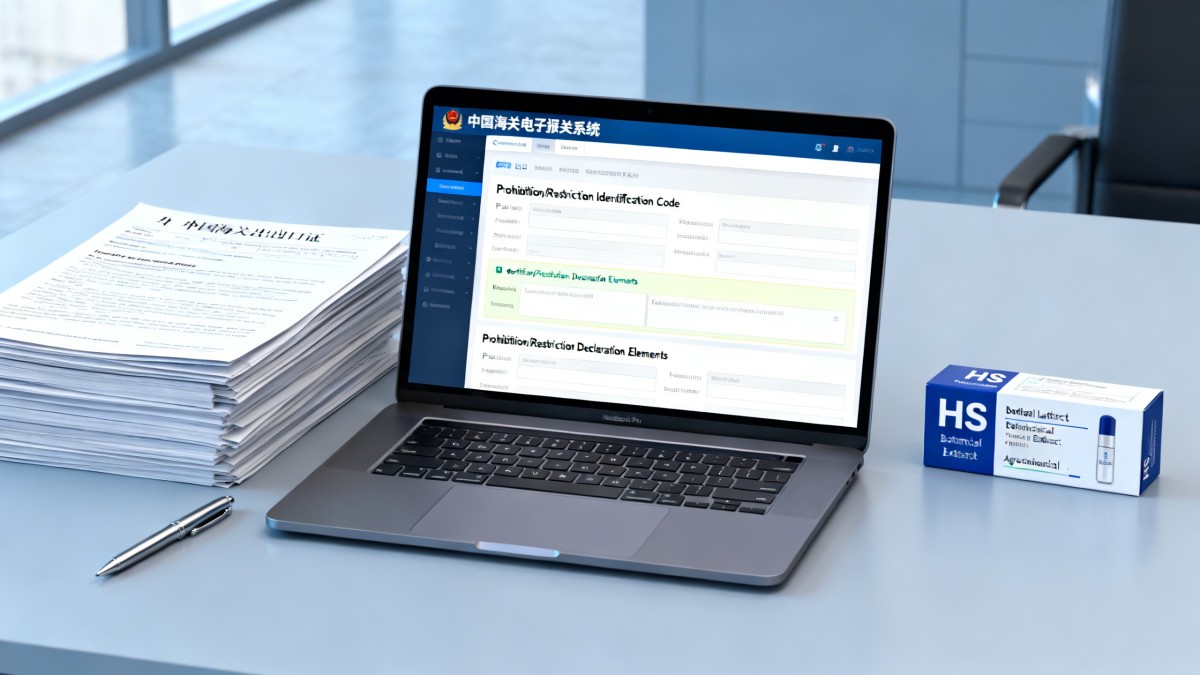
Conclusion: This requirement formalizes a new layer of export declaration accountability for specific natural and synthetic chemical categories. It does not alter underlying control status, but increases procedural rigor and cross-functional coordination demands across sourcing, manufacturing, and logistics functions. Currently, it is more accurately interpreted as an enforcement enabler than a substantive policy shift—making advance alignment with classification standards and documentation discipline the most pragmatic response.
Source Information:
Primary source: Announcement issued by the Customs General Administration of the People’s Republic of China, effective 1 May 2026.
Note: The exact format, assignment methodology, and authoritative code list for 'Prohibition/Restriction Identification Code' remain pending official publication and are therefore subject to ongoing observation.
Related Intelligence
- Botanical ExtractsChoosing Botanical Extracts for Pharmaceuticals: Potency, Purity, and ComplianceBotanical extracts for pharmaceuticals: learn how to assess potency, purity, traceability, and GMP compliance for confident, regulatory-ready supplier selection.
- Botanical ExtractsBotanical Extracts Market Outlook: Supply, Pricing, and Buyer RisksBotanical extracts market insights on supply, pricing, quality control, and buyer risks—compare suppliers confidently and protect your sourcing strategy.
- Botanical ExtractsEurope Botanical Extracts Market: Key Growth Drivers, Risks, and OpportunitiesEurope botanical extracts market insights: explore growth drivers, regulatory risks, supply-chain challenges, and scalable opportunities for compliant, high-value ingredients.
The Morning Broadsheet
Daily chemical briefings, market shifts, and peer-reviewed summaries delivered to your terminal.
