

The Authority in Global Agricultural Chemistry & Bio-Resources
Selecting Pure Oxygen Systems for High-Density Aquaculture and RAS Operations
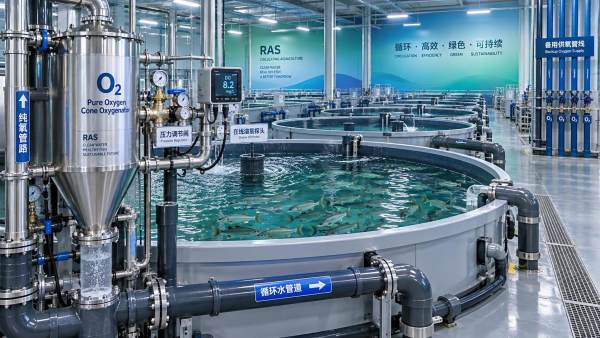
At high stocking density, oxygen is not simply another utility. It is the variable that determines whether feeding plans, growth targets, and biofilter capacity can be used with confidence—or must be held back to protect fish welfare. For technical evaluators comparing pure oxygen systems aquaculture facilities can deploy, the central question is not “Which device adds the most oxygen?” It is whether the selected system can maintain a stable dissolved oxygen (DO) margin through peak biomass, warm-water periods, feeding events, partial equipment failures, and changing water chemistry.
This distinction matters especially in recirculating aquaculture systems (RAS), hatcheries, smolt facilities, and intensive raceways. A system that performs well during a short acceptance test may still struggle when hydraulic loading rises, oxygen demand peaks after feeding, or the incoming water contains elevated carbon dioxide and nitrogen. Sound selection therefore begins with the farm’s oxygen balance and risk profile, then works outward toward oxygen source, transfer equipment, controls, distribution piping, and emergency backup.
Begin with the oxygen demand profile, not the equipment catalogue
Many procurement exercises start with a preferred technology: oxygen cone, low-head oxygenator, microbubble diffuser, or direct injection skid. That sequence can lead to an expensive mismatch. The more reliable approach is to map where oxygen is consumed, when demand peaks, and how much operating reserve is required.
Fish respiration is the obvious oxygen load, but it is not the only one. Biofiltration, solids handling, ozone contact systems where used, and other biological processes can contribute meaningful demand. Oxygen consumption also changes with fish size, biomass, temperature, species, activity, feeding intensity, and stress events. A plant operating close to its average oxygen requirement can appear efficient while leaving little room for the conditions that cause real production losses.
Technical teams should ask suppliers to size against a documented design envelope rather than a single nominal flow rate. The envelope should identify:
- maximum standing biomass by production zone;
- anticipated peak feed load and post-feeding respiration;
- seasonal source-water temperature and salinity conditions;
- required minimum DO at the tank outlet or fish exposure point;
- oxygen demand from process equipment beyond the fish tanks;
- planned expansion phases and their effect on headers, vessels, and controls; and
- the oxygen capacity that remains available after the loss of one critical component.
The best design target is not necessarily the highest possible DO concentration. Excessive supersaturation can create avoidable gas-management concerns, while an apparently acceptable average DO can conceal low-oxygen zones in tanks or return channels. The operational goal is stable, well-distributed oxygen availability at the fish, with enough reserve to manage disturbances without abrupt manual intervention.
Choose the oxygen source and transfer method as one system
Pure oxygen may be supplied as liquid oxygen from bulk storage, compressed gas cylinders or packs, or on-site generation. Each option affects the rest of the system. Bulk liquid oxygen often suits high and sustained demand, provided site access, tank storage, vaporization capacity, delivery reliability, and safety separation distances are addressed. Cylinder supply can be practical for smaller installations, commissioning, or emergency backup, though handling demands and changing logistics become more significant as consumption rises. On-site generation can reduce dependence on deliveries in some locations, but evaluators need to examine purity, flow capacity, power demand, maintenance requirements, and resilience during outages.
Once the source is defined, transfer technology determines how effectively oxygen enters the water and how controllable the process will be. Four categories frequently appear in RAS evaluations.
No technology is universally superior. Oxygen cones can deliver strong gas transfer in a controlled sidestream, but their suitability rests on the available pressure, pump duty, maintenance access, and how the oxygenated water is reintroduced. Low-head oxygenators may offer a compelling hydraulic profile in certain layouts, particularly where large recirculating flows make every meter of head consequential. Diffusers are simple in concept, yet their location and bubble pattern can influence tank hydraulics, fish behavior, and gas stripping. Direct injection may save footprint but deserves close scrutiny where mixed gas and water flows create operational instability.
Transfer efficiency is useful—but utilization is the procurement metric
Supplier literature often emphasizes oxygen transfer efficiency. It is an important measure, but it should not be viewed in isolation. A technically meaningful comparison also considers oxygen utilization: how much supplied oxygen is actually retained in the process water under real operating conditions. Lost oxygen is not just a cost issue; it can indicate insufficient contact time, unfavorable pressure conditions, poor mixing, or a mismatch between the device and the hydraulic circuit.
Evaluators should request a clear statement of test conditions behind any performance curve. Water temperature, salinity, initial DO, inlet gas purity, system pressure, flow rate, and backpressure all influence results. A curve generated with clean freshwater at a fixed operating point should not be treated as a direct forecast for warm, saline, solids-bearing RAS water operating across variable flows.
It is also worth separating oxygen addition from overall gas management. In intensive systems, carbon dioxide accumulation can limit fish performance even when DO appears satisfactory. Nitrogen and total dissolved gas conditions may also require attention, especially when pressurized oxygenation and changes in hydraulic pressure are involved. A well-selected pure oxygen system should fit within the facility’s complete gas balance, including degassing, aeration, ventilation, and monitoring points.
Hydraulics and placement decide what the fish actually experience
An oxygenation skid may perform exactly as specified while the production tanks still develop local DO variation. This usually points to distribution rather than generation. The location of injection, the route of the oxygenated sidestream, mixing energy, tank geometry, and return-water patterns all influence the oxygen profile around the fish.
For central oxygenation, confirm that the distribution header can maintain pressure and flow at the most remote use point. Pipe sizing should account for present demand, future expansion, condensate management where relevant, isolation valves, and the ability to service one branch without starving another. For decentralized equipment, assess whether each tank or module receives appropriate control and whether a local failure can be detected quickly.
Water-side hydraulics deserve the same attention. A sidestream flow that is too low may limit transfer capacity; one that is too high can waste pumping energy or disrupt the intended treatment process. In tank applications, oxygenated water should enter where it supports circulation rather than creating a narrow high-DO plume near the inlet and lower levels elsewhere. Dye tests, computational fluid dynamics where justified, and multi-point DO logging can reveal weaknesses that a single probe will miss.
Controls should protect biology, not merely automate valves
In high-density production, manual oxygen adjustment is rarely adequate as the primary control method. Demand can shift faster than an operator can recognize it, particularly during feeding, grading, handling, or a circulation upset. A practical control architecture combines continuous DO measurement with proportional oxygen dosing and well-defined alarm logic.
Probe quality and placement are central. A DO sensor located immediately downstream of an injection point can report an attractive value while fish at the far side of the tank experience a lower concentration. Install sensors at biologically meaningful locations, and where risk is high, use multiple measurement points or cross-checks. Calibration routines, membrane or optical-sensor maintenance, cleaning schedules, and response-time verification should be included in the operating plan rather than treated as afterthoughts.
Controls should also distinguish between normal modulation and emergency action. Typical functions may include a standard DO setpoint, a low-DO alarm threshold, automatic opening of a backup oxygen path, pump-failure interlocks, low supply-pressure alarms, and remote notification. The philosophy should be explicit: what happens if the primary controller fails, a sensor drifts, a tank pump trips, or site power is lost? A system that fails closed or relies on one unverified signal may introduce more risk than its polished interface suggests.
Redundancy needs to be designed around credible failures
“Redundant” is frequently used in specifications, but the term has little value until the failure scenario is defined. A second oxygenator does not provide real resilience if both units depend on the same pump, electrical panel, supply regulator, or control signal. Likewise, a backup oxygen manifold is ineffective if it cannot reach the affected tanks at the required flow.
For critical production areas, evaluate redundancy across the entire chain: oxygen inventory, vaporization or generation, pressure regulation, distribution, water circulation, transfer device, controls, and standby power. The appropriate level depends on species sensitivity, biomass concentration, staff coverage, and emergency response capability. A hatchery with vulnerable early life stages may require a different risk threshold from a grow-out system with lower density and greater water exchange.
Emergency oxygen must be more than a line item on a P&ID. Conduct practical drills. Measure how quickly backup supply is available, identify which valves must be operated, verify that alarms reach responsible personnel, and confirm that operators can act safely under pressure. In a genuine low-DO event, clarity and speed matter more than theoretical capacity.
Safety, materials, and maintainability belong in the selection decision
Oxygen itself is not flammable, but oxygen-enriched environments increase combustion intensity. Equipment selection should therefore include oxygen-compatible materials, clean installation practices, suitable regulators and fittings, clear labeling, controlled access, and procedures for leak checks and isolation. Greases, contaminants, and unsuitable components can create serious hazards in oxygen service. Local codes, insurer requirements, and applicable environmental or occupational safety standards should be reviewed early, especially for bulk storage and enclosed process rooms.
On the water side, materials must tolerate the operating environment. Salinity, ozone residuals where applicable, disinfectants, temperature, and abrasive solids can affect seals, plastics, metals, and diffuser components. Ask not only what materials are used, but which parts are consumable, how they are accessed, what cleaning methods are permitted, and whether service can occur without shutting down a production block.
Maintainability is often the quiet differentiator between comparable systems. A highly efficient unit that requires difficult cleaning, specialized spares, or prolonged isolation may be less valuable than a slightly less compact design with predictable service access and locally supportable components.
A practical comparison framework for technical evaluators
Before selecting among pure oxygen systems for aquaculture, convert proposals into a common decision sheet. Compare each option using the same water quality targets, peak load assumptions, utility costs, and contingency criteria. Require vendors to identify exclusions: degassing equipment, pumps, automation panels, instruments, commissioning support, pipework, backup supply, or civil works are often treated differently from one proposal to another.
Useful questions during technical clarification include:
- What oxygen addition rate is guaranteed at the stated water temperature, salinity, flow, and pressure?
- What is the expected operating range, and how does performance change at part load?
- What pumping head, electrical demand, and gas pressure are required at the duty point?
- How are carbon dioxide, nitrogen, and total gas pressure managed downstream?
- Which components represent single points of failure?
- What instrumentation is included, where should it be installed, and how is it validated?
- What maintenance activities are expected during a production cycle?
- Can the configuration accommodate the next planned biomass increase without replacing core infrastructure?
The final choice should feel less like buying an oxygen device and more like validating a life-support system for the farm. A well-matched solution delivers controlled oxygen where fish need it, works efficiently within the available hydraulics, communicates clearly with the automation layer, and remains dependable when operations become least forgiving. For RAS and high-density facilities, that disciplined evaluation is what turns oxygen capacity into dependable production capacity.
Related Intelligence
- RAS SystemsAquaculture Filter Installation Costs: Plumbing, Labor, and CommissioningUnderstand aquaculture filter installation cost, from plumbing and labor to commissioning. Compare complete project scopes, uncover hidden expenses, and budget confidently before you buy.
- RAS SystemsSustainable Aquaculture Practices That Cut Feed Waste and Protect Fish Farm Water QualitySustainable aquaculture for fish farms: reduce feed waste, protect water quality, and build resilient, efficient systems with practical strategies.
- RAS SystemsDrum Filter System Price: How Flow Rate, Micron Rating, and Automation Affect CostDrum filter system price depends on flow rate, micron rating, automation, materials, and lifecycle costs. Compare quotes confidently and choose the right system.
The Morning Broadsheet
Daily chemical briefings, market shifts, and peer-reviewed summaries delivered to your terminal.
