

The Authority in Global Agricultural Chemistry & Bio-Resources
RAS Technology Explained: How Biofiltration and Oxygen Control Work Together
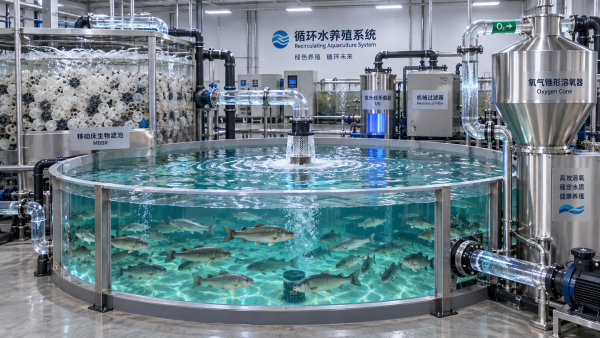
RAS Technology Explained: How Biofiltration and Oxygen Control Work Together
RAS technology is often described as a way to grow fish with less water. That is true, but incomplete. A recirculating aquaculture system is really a controlled water-treatment plant built around a living crop. Fish produce waste continuously, feed introduces nutrients and fine solids, and the system must keep water conditions inside a narrow operating window every hour of the day.
Two functions sit at the center of that job: biofiltration and oxygen control. Biofilters convert toxic nitrogen waste into less immediately harmful forms. Oxygen systems maintain the dissolved oxygen needed by fish, nitrifying bacteria, and—in practical terms—the farm’s feeding and biomass plan. Neither function can be evaluated in isolation. A biofilter may look correctly sized on a process drawing yet underperform if oxygen is poorly distributed, solids bypass the mechanical filtration stage, alkalinity declines, or water temperature shifts outside the bacteria’s effective range.
For operators assessing commercial aquaculture projects, this relationship deserves more attention than tank volume or headline production capacity. Those figures are easy to present. Stable water chemistry under realistic feeding pressure is harder to design, commission, and maintain.
A Recirculating System Is a Chain, Not a Collection of Equipment
In a typical RAS layout, water leaves the culture tank carrying feces, uneaten feed, dissolved ammonia, carbon dioxide, and suspended particles. Mechanical filtration removes much of the settleable and fine solid load. Water then passes through biological treatment, degassing, oxygenation, disinfection or polishing equipment where applicable, and returns to the fish tanks. The exact sequence varies by species, salinity, production stage, and engineering philosophy, but the operating logic is consistent: keep solids from accumulating, control dissolved waste, replace consumed oxygen, and prevent a localized failure from becoming a farm-wide event.
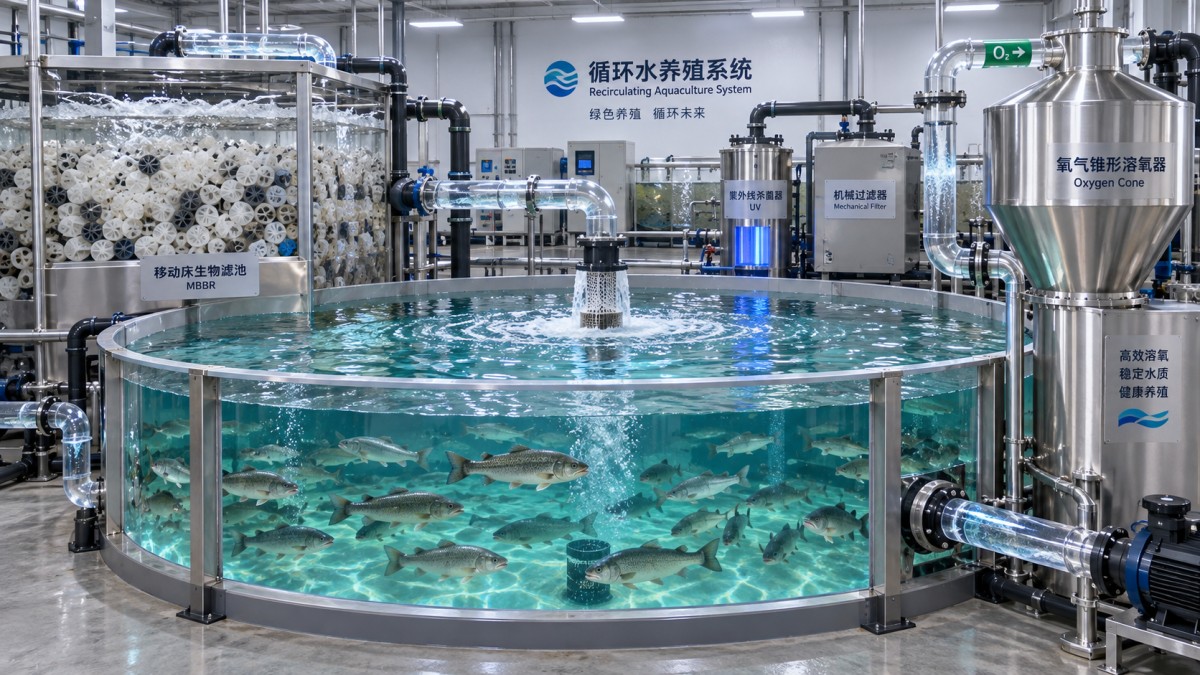
The common mistake is to treat each component as a standalone specification. In reality, a drum filter, moving-bed biofilm reactor, oxygen cone, pump, and sensor package form one process loop. Increasing feed rate changes ammonia production. More ammonia increases biological oxygen demand. Higher oxygen demand can expose insufficient transfer capacity or poor mixing. Lower dissolved oxygen then affects fish appetite and nitrification at the same time. By the time an operator sees a water-quality alarm, the root cause may be several pieces of equipment upstream.
This is why serious RAS technology reviews start with a mass-balance mindset: expected biomass, feeding curve, feed composition, water exchange rate, temperature, salinity, oxygen source, and waste-handling route. The design question is not simply “How large is the biofilter?” It is “What load reaches it, under what peak condition, and what happens when that condition changes?”
What Biofiltration Actually Does
Fish excrete nitrogenous waste, primarily as ammonia. In water, ammonia exists as ionized ammonium and un-ionized ammonia. The un-ionized fraction is generally the more toxic form and is influenced by factors including pH and temperature. That distinction matters because a stable total ammonia reading can carry a different welfare risk when the water chemistry changes.
A biofilter relies on microbial communities attached to media or other surfaces. In the nitrification process, one group of microorganisms oxidizes ammonia to nitrite; another converts nitrite to nitrate. Nitrite is also a concern for fish health, so the system cannot be considered safe merely because ammonia begins to fall. Nitrate is less acutely toxic in many culture situations, but it still accumulates in recirculating water and must be managed through water exchange, denitrification, plant integration in certain designs, or other treatment strategies appropriate to the facility.
Nitrification is not a passive filter action. The microorganisms need oxygen, suitable water chemistry, surface area, circulation, and time to establish. They are also sensitive to operational disruption. A newly installed biological filter does not immediately have its design capacity. It must mature under controlled loading, and a sudden increase in biomass or feed can outrun that biological capacity even when the tank and pump sizes appear adequate.
The chemistry has practical consequences. Nitrification consumes oxygen and alkalinity and contributes to acidification pressure in the system. If alkalinity is allowed to decline, pH may become less stable and biological performance can weaken. Operators therefore monitor more than ammonia. A useful routine looks at total ammonia nitrogen, nitrite, nitrate, pH, alkalinity, temperature, dissolved oxygen, carbon dioxide, and solids trends together. A single number rarely tells the full story.
Biofilter media choice should follow the treatment objective, not fashion. Moving-bed systems are widely used because continuous media movement can maintain exposed surface and reduce clogging risk. Fixed-bed and trickling configurations can be effective in the right process arrangement. The critical issue is whether the media receives adequately pretreated water, sufficient oxygen, and reliable hydraulic flow. A biological stage repeatedly burdened with sludge is being asked to work as both a solids trap and a nitrification unit; that is usually an expensive compromise.
Why Oxygen Control Cannot Be Separated From Biofiltration
Fish need dissolved oxygen for respiration, but they are not the only oxygen consumers in an RAS. Biofilter microorganisms consume it. Organic matter decomposing in tanks, pipes, sumps, and filters consumes it. At high stocking density, oxygen demand can rise rapidly after feeding, during warm-water periods, or when fish are stressed and ventilation or mixing is poor.
This creates a design tension. Oxygen added at the wrong point may satisfy a sensor near the injection location while leaving another part of the loop under-supplied. A biofilter located downstream of heavily loaded culture tanks can encounter a lower oxygen concentration than the fish-tank reading suggests. Conversely, concentrating oxygen only around biological treatment does not guarantee adequate oxygen availability in every rearing tank.
Good oxygen control is therefore about distribution, transfer efficiency, and contingency capacity—not merely about owning an oxygen generator or installing diffusers. Depending on scale and site conditions, farms may use liquid oxygen, pressure swing adsorption systems, low-head oxygenation units, oxygen cones, packed columns, or tank-side diffusers. Each option has trade-offs in energy use, operating pressure, maintenance, capital cost, redundancy, and response speed.
Pure oxygen systems can provide considerable transfer capability, but they demand careful process control. Overconfidence in the oxygen supply itself can distract from circulation failures, blocked diffusers, incorrect flow distribution, or rising carbon dioxide. Water can show acceptable dissolved oxygen while fish still perform poorly if carbon dioxide removal is inadequate. Gas management is a paired discipline: adding oxygen and stripping carbon dioxide should be considered together.
The operating relationship in simple terms
When feeding increases, ammonia production generally rises. The biofilter needs more oxygen to oxidize that ammonia. Fish also need more oxygen as metabolic activity and feed intake increase. If oxygen transfer and water circulation do not keep pace, nitrification can slow at precisely the moment the nitrogen load is climbing. Ammonia and nitrite may then accumulate after the oxygen event, making the problem look like a biofilter failure rather than the integrated process failure it actually is.
That lag is operationally important. Water-quality data should be interpreted as a trend, not only as a pass/fail reading. A facility may still be within its internal limits but heading in the wrong direction: falling dissolved oxygen overnight, declining alkalinity, rising nitrite after a feed increase, or growing pressure differential across a solids filter. Experienced teams react to those trajectories before fish behavior makes the issue obvious.
Where Well-Designed Systems Commonly Lose Stability
The most damaging RAS problems are often mundane rather than exotic. A sensor drifts because it was not cleaned or calibrated. A backup oxygen system exists but is not tested under load. A feeding program changes faster than the biological system can adapt. Fine solids pass through mechanical treatment and create oxygen demand where it was not expected. A pump maintenance shutdown alters circulation through a biofilter. None of these issues are unusual, and none can be solved by a single premium component.
Instrumentation deserves particular scrutiny. Dissolved oxygen probes, pH sensors, temperature sensors, flow meters, oxidation-reduction potential instruments where used, and alarm systems are only as useful as their maintenance regime. One probe can be a useful operating reference; it is not always enough protection for a high-biomass facility. Critical locations commonly need sensor redundancy, independent verification methods, and alarm thresholds that trigger a practiced response rather than a vague notification.
Power resilience is equally central. Recirculating aquaculture removes dependence on a large natural water body, but it replaces that buffer with dependence on pumps, blowers, controls, and oxygen infrastructure. Emergency power, reserve oxygen arrangements, isolation capability, and written response procedures should be reviewed as part of process design. They are not optional accessories to be considered after production tanks are stocked.
How to Evaluate a RAS Technology Proposal
When comparing RAS technology suppliers or internal engineering concepts, buyers should ask for the assumptions behind the process design. A credible proposal can explain its planned biomass and feeding basis, anticipated nitrogen load, biofilter approach, oxygen-transfer strategy, solids-management sequence, water-exchange assumptions, and fail-safe provisions. A capacity claim without those linked assumptions is difficult to assess.
It is also sensible to separate equipment performance from farm performance. A pump may have a documented duty point, a filter may have stated hydraulic limits, and an oxygenation device may have a defined operating envelope. The farm outcome depends on how these elements behave together under real temperature variation, feed loading, maintenance periods, and operator response. Technical documentation, commissioning protocols, spare-parts planning, and training should carry almost as much weight as the equipment list.
- Ask where dissolved oxygen is measured, where oxygen is injected, and how mixing is verified.
- Confirm how the biofilter is protected from excess solids and how biological start-up is managed.
- Review the response plan for pump failure, power loss, oxygen-supply interruption, and abnormal ammonia or nitrite readings.
- Check whether the proposed control system records trends rather than only displaying live values.
- Clarify which water-quality targets are species- and life-stage-specific, rather than assuming one setpoint fits the entire farm.
For projects subject to environmental permits, food-safety requirements, animal-health rules, discharge limits, or local building and utility standards, technical design must be reviewed against the applicable jurisdiction. There is no single universal compliance template for every RAS facility. The relevant requirements depend on location, species, water source, discharge route, processing scope, and the legal status of the operation.
The Practical Standard: Predictable Water, Not Impressive Hardware
The most useful way to judge a recirculating aquaculture system is not by how many treatment components it contains. It is by whether operators can predict water quality across normal production changes and respond safely when conditions depart from plan. Biofiltration provides the biological conversion that keeps nitrogen waste from becoming an acute threat. Oxygen control supports both fish metabolism and the biological engine doing that conversion. Solids removal, degassing, alkalinity management, reliable hydraulics, and monitoring make the relationship workable.
For the aquaculture and fishery technology audience followed by AgriChem Chronicle, that integration is where procurement and operational diligence meet. The right question is rarely whether a supplier offers a biofilter or oxygen system. It is whether the complete process has been sized, documented, monitored, and stress-tested around the farm’s actual production plan. In RAS, biological stability is not purchased once. It is designed into the system and then earned through daily operation.
Related Intelligence
- RAS SystemsHow to Vet Middle East Oxygenation System Suppliers for RAS ProjectsOxygenation system suppliers Middle East: learn how to vet RAS partners for proven performance, resilience, local service, and lifecycle value.
- RAS SystemsRAS System Cost Model: What Investors Should Budget Beyond Initial EquipmentRAS system cost model guide for investors: budget beyond equipment for energy, compliance, working capital, resilience, and sustainable returns.
- RAS SystemsRAS Technology Explained: How Biofiltration and Oxygen Control Work TogetherRAS technology explained: discover how biofiltration and oxygen control work together to maintain stable water quality, protect fish health, and improve aquaculture performance.
The Morning Broadsheet
Daily chemical briefings, market shifts, and peer-reviewed summaries delivered to your terminal.
