

The Authority in Global Agricultural Chemistry & Bio-Resources
Wholesale squid jigs can vary a lot in catch performance

Wholesale squid jigs can differ dramatically in catch performance, and for distributors, agents, and resellers, that difference is not a technical footnote. It directly affects customer satisfaction, reorder rates, returns, and margin stability across commercial fishing channels.
The core search intent behind “wholesale squid jigs” is not simply to find a bulk supplier. It is to understand why apparently similar products perform very differently in actual fishing use, and how to choose stock that wins repeat business.
For channel buyers, the most important questions are practical. Which design factors truly affect catch rates? How can poor-performing jigs be identified before committing to volume orders? Which supplier claims matter, and which are mostly marketing language?
This article focuses on those decisions. Rather than offering generic tackle descriptions, it examines the specific product variables, testing methods, sourcing criteria, and portfolio strategies that help trade buyers select wholesale squid jigs with dependable field performance.
Why catch performance varies so much in wholesale squid jigs
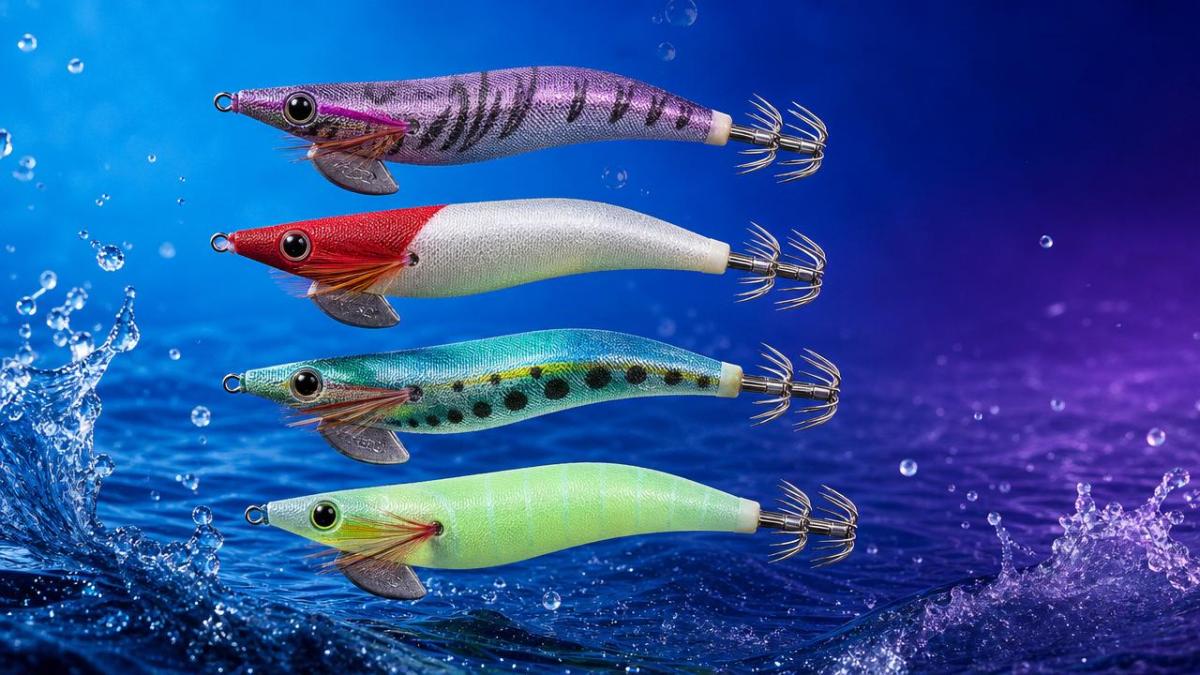
Many wholesale squid jigs look similar in catalog photos, but real-world performance can vary sharply because squid respond to light, movement, sink behavior, profile, and hook reliability under changing water conditions.
For distributors, this means two products with similar size, price, and packaging may generate completely different feedback from commercial fishermen, charter operators, or regional tackle retailers after only a few trips.
The main reason is that squid jigs are performance-sensitive products. Small differences in center of gravity, cloth wrapping tension, crown alignment, coating consistency, or body symmetry can alter how the lure falls and tracks.
In bulk procurement, these details are often overlooked when decisions are made primarily on ex-factory cost. Yet in the field, they are exactly the factors that determine whether a jig gets recommended, ignored, or returned.
What distributors and resellers should evaluate before placing volume orders
For trade buyers, the first priority is not finding the cheapest squid jig. It is finding the lowest-risk product line that can produce stable sell-through and positive user feedback across different customer segments.
That requires evaluating five core areas: hook quality, luminous performance, balance and sink rate, outer material durability, and production consistency between batches. These factors collectively shape catch performance and after-sales risk.
If one of these variables is weak, the product may still sell initially on price. However, repeat orders usually decline once end users experience missed hookups, poor glow retention, tearing cloth, or erratic underwater action.
Wholesale squid jigs should therefore be assessed as working tools, not decorative SKUs. A strong product is one that performs predictably across common fishing environments and can maintain quality at commercial order volumes.
How hook sharpness and crown design influence landing rates
Hook performance is one of the most visible differences between low-grade and reliable wholesale squid jigs. Squid often strike tentacles-first, so crown design has a direct effect on hold strength and landing consistency.
Trade buyers should inspect needle sharpness, barb uniformity where applicable, wire stiffness, corrosion resistance, and alignment of the crown ring. Even slight irregularities can reduce hook-up efficiency or increase dropped catches.
Double-crown and multi-angle crown structures may improve holding ability in some applications, but only if spacing is precise. Poorly assembled crowns can snag excessively, deform during transport, or create unstable lure posture.
A useful supplier evaluation method is to request close-up production images, material specifications, and sample pull-stress results. Physical sample inspection remains essential because hook quality is difficult to judge from sales sheets alone.
Luminous coating quality matters more than many buyers expect
Glow performance is not just a visual feature. In low-light, deeper, or turbid conditions, luminous quality can determine whether a squid jig gets noticed at all, especially during night operations or early morning commercial runs.
Not all glow coatings perform equally. Differences appear in charge speed, brightness level, glow duration, surface uniformity, and resistance to cracking after repeated exposure to saltwater, friction, and temperature changes.
Cheap coatings may look acceptable on arrival but fade quickly in use. This creates a common trade problem: products move through distribution smoothly, yet complaints emerge later when anglers compare them against proven brands.
Distributors sourcing wholesale squid jigs should request information on coating materials, application method, and consistency controls. Side-by-side sample charging tests under identical light conditions can reveal quality gaps very quickly.
Balance, sink rate, and underwater action are often the real performance separators
Among experienced buyers, balance and sink behavior are often the clearest predictors of catch performance. A squid jig that sinks at the wrong angle or rotates unnaturally can underperform even if its finish looks premium.
Well-balanced jigs maintain a consistent posture during descent and respond cleanly to jerk-and-fall retrieves. This action helps present the lure naturally, which is especially important when squid are selective or pressure is high.
Sink rate also needs to match target fishing styles. Faster-sinking models may suit deeper water, stronger current, or faster-paced commercial use. Slower-falling models may work better in shallower areas or cautious feeding conditions.
For resellers, the key lesson is segmentation. One product does not fit every regional fishery. Stronger product portfolios often include several sink profiles and body weights instead of relying on a single general-purpose SKU.
Durability affects margins, reputation, and reorder behavior
Durability issues often become visible only after product reaches the market. Cloth peeling, seam separation, paint chipping, eyelet loosening, and crown corrosion all reduce perceived value and trigger complaints.
For distributors and agents, this is more than a quality issue. It is a commercial issue. Products with weak durability increase return handling costs, damage customer trust, and reduce the chance of long-term account retention.
Durability should be assessed at both material and assembly level. Look at fabric adhesion, body hardness, resistance to deformation, anti-rust treatment, and whether the finishing process remains stable across production runs.
When evaluating wholesale squid jigs, it is wise to expose samples to basic saltwater immersion, abrasion, and packing compression tests. These simple checks often reveal weaknesses that are hidden during first-look inspection.
How to compare suppliers beyond catalog claims
Many suppliers describe their squid jigs as premium, high-catch, or export quality. These labels are not useless, but they are not enough for procurement decisions, especially when serving demanding fishing trade accounts.
The stronger approach is to compare suppliers using evidence. Ask for batch consistency controls, quality checkpoints, defect rate records, coating specifications, hook material details, and packaging protection standards for shipment.
It is also important to evaluate communication discipline. Reliable manufacturers answer technical questions clearly, provide samples that match later production, and can explain how they control weight, balance, and finish tolerance.
For agents and distributors, factory transparency often predicts long-term reliability better than headline price. A supplier that can document process control usually creates fewer surprises than one that competes only on quotations.
Field testing is the fastest way to reduce procurement risk
Sample testing with actual users is one of the most effective ways to assess wholesale squid jigs before scaling volume. It converts supplier promises into actionable buying evidence.
Distributors can send comparative samples to trusted charter operators, commercial squid crews, or experienced regional retailers. Testing should compare hook-up rate, glow retention, sink behavior, body durability, and ease of use.
The best test program is structured rather than casual. Use the same fishing window where possible, record conditions, compare multiple SKUs, and gather feedback in a consistent format that highlights performance and defect frequency.
Even small pilot testing can protect capital. A modest sample program is far less expensive than committing to a container or large seasonal order that later underperforms in the market.
Building a more competitive product portfolio with wholesale squid jigs
Distributors do not need every squid jig to be the absolute highest-end model. They need a product mix that aligns with customer segments, price expectations, and local fishing conditions while protecting commercial credibility.
A practical portfolio often includes entry-level value models, proven mid-range workhorse jigs, and premium options for professional users or specialist retailers. This structure supports broader market coverage without diluting standards.
However, low-cost models should still meet minimum performance thresholds. If a budget line fails too obviously in catch performance, it can damage the perceived quality of the entire brand or distribution offering.
For this reason, channel buyers should define clear acceptance standards for each tier. These may include minimum glow duration, acceptable sink tolerance, corrosion resistance, crown alignment, and packaging integrity.
Warning signs that a low-price offer may create downstream problems
Not every low-priced offer is poor, but extreme price gaps usually deserve caution. In squid jigs, lower cost is often achieved by reducing coating quality, loosening weight tolerance, using weaker hooks, or shortening finishing steps.
Other warning signs include inconsistent sample appearance, vague technical answers, reluctance to send duplicate samples, no explanation of anti-rust treatment, and absence of standard export packing details.
Buyers should also watch for products that are visually impressive but technically weak. Heavy decorative finishing can distract from poor balance, uneven crowns, or short-lived luminous treatment that limits real fishing value.
In wholesale squid jigs, procurement mistakes are often not obvious at purchase stage. They appear later through slower repeat orders, mixed retailer feedback, and pressure to discount remaining inventory.
Conclusion: performance knowledge is a sourcing advantage
Wholesale squid jigs can vary a lot in catch performance, and that variation has direct commercial consequences for distributors, agents, and resellers. Similar appearance does not mean similar field results.
The most effective buyers focus on the variables that genuinely influence catch success: hook design, luminous coating quality, balance, sink rate, durability, and batch consistency. These factors matter more than broad marketing claims.
By combining supplier verification, structured sample review, and limited field testing, channel partners can reduce sourcing risk and build a more dependable product range for commercial and retail fishing customers.
In a market where repeat business depends on results, understanding squid jig performance is not just technical knowledge. It is a practical advantage that supports stronger margins, better buyer trust, and more resilient wholesale growth.
Related Intelligence
- Commercial FishingWhat Should You Check in a Fishery Equipment Maintenance Contract?What should I look for in a fishery equipment maintenance contract? Explore coverage, response times, costs, records, safety, and biosecurity essentials.
- Commercial FishingDo commercial fishing vessels with hybrid diesel-electric propulsion reduce fuel cost per kg landed by more than 12%?Commercial fishing vessels with hybrid diesel-electric propulsion *can* cut fuel cost per kg landed by >12%—but only under precise operational and infrastructure conditions. Discover the real ROI.
- Commercial FishingHow to Choose Oyster Processing Equipment for Capacity, Hygiene, and Labor EfficiencyOyster processing equipment guide: compare capacity, hygienic design, and labor efficiency to build a reliable, scalable line and make smarter buying decisions.
The Morning Broadsheet
Daily chemical briefings, market shifts, and peer-reviewed summaries delivered to your terminal.
