

The Authority in Global Agricultural Chemistry & Bio-Resources
How to Choose Fishing Boat Accessories in Bulk for Commercial Fleets

Selecting fishing boat accessories bulk for commercial fleets is not just a pricing exercise—it is a decision that affects vessel uptime, crew safety, compliance, and long-term operating costs. For procurement teams managing large-scale fishery operations, the right sourcing strategy must balance durability, supplier reliability, technical compatibility, and regulatory requirements to ensure every outfitted vessel performs efficiently in demanding marine environments.
For most buyers, the core search intent behind fishing boat accessories bulk is practical procurement guidance. They are not looking for a generic list of marine parts. They want to know how to compare suppliers, standardize specifications, reduce replacement frequency, and avoid costly mismatches across multiple vessels.
That means the most useful article is one that helps procurement teams make better decisions. It should explain how to evaluate accessory categories, verify product quality, manage compliance risk, estimate lifecycle cost, and build a repeatable sourcing framework for fleet-scale purchasing.
What Procurement Teams Actually Need When Buying Fishing Boat Accessories in Bulk
Commercial fleet buyers usually care about four things first: operational reliability, total delivered cost, compatibility with existing vessels, and supplier consistency. Unit price matters, but it rarely outweighs downtime, warranty disputes, or failed inspections.
In bulk purchasing, a wrong decision is multiplied across the fleet. If deck hardware corrodes early, lighting systems fail in rough weather, or storage components do not fit installed layouts, the issue becomes a maintenance and scheduling problem, not just a purchasing error.
That is why fishing boat accessories bulk procurement should start with vessel use profiles. A coastal day-fishing fleet has different accessory demands from long-range trawlers, aquaculture support boats, or refrigerated commercial vessels operating in highly corrosive offshore conditions.
Procurement teams should map purchases against actual operating conditions. Salt exposure, load cycles, crew handling patterns, washdown intensity, and maintenance intervals all influence which accessory specifications are appropriate for the fleet.
Which Fishing Boat Accessories Deserve the Most Attention in Bulk Orders
Not every accessory category carries the same operational risk. Buyers should prioritize items that affect safety, deck workflow, storage efficiency, electrical reliability, and basic vessel durability. These categories typically generate the highest consequences if quality is poor.
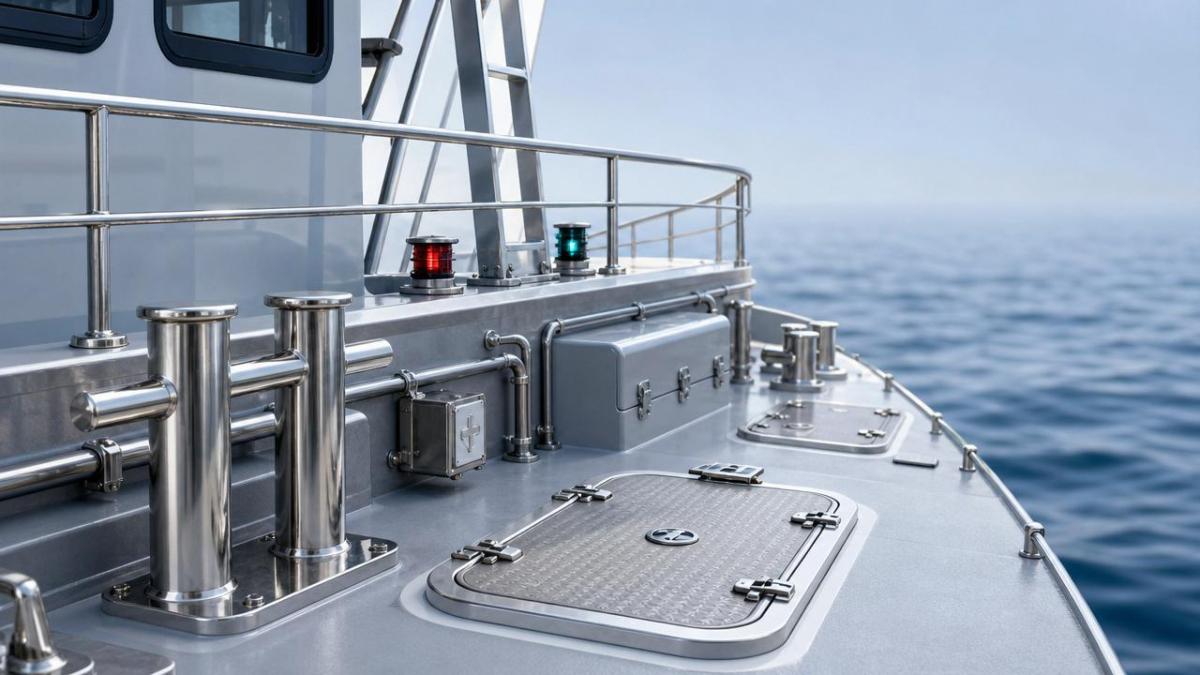
High-priority accessory groups often include deck fittings, cleats, rails, rod holders, hatches, hinges, latches, lighting systems, control panels, seating hardware, navigation mounting points, pumps, hoses, and storage assemblies.
For fleets involved in catch handling, fish boxes, insulated compartments, non-slip deck accessories, washdown equipment, and drainage-related components should receive special scrutiny. These items directly affect hygiene, labor efficiency, and onboard handling speed.
Bulk buyers should also pay close attention to smaller consumable or semi-durable items. Fasteners, seals, brackets, clips, and mounting hardware may appear low value, but failure in these components can compromise larger systems and increase maintenance frequency.
How to Evaluate Quality Beyond Product Photos and Basic Catalog Claims
One of the biggest mistakes in fishing boat accessories bulk sourcing is relying on appearance-based comparisons. Two products may look similar in a catalog while differing significantly in alloy quality, UV resistance, sealing performance, or fatigue durability.
Procurement teams should request technical documentation, not just brochures. Material grades, coating processes, salt-spray testing data, ingress protection ratings, load capacities, dimensional tolerances, and fastening specifications are all relevant to real-world decision-making.
For metal components, corrosion resistance is critical. Marine-grade stainless steel, anodized aluminum, and high-performance composite materials should be verified by specification. Generic “stainless” claims are often insufficient for commercial saltwater applications.
For polymer and rubber accessories, buyers should ask about UV stability, brittleness under temperature fluctuation, chemical resistance, and expected service life. Accessories exposed to constant sun, spray, and cleaning agents must be selected for those exact conditions.
Sample testing remains one of the most effective controls. Before issuing a large order, buyers should physically inspect representative samples, test fit on target vessels, and involve maintenance or operations teams in validating usability and installation requirements.
Supplier Assessment: What Separates a Reliable Bulk Partner from a Trading Intermediary
Choosing the right supplier matters as much as choosing the right product. In commercial fleets, buyers need partners who can maintain specification consistency over time, support documentation requests, and fulfill repeat orders without quality drift.
Start by clarifying whether the seller is a manufacturer, authorized exporter, or pure trading company. None of these models is automatically wrong, but transparency matters. Buyers should understand who controls production, quality checks, packaging, and replacement handling.
Ask suppliers about batch traceability, inspection procedures, defect-response timelines, and spare stock capacity. A serious supplier should be able to explain its quality workflow, packaging standards, lead time assumptions, and how it manages urgent replenishment requests.
Procurement teams should also evaluate communication quality. In bulk international purchasing, poor document control can delay customs clearance, cause receiving errors, and create disputes over technical requirements. Fast and precise communication is a supply chain asset.
Where possible, request references from comparable marine, fishery, or industrial clients. Suppliers experienced in commercial rather than recreational markets usually understand repeatability, compliance documentation, and the practical importance of installation compatibility.
Compatibility and Standardization Across the Fleet
Standardization is one of the strongest business cases for structured bulk procurement. When accessories are harmonized across vessels, training becomes easier, maintenance becomes faster, spare inventory becomes leaner, and repair decisions become more predictable.
Buyers should build a vessel-by-vessel compatibility matrix before ordering. This should include mounting dimensions, electrical ratings, material requirements, environmental exposure levels, and any differences between vessel classes in the fleet.
If a fleet includes mixed-age boats, direct substitution may not always be possible. In those cases, procurement should decide whether to maintain dual specifications temporarily or use retrofittable accessories that support future standardization.
It is often worth paying slightly more for standardized components if the result is lower inventory complexity and fewer installation errors. Lower SKU variation can reduce warehouse confusion and improve the speed of onboard replacement work.
Regulatory and Safety Considerations Buyers Should Not Treat as Secondary
Commercial fleets operate within a framework of safety, labor, and environmental requirements. Even accessories that seem minor can affect compliance if they influence lighting visibility, deck safety, emergency access, sanitation, or electrical integrity.
Procurement teams should check whether products align with applicable marine standards, local fishery regulations, workplace safety expectations, and any buyer-specific certification requirements. This is particularly important for electrical accessories, safety fixtures, and catch-handling equipment.
For international sourcing, document readiness matters. Product declarations, test reports, packing details, material statements, and origin records may all be needed for customs, insurance, internal audits, or customer due diligence.
If your operation supplies regulated downstream markets, accessory hygiene and material safety can also matter. Components used around fish storage, washdown, or processing-related areas should support sanitary maintenance and resist contamination risks.
Total Cost of Ownership Is More Important Than the Lowest Quote
The best fishing boat accessories bulk decision is rarely the cheapest line-item offer. Buyers should calculate total cost of ownership, including shipping, duties, installation time, failure rates, maintenance burden, replacement intervals, and downtime risk.
A cheaper hatch latch that fails every season can cost far more than a premium model that lasts several years. The same logic applies to pumps, lighting assemblies, hinges, deck hardware, and storage fixtures exposed to hard commercial use.
Procurement teams should compare quotes using a lifecycle framework. Estimate service life in actual marine conditions, labor required for replacement, frequency of emergency repairs, and impact on vessel scheduling if components fail during peak operating periods.
Warranty terms should also be reviewed carefully. A long warranty is only useful if claims are practical to process and the supplier can ship replacements quickly. Response speed often matters more than headline warranty length.
How to Structure a Smarter Bulk Purchasing Process
A repeatable purchasing process reduces risk and improves negotiating power. Start with usage analysis, then define technical specifications, shortlist suppliers, review samples, compare landed cost, and document performance after installation.
Cross-functional input is essential. Procurement should involve fleet maintenance managers, captains, technical supervisors, and warehouse teams early. They often identify practical issues that do not appear in quotations, such as awkward mounting access or poor part interchangeability.
For large tenders, divide accessories into critical, standard, and low-risk categories. Critical items may justify deeper testing and stricter supplier review, while low-risk items can be sourced more flexibly if they meet baseline quality requirements.
It is also useful to implement approved vendor and approved specification lists. This makes future reordering faster and prevents specification drift when new buyers or regional teams place orders independently.
Questions to Ask Suppliers Before Placing a Fleet-Scale Order
Strong procurement outcomes often depend on asking better questions upfront. Buyers should request evidence, not just assurances, especially when comparing overseas suppliers or evaluating unfamiliar accessory brands.
Useful questions include: What material grades are used? Can you provide marine environment test data? How do you control dimensional consistency? What is your defect rate? How do you handle replacement shipments? Can you support custom labeling or kitting?
Also ask about packaging for marine logistics. Bulk accessories should be packed to prevent corrosion, impact damage, and mixed-part confusion. Poor packaging can turn acceptable factory quality into unacceptable delivered quality.
If recurring orders are likely, discuss framework pricing, reorder lead times, inventory reservation, and whether the supplier can maintain consistent specifications over multiple production cycles. Consistency is a major value driver in fleet procurement.
Common Mistakes in Fishing Boat Accessories Bulk Procurement
The most frequent mistake is over-prioritizing unit price while underestimating operational consequences. This usually leads to premature failure, inconsistent fitment, or maintenance frustration across multiple boats.
Another common problem is buying too many accessory types from too many suppliers without standardization logic. That approach may seem flexible at first, but it often increases stock complexity, slows repairs, and weakens negotiating leverage.
Buyers also make avoidable errors when they fail to validate samples under actual use conditions. A component that performs well in light recreational settings may not survive commercial washdowns, repetitive loading, and constant salt exposure.
Finally, many teams neglect post-purchase review. Without tracking service life, defect rates, and crew feedback, procurement cannot improve future sourcing decisions or build a data-backed case for changing suppliers.
Final Takeaway for Commercial Fleet Buyers
Choosing fishing boat accessories bulk for commercial fleets should be treated as an operational strategy, not a simple catalog purchase. The most effective buyers focus on durability, compatibility, compliance, supplier reliability, and lifecycle economics rather than headline pricing alone.
When procurement teams build clear specifications, test samples, standardize across vessels, and evaluate suppliers on repeatability, they reduce downtime and improve long-term fleet performance. In demanding marine environments, those gains often outweigh modest savings from lower-grade alternatives.
The best purchasing outcome is not just a successful first order. It is a supply model that supports safe operations, faster maintenance, cleaner inventory control, and dependable vessel readiness across the entire fleet.
Related Intelligence
- Commercial FishingAustralis Secures Vietnam Leases for 30,000-Tonne Barramundi Hub, Opens Processing PlantAustralis secures 16 Vietnam marine leases for a 30,000-tonne barramundi hub and opens its Blue Loop processing plant. Explore the potential impact on seafood sourcing.
- Commercial FishingWhat Certifications Do Fishery Supplies Need for Export?What certifications should fishery supplies carry for export? Explore requirements for equipment, feed, and chemicals to avoid costly delays and ship with confidence.
- Commercial FishingWhat Should You Check in a Fishery Equipment Maintenance Contract?What should I look for in a fishery equipment maintenance contract? Explore coverage, response times, costs, records, safety, and biosecurity essentials.
The Morning Broadsheet
Daily chemical briefings, market shifts, and peer-reviewed summaries delivered to your terminal.
