

The Authority in Global Agricultural Chemistry & Bio-Resources
Saudi SASO Mandates Local Energy Management for Smart Greenhouses
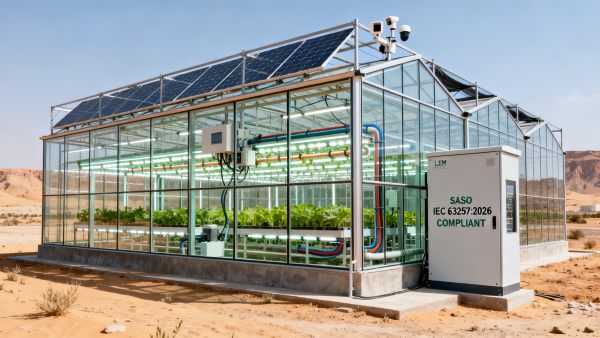
Saudi Arabia’s Standards Organization (SASO) has enforced a new regulatory requirement effective May 15, 2026: all imported Smart Greenhouse systems must be pre-installed with a locally compliant Energy Management System (LEM) adhering to Saudi grid communication protocols. This development directly impacts exporters — particularly those in China — involved in agricultural technology hardware, energy-integrated controlled-environment agriculture (CEA) systems, and cross-border compliance services.
Event Overview
Effective May 15, 2026, SASO has implemented the updated standard SASO IEC 63257:2026 for greenhouse equipment energy efficiency. Under this regulation, every Smart Greenhouse system imported into Saudi Arabia must integrate a Local Energy Management (LEM) system certified for interoperability with Saudi national grid communication protocols. Non-compliant shipments will be denied customs clearance, with risk of full-container rejection.
Industries Affected by Segment
Export-Oriented Manufacturing Enterprises
Manufacturers exporting Smart Greenhouse systems — especially those based in China — are directly affected because the LEM integration is now a mandatory pre-shipment requirement. Impact manifests in product design cycles, factory-level configuration workflows, and certification timelines. Systems previously shipped without embedded LEM functionality no longer meet entry conditions.
Compliance & Certification Service Providers
Third-party testing labs, certification bodies, and regulatory consultants supporting export compliance must now verify LEM interoperability against SASO-defined grid protocols — not just generic energy efficiency metrics. This adds a new layer to technical documentation review, firmware validation, and conformity assessment scope.
Supply Chain & Logistics Operators
Freight forwarders and customs brokers handling Smart Greenhouse consignments to Saudi Arabia face increased documentation scrutiny. Pre-clearance verification now includes proof of LEM integration and SASO-recognized certification — making shipment delays or rejections more likely if documentation is incomplete or outdated.
OEM/ODM Component Suppliers
Suppliers of core subsystems — such as climate control units, solar inverters, or IoT gateways — may experience revised technical specifications from their downstream Smart Greenhouse integrators. If their components do not support Saudi grid protocol interfaces (e.g., Saudi-specific DLMS/COSEM profiles), integration readiness becomes a bottleneck.
Key Focus Areas and Recommended Actions
Monitor official SASO guidance on LEM technical specifications
While SASO IEC 63257:2026 is published, detailed implementation guidelines — including accepted communication protocol versions, test procedures, and approved LEM architecture models — remain pending formal release. Exporters should track SASO’s official portal and authorized notification bodies for updates before finalizing product configurations.
Review and revise pre-shipment compliance checklists
Current quality assurance and export readiness checklists must be updated to include LEM firmware verification, Saudi grid protocol conformance evidence (e.g., test reports from SASO-accredited labs), and bilingual labeling requirements for LEM interface documentation. Delaying this revision risks post-production retrofitting or shipment hold.
Distinguish between regulatory signal and operational enforcement
Analysis shows that SASO’s enforcement timeline is fixed (May 15, 2026), but field-level customs application may vary across ports during initial rollout. Observably, early adopters who complete LEM integration and certification ahead of Q1 2026 may encounter fewer procedural ambiguities than those initiating compliance efforts after March 2026.
Engage local Saudi technical partners for protocol validation
Given the specificity of Saudi grid communication requirements, direct collaboration with Saudi-based engineering firms or SASO-authorized technical assessors is advisable for protocol-level validation — rather than relying solely on international lab certifications. This reduces risk of misalignment between test conditions and actual grid interface expectations.
Editorial Perspective / Industry Observation
This requirement is better understood as a structural shift in market access conditions — not merely an incremental compliance update. From an industry perspective, SASO is signaling a broader policy direction toward localized energy intelligence in imported infrastructure, particularly for systems interacting with national utilities. Analysis suggests it reflects Saudi Vision 2030 priorities around energy efficiency, grid resilience, and domestic data sovereignty — though the current rule applies narrowly to Smart Greenhouses. It is not yet evident whether similar LEM mandates will extend to other smart agricultural or building automation imports; however, this case sets a precedent worth monitoring closely.
Currently, the regulation functions both as an enforceable standard and as an early indicator of tightening technical localization expectations for high-value agri-tech exports to Gulf Cooperation Council (GCC) markets.
Conclusion
This SASO requirement marks a concrete escalation in technical localization expectations for Smart Greenhouse exports to Saudi Arabia. It does not represent a temporary adjustment but a binding entry condition with tangible supply chain implications. For affected enterprises, the most appropriate framing is operational necessity — not optional optimization. The focus should be on verifiable integration, documented conformance, and proactive alignment with Saudi technical stakeholders — rather than waiting for broader regional harmonization or regulatory relaxation.
Information Source
Main source: Saudi Standards, Metrology and Quality Organization (SASO), Standard SASO IEC 63257:2026, effective May 15, 2026. Further technical implementation details — including approved LEM architecture references and grid protocol annexes — are pending official publication and remain under observation.
Related Intelligence
- Smart GreenhouseGreenhouse Equipment for Vertical Farming: Choosing Lighting and VentilationChoose greenhouse equipment for vertical farming with confidence. Compare lighting, airflow, and moisture control to improve crop uniformity and manage costs. Explore the guide.
- Smart GreenhouseSelecting Greenhouse Propagation Equipment for Hot, Humid Southeast Asian NurseriesGreenhouse propagation equipment Southeast Asia: discover how to select resilient irrigation, ventilation, benches, and automation for hot, humid nurseries.
- Smart GreenhouseWhat Are the Biggest Challenges in Agri-Tech Adoption in 2026?What are the biggest challenges in agri tech adoption for 2026? Explore cost, data, connectivity, skills, compliance, and ROI barriers.
The Morning Broadsheet
Daily chemical briefings, market shifts, and peer-reviewed summaries delivered to your terminal.
