

The Authority in Global Agricultural Chemistry & Bio-Resources
Vietnam Enforces Self-Certified Origin Declarations & Mandatory EPR Registration for Agrochemicals and Natural Ingredients Starting May 2026
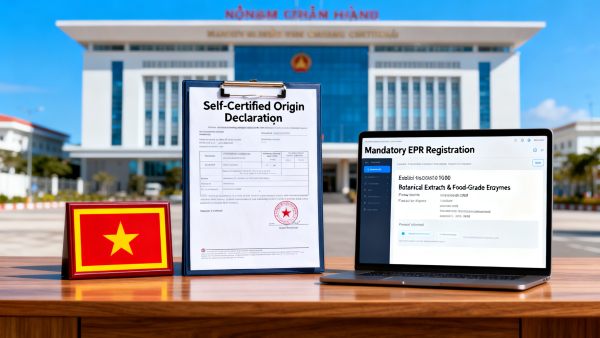
Vietnam will implement new regulatory requirements on 1 May 2026, mandating self-certified origin declarations and mandatory Extended Producer Responsibility (EPR) registration for exports of feed additives, botanical extracts, and food-grade enzymes—key product categories within the agrochemical and natural ingredients sectors. These measures directly affect market access, customs clearance, and compliance timelines for suppliers exporting to Vietnam.
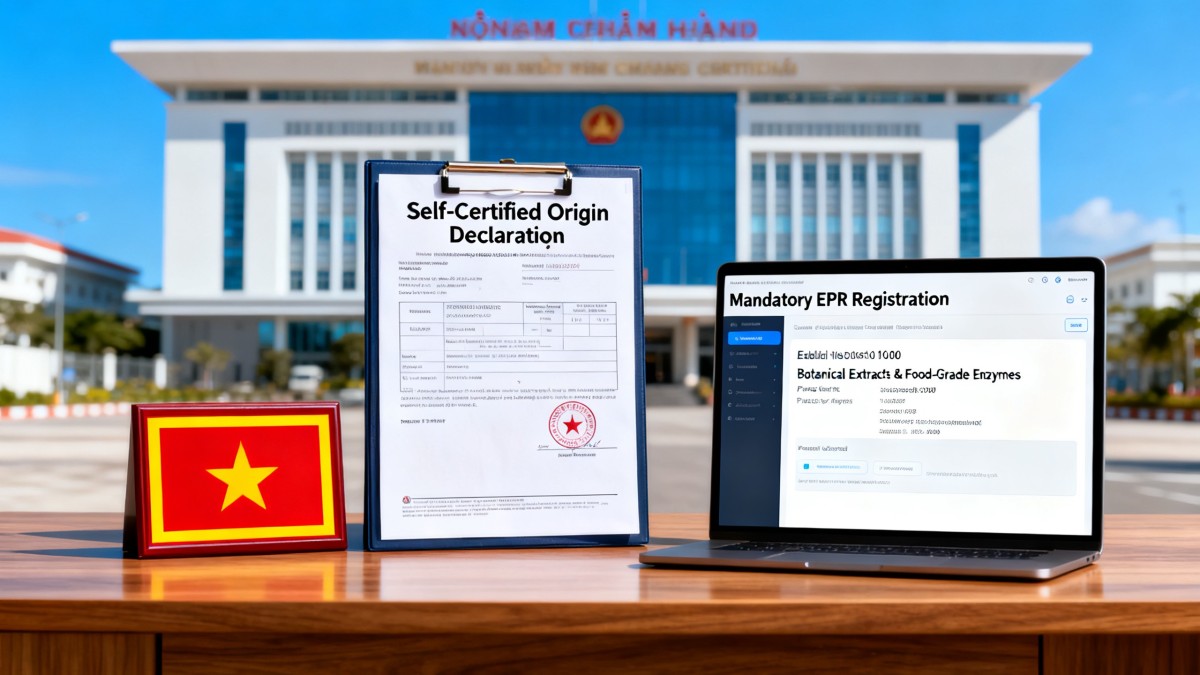
New Regulatory Requirements Take Effect 1 May 2026
Effective 1 May 2026, exporters of feed additives, botanical extracts, and food-grade enzymes to Vietnam must issue their own origin declarations and complete mandatory EPR registration covering electronic products, batteries, and packaging. Customs authorities in Vietnam will reject clearance for any shipment lacking a valid EPR registration number. The scope explicitly targets agrochemicals, botanical extracts, and natural ingredients suppliers engaged in direct export to the Vietnamese market.
Impact Across the Supply Chain
Direct Exporters
These enterprises now bear full responsibility for origin certification and EPR registration—previously often delegated to importers or third-party agents. This shifts legal liability, increases internal compliance workload, and introduces new documentation dependencies before shipment.
Raw Material Sourcing Companies
Suppliers providing base materials (e.g., plant-derived actives or enzyme substrates) to exporters must ensure traceability and supporting documentation align with origin declaration criteria—especially regarding processing thresholds and regional value content—potentially triggering upstream audits or data requests.
Manufacturers and Formulators
Companies blending, encapsulating, or packaging finished products face dual obligations: verifying origin eligibility of inputs *and* registering final packaged goods under Vietnam’s EPR framework—including packaging components and associated battery-powered devices (e.g., smart sensors in active ingredient monitoring systems).
Supply Chain Service Providers
Freight forwarders, customs brokers, and compliance consultants must update procedural checklists, integrate EPR verification into pre-clearance workflows, and support clients in validating both origin statements and registered EPR status—making technical accuracy and real-time registry access essential.
Key Compliance Priorities for Exporters
Origin Declaration Readiness
Develop internal protocols to assess and document origin eligibility per Vietnamese rules—including processing steps, tariff classification changes, and regional value addition—prior to issuing legally binding self-declarations.
EPR Registration Timing and Scope
Initiate EPR registration well in advance of first shipment, as processing may require submission of product composition, packaging schematics, and waste management commitments—particularly for multi-layer packaging or integrated electronics used in controlled-release formulations.
Customs Clearance Integration
Ensure EPR registration numbers are embedded in commercial invoices, packing lists, and e-customs declarations; absence of this identifier will result in automatic clearance rejection—not delay or request for correction.
Supplier Documentation Alignment
Require upstream suppliers to provide origin-relevant certificates (e.g., mill test reports, harvest records, fermentation batch logs) and confirm EPR-covered material compliance—especially where botanical extracts or enzymes are supplied as bulk intermediates for local repackaging.
Industry Perspective: A Strategic Shift Toward Producer Accountability
Analysis shows that Vietnam’s move reflects a broader regional trend—aligning with EU and ASEAN sustainability frameworks—where environmental responsibility is increasingly embedded at the point of import rather than delegated post-entry. From an industry perspective, this signals a structural shift: compliance is no longer a logistics checkpoint but a prerequisite for market participation. What deserves closer attention is the cumulative effect of origin self-certification and EPR—both demand granular supply chain visibility, longer internal validation cycles, and cross-functional coordination between regulatory affairs, procurement, and R&D teams. Observably, manufacturers with mature digital traceability systems and prior EPR experience (e.g., in EU markets) hold a distinct operational advantage.
Strategic Implications for Market Access
This regulation redefines entry requirements for Vietnam’s growing natural ingredients market—not through tariffs or quotas, but via procedural gatekeeping. Success hinges less on price competitiveness and more on demonstrable, auditable compliance infrastructure. For exporters, timely implementation represents not only risk mitigation but also a signal of long-term commitment to responsible sourcing and circular economy principles—factors increasingly weighted by Vietnamese importers and distributors.
Source Information and Verification Notes
This article was generated based solely on the user-provided title, event date (2026-05-01), and summary description. Specific official source links were not provided in the input and should be verified continuously. Stakeholders are advised to monitor updates from Vietnam’s Ministry of Industry and Trade (MOIT), General Department of Vietnam Customs, and the national EPR registry platform for detailed guidance on declaration templates, EPR fee structures, registration timelines, and enforcement interpretations—particularly regarding borderline cases such as enzymatic blends with synthetic carriers or multi-origin botanical extracts.
Related Intelligence
- Smart GreenhouseGreenhouse Equipment for Vertical Farming: Choosing Lighting and VentilationChoose greenhouse equipment for vertical farming with confidence. Compare lighting, airflow, and moisture control to improve crop uniformity and manage costs. Explore the guide.
- Forestry EquipmentChoosing Compact Forestry Machinery for Small Woodlots and Narrow AccessChoose compact forestry machinery that fits small woodlots and narrow access. Compare payload, turning clearance, safety, and running costs to find the right machine for your site.
- APIs & IntermediatesProcurement Planning: Which Resource Reports Help Prevent Material Shortages?Discover how procurement planning resource reports reveal usable stock, shortage dates, and supplier risks so you can prevent material shortages and keep production on track.
The Morning Broadsheet
Daily chemical briefings, market shifts, and peer-reviewed summaries delivered to your terminal.
