

The Authority in Global Agricultural Chemistry & Bio-Resources
How to Select Poultry Feeding Systems for Broiler Farms by Flock Size and Feed Waste
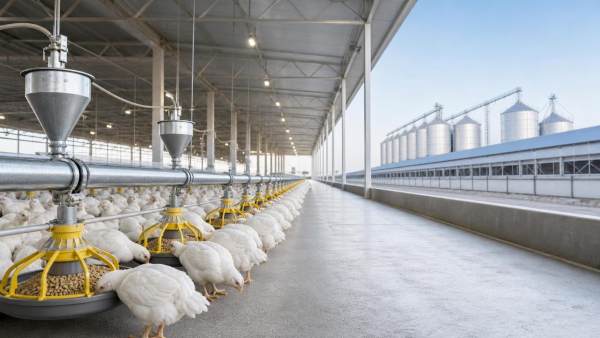
Selecting a poultry feeding system for a broiler farm is not a simple equipment comparison. The feeder design influences feed conversion, bird uniformity, labor demand, sanitation routines, and ultimately the cost of liveweight gain. In high-throughput operations, even a modest reduction in feed spillage can materially affect margins because feed remains the dominant operating cost in broiler production.
The right choice depends less on whether a system is marketed as “automatic” or “high capacity” than on whether its feed delivery, pan geometry, adjustment range, and control logic match the flock size, bird genetics, housing format, feed form, and management discipline of the farm. A system that performs well in a 20,000-bird house may become uneven, difficult to maintain, or unnecessarily expensive when applied to a multi-house complex with several hundred thousand birds.
For farm poultry feeding systems, the central evaluation question is therefore practical: how reliably can the equipment place the correct amount of feed in front of birds, at the correct height and distribution, while minimizing losses from spillage, segregation, bridging, contamination, and mechanical downtime?
Start with the production model, not the feeder catalogue
Broiler feeding equipment is often specified too early in a project. A supplier may be asked to quote pan feeders, feed lines, hoppers, and controls before the operator has defined stocking density, flock cycles, target slaughter weight, feed program, or future capacity. This creates a risk that the selected system is adequate on paper but poorly aligned with daily production conditions.
A more reliable starting point is to define the house and flock operating envelope:
- Maximum birds placed per house and expected market-age bird weight;
- House length, width, ceiling height, floor condition, and ventilation arrangement;
- Number of feeding phases, including starter, grower, and finisher diets;
- Feed presentation: mash, crumble, pellet, or pellet-based diets with fines;
- Number of production cycles per year and cleaning procedures between flocks;
- Whether the farm will remain single-house, expand by modules, or integrate several sites under central feed supply.
These variables determine the required line count, pan spacing, feeder capacity, drive-unit loading, hopper size, auger configuration, and control sophistication. They also determine whether a relatively simple system is commercially sensible or whether centralized automation is justified.
Flock size matters, but it should not be treated as a standalone design input. Two farms with the same bird numbers can require different feeding configurations if one uses narrow houses with high stocking density and another uses wider houses, lower density, or segmented production zones. The practical objective is not merely to install enough pans; it is to ensure birds have consistent access without creating large quantities of exposed feed.
How flock size changes the feeding-system decision
Small and medium broiler units often prioritize manageable capital cost, straightforward maintenance, and dependable operation during power interruptions or minor mechanical faults. Larger complexes place greater value on labor reduction, centralized monitoring, feed inventory visibility, and the ability to maintain consistency across many houses.
For smaller farms or individual houses, manually managed feeders, semi-automatic hopper systems, or basic automated pan lines may be suitable where labor is available and the operator can inspect feed levels frequently. The advantage is simplicity: fewer controls, lower installation cost, and easier troubleshooting. The limitation is that feeding consistency depends heavily on staff discipline. Delayed refilling or poorly adjusted feeder height can quickly lead to uneven growth.
For commercial houses with larger placements, automatic pan-feeding systems are generally the operational baseline. A bulk bin transfers feed through a flex-auger or chain system to one or more feed lines. Feed is distributed into pans, and sensors or control units manage replenishment. The system can reduce routine labor substantially, but only if line capacity, feed-flow characteristics, and sensor placement are correctly engineered.
At complex scale, the decision extends beyond individual houses. Centralized feed handling, silo level monitoring, remote alarms, data logging, and coordinated control can improve visibility across the site. Yet higher automation also increases dependence on electrical components, calibration, software support, and spare-parts availability. Automation should therefore be evaluated as an operating system, not as an isolated feature.
Feed waste is the economic variable that deserves the closest scrutiny
Feeder systems are frequently compared by purchase price, motor specification, or nominal bird capacity. Those factors matter, but feed waste usually has more persistent economic consequences. Waste is not limited to visible feed on the litter. It includes fines accumulating in pans, feed flicked beyond the pan edge, overfilled feeders, feed exposed during low bird activity, and avoidable losses caused by poor adjustment as birds grow.
Broilers change rapidly in size and feeding behavior. A feeder setting that is acceptable during the starter stage may become too low, too full, or too accessible later in the cycle. When pans are overfilled, birds can rake feed out while eating. When pan lips are too low relative to bird height, waste often rises. When feed depth is insufficient, on the other hand, birds may spend more time searching and may show uneven access at busy periods.
The most useful systems provide repeatable adjustment rather than simply a wide adjustment range. Height-setting mechanisms should be easy to raise evenly across the house. Feed-depth control should have clear, consistent settings and should not drift during vibration or cleaning. A supplier should be able to explain how the system is adjusted through the flock cycle and what management checks are needed at each stage.
Pan design also matters. Relevant details include the shape of the feed cone, anti-scratch grille design, pan rim profile, usable feeding circumference, the ability to manage fines, and how readily the pan can be cleaned. A pan that appears robust but allows birds to scatter feed can be more costly over its service life than a higher-priced design with better feed retention.
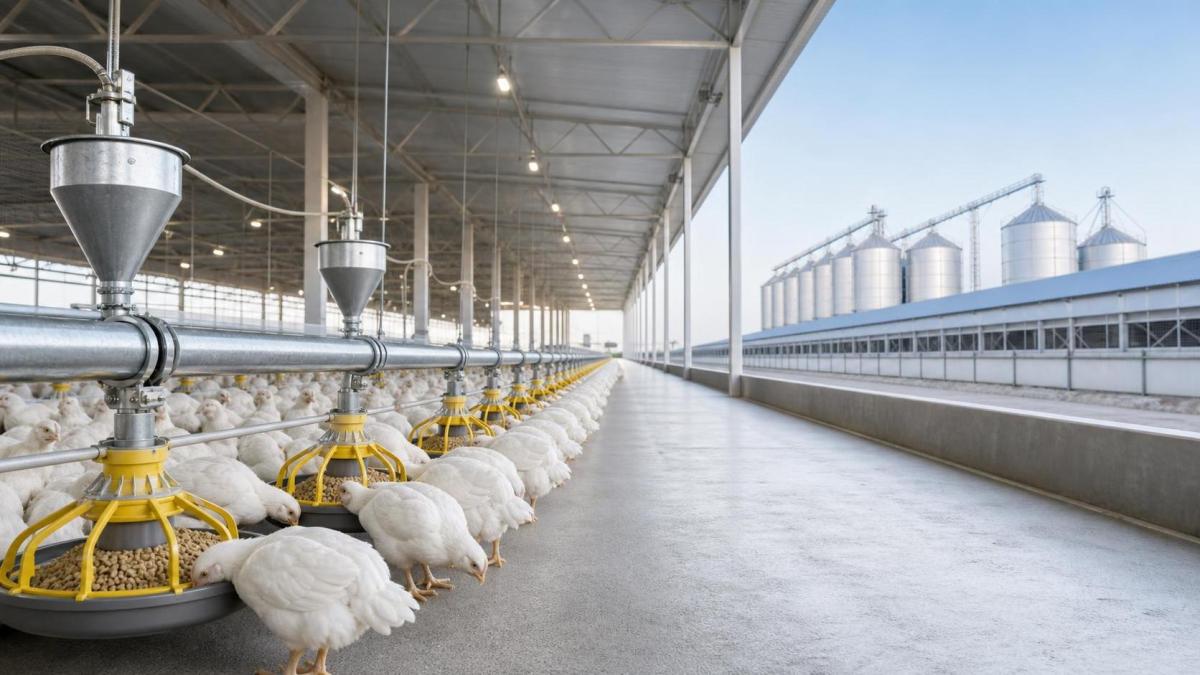
Feed form must be considered alongside pan design. Crumbles, pellets, mash, and diets containing a high proportion of fines flow and accumulate differently. A system tested mainly with uniform pellets may not behave the same way with variable feed from local mills or with diets that change seasonally. Before placing an order, it is reasonable to provide suppliers with representative feed specifications and request confirmation that augers, boot units, pan outlets, and settings are compatible with the anticipated particle-size distribution.
Pan feeders, chain feeders, and alternative configurations
For modern floor-raised broilers, automated pan feeder systems are widely used because they can distribute feed across long houses, support bird access around the pan, and be raised for cleaning and catching. Their performance depends on proper line spacing, pan density, and management, but they are well suited to commercial broiler production.
Chain feeder systems can offer consistent feed movement and are used in some poultry applications, particularly where linear feed access or specific house designs make them appropriate. Their suitability for broilers should be assessed against the housing configuration, bird density, cleaning requirements, and the local availability of components and service technicians. The decision should not be based on the assumption that one delivery method is universally more reliable than another.
Tube feeders and simpler gravity-fed equipment remain relevant for low-capital or smaller-scale operations. They can be functional where flock size is limited and regular manual supervision is realistic. However, they tend to require more labor and can produce more variable feed access in large groups. They may also be less effective where uniformity and controlled feed distribution are central performance goals.
In practice, the best configuration is often determined by the interaction between feeder lines and the whole house system. Feeder layout cannot be separated from drinker lines, ventilation inlets, heating equipment, litter management, and access for cleaning. A line arrangement that leaves dead zones, obstructs airflow, or complicates litter work may create costs that were not visible in the equipment quotation.
Do not accept bird-capacity claims without checking the design assumptions
Supplier literature commonly states a number of birds per pan or a maximum line capacity. These figures are useful only when the assumptions are known. Capacity may be based on a particular final bird weight, house width, pan diameter, feeding program, or local management practice. It may not reflect the actual stocking density or processing weight planned for the site.
Rather than requesting a generic recommendation, provide suppliers with a defined design brief and ask them to submit calculations showing:
- Number of birds per pan at placement and near harvest;
- Total pan count and number of feed lines per house;
- Line length, motor size, gearbox rating, and drive arrangement;
- Bulk-bin capacity in relation to delivery frequency and feed consumption peaks;
- Expected feed transfer rate from silo to house;
- Sensor locations, control sequence, and alarm response in the event of empty lines or motor overload;
- Recommended feeder height and feed-depth settings by bird age.
These details reveal whether a supplier is offering an engineered solution or merely scaling a standard bill of materials. They also make quotations more comparable. A lower initial price can conceal fewer pans, undersized drives, thinner galvanized components, limited control functionality, or exclusions for installation accessories.
Material quality and sanitation affect lifecycle cost
Poultry houses are corrosive environments. Humidity, ammonia, disinfectants, dust, and repeated washdown place continual stress on metal parts, plastics, electrical enclosures, and fasteners. The purchase specification should identify the materials used for feed tubes, pans, suspension components, motors, gearboxes, and control cabinets.
Galvanized steel quality, plastic resistance to ultraviolet exposure and cleaning chemicals, sealing performance of electrical enclosures, and the durability of suspension hardware all influence service life. It is not enough to ask whether a system is corrosion resistant. The more useful question is which components are most likely to fail first under local house conditions, and whether those parts can be replaced individually without dismantling a full line.
Sanitation deserves equal attention. Systems should allow practical cleaning between flocks, avoid inaccessible pockets where old feed can remain, and permit lines to be raised safely. Feed residues can attract pests, support mold growth under poor storage conditions, and complicate biosecurity procedures. Equipment that is difficult to clean may appear economical at purchase but increase health and labor risks over time.
Evaluate controls as an operational safeguard, not a digital upgrade
Controls can range from simple timer-based operation to sensor-driven systems linked with house controllers and remote monitoring platforms. More advanced controls can help identify interrupted feed flow, motor overloads, empty hoppers, or abnormal consumption patterns. These functions can be valuable, particularly across multiple houses where a mechanical failure may not be noticed immediately.
However, digital capability should be judged by reliability and usability. Important questions include whether alarms work during communications outages, whether local manual override is available, what data can be exported, who owns the operating data, and how long replacement controllers or sensors take to obtain. A sophisticated dashboard does not compensate for poor mechanical design or weak after-sales support.
Power resilience is another practical consideration. Farms in regions with unstable electricity supply should assess backup generation capacity, restart behavior after outages, protection against voltage fluctuations, and the consequences of feed interruption during high-demand periods. The feeding system should be included in the site’s broader emergency-power plan rather than treated as a separate purchase.
Supplier assessment should extend beyond the equipment specification
Broiler feeding systems are installed assets with a long operating life, and supply risk can emerge years after commissioning. The relevant supplier assessment is therefore broader than unit price and shipment date.
Review manufacturing consistency, spare-parts stock, installation documentation, commissioning support, warranty conditions, and the supplier’s ability to provide service in the destination market. For cross-border purchases, confirm packing methods, container loading plans, tariffs, import documentation, electrical compatibility, and the availability of local installation contractors. A feeder line with a proprietary component may be difficult to maintain if replacement parts require long international lead times.
Reference farms are useful, but they should be comparable in climate, house design, production scale, and feed type. A reference installation in a temperate, tightly controlled house may not predict performance in a hot-humid region with higher corrosion pressure, more variable power supply, or feed containing greater levels of fines.
Before contract award, request a complete scope matrix separating supplied equipment from exclusions. Installation steelwork, bulk bins, electrical cabling, control integration, transport, commissioning, and training are common areas where budget gaps emerge. Performance expectations should also be discussed carefully. Equipment suppliers can support feed access and reduce avoidable spill, but feed conversion and mortality remain influenced by genetics, health status, ventilation, water quality, litter condition, and management.
A sound selection protects both feed efficiency and operational flexibility
The most effective poultry feeding system is rarely the one with the longest feature list. It is the system that provides uniform feed availability, limits waste under the farm’s actual feed and bird conditions, can be adjusted accurately as the flock grows, and remains serviceable throughout repeated production cycles.
For a growing broiler operation, scalability matters. Feed lines, control capacity, and bulk-feed handling should be considered in relation to the next expansion stage, but overbuilding should be avoided where it adds complexity without a clear operating return. The decision should be supported by a lifecycle view: capital cost, expected feed-loss reduction, labor savings, energy demand, cleaning time, spare-parts exposure, and expected service life.
When these factors are evaluated together, farm poultry feeding systems become easier to compare on their real contribution to production performance. The purpose is not to buy the most automated feeder available. It is to establish a feeding process that stays consistent from placement to harvest, supports predictable cost control, and does not create avoidable operational risk as flock size increases.
Related Intelligence
- Feeding & Watering SystemsHow to Size Commercial Farm Feed Systems for Herd Capacity and Feed FlowFarm commercial feed systems: learn how to size storage, conveyors, and feed flow for herd capacity, peak demand, resilience, and efficient farm operations.
- Feeding & Watering SystemsSelecting a Nipple Drinking System for Broiler and Layer HousesNipple drinking system selection guide for broiler and layer houses: compare water flow, pressure control, flushing, durability, and installation needs.
- Feeding & Watering SystemsHow to Select Poultry Feeding Systems for Broiler Farms by Flock Size and Feed WasteFarm poultry feeding systems: learn how to match feeder design to broiler flock size, reduce feed waste, improve uniformity, and control lifecycle costs.
The Morning Broadsheet
Daily chemical briefings, market shifts, and peer-reviewed summaries delivered to your terminal.
