

The Authority in Global Agricultural Chemistry & Bio-Resources
Feeder and Drinker Placement in Deep-Litter Poultry Houses
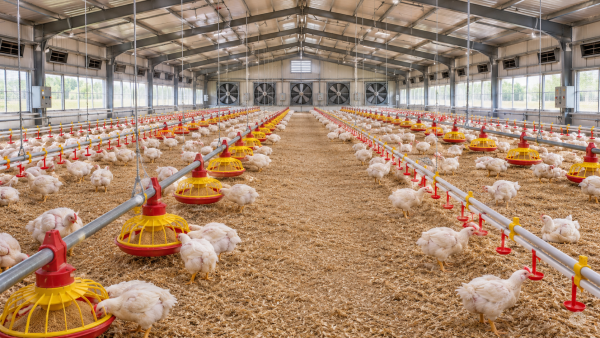
In a deep-litter poultry house, feeder and drinker placement determines more than where equipment fits. Birds must be able to reach feed and water without crowding, while staff need room to adjust equipment, inspect litter and remove wet material. A layout that looks balanced on a drawing can perform poorly if a drinker line sits over a persistent wet patch, a feeder blocks a service route, or young birds cannot find water during placement.
Technical evaluation should therefore begin with the flock and the operating routine, not with equipment capacity alone. Species, bird age, stocking plan, house dimensions, ventilation pattern and the depth and condition of the litter all affect the choice. The best arrangement is one that gives birds consistent access throughout the growing period and gives operators practical control over spillage, maintenance and cleaning.
Start with bird movement and usable floor area
Deep-litter systems place birds on bedding rather than raised flooring, so the area shown on the building plan is not necessarily the area available for normal movement. Feeder pans, drinker lines, partitions, structural posts and maintenance spaces all influence how birds distribute themselves. Equipment should be laid out across the usable floor rather than concentrated where installation is easiest.
Look for locations where birds would need to pass a major obstacle to reach water or where a line ends well short of an occupied area. Corners, areas near partitions and spaces affected by drafts may receive less traffic. At the same time, a narrow passage between equipment lines can become congested when birds move to feed or drink. A plan should show the birds’ likely routes as well as the positions of the equipment itself.
For a broiler house, the layout must work both for small chicks during brooding and for larger birds later in the cycle. Temporary chick feeders or supplementary drinkers may be necessary, depending on the equipment and management plan. Their positions should encourage birds to find the permanent system without creating isolated clusters or blocking access when temporary equipment is removed.
A poultry house planning guide can provide context for evaluating the building layout alongside equipment placement. The useful distinction is between a general arrangement and a site-specific plan: the latter must account for actual dimensions, bird type, equipment specifications and the operator’s ability to inspect every occupied area.
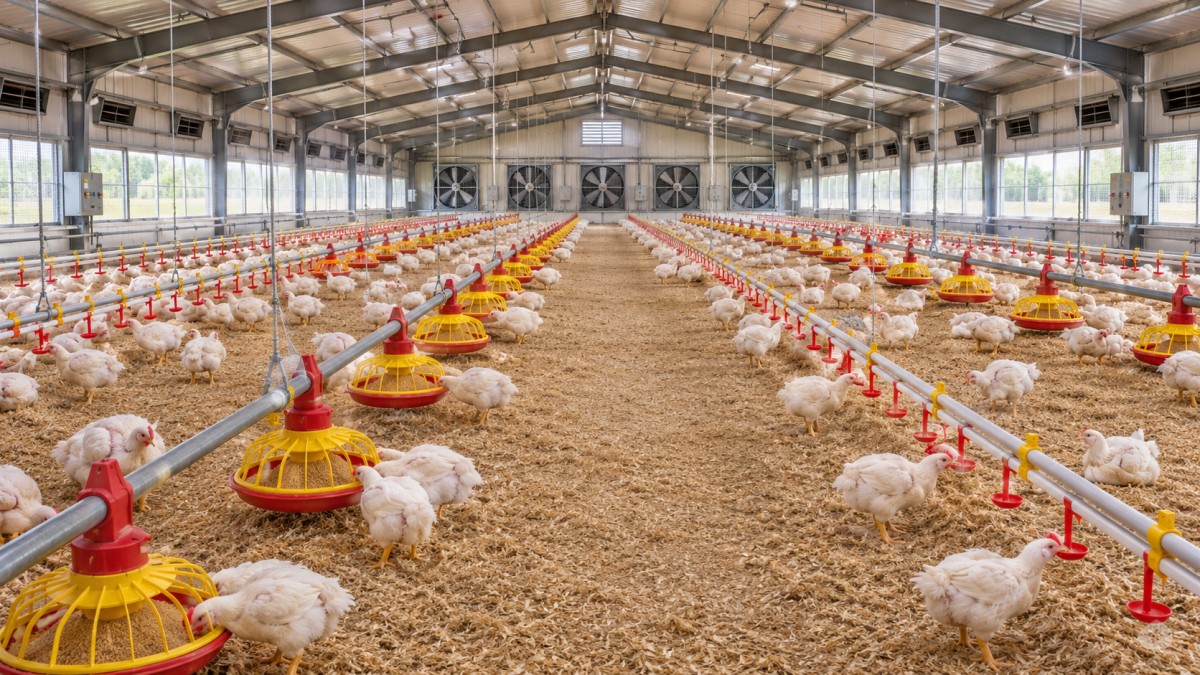
Compare feeder arrangements against the flock and the building
Pan feeders and chain or trough feeders present different placement questions. A pan line distributes individual feeding points along the house, whereas a trough system provides access along a continuous edge. Neither format should be judged solely by its nominal capacity. The evaluator should establish the usable feeding space or number of feeding positions specified for the bird category, then check whether the proposed distribution makes that capacity accessible across the house.
Suspended pan lines can be raised as birds grow and lifted for cleaning or litter removal. Their usefulness depends on the suspension and winching arrangement: a line that cannot be raised evenly may leave some pans too high and others too low. The feed delivery system also needs to reach the end of each line without leaving persistent differences in feed availability. Ask suppliers how line length, slope and the selected feed affect the proposed configuration.
Trough systems need a clear assessment of access from either side, especially near walls or partitions. A trough placed too close to a barrier may have less usable edge than its physical length suggests. Corners, drive units and return sections also occupy space and require access. Where the layout includes frequent pen changes, assess how easily the equipment can be separated, cleaned and reinstated without damaging the litter floor or compromising feed delivery.
Feeder height is an operational setting, not a dimension that can be fixed once during installation. If feeding surfaces remain too low as birds grow, birds may scratch feed into the litter; if too high, smaller or weaker birds may struggle to reach it. The required setting depends on the feeder design and bird size, so the purchasing specification should include the supplier’s adjustment instructions and a means of making changes safely.
Position drinkers for access without creating wet-litter zones
Water equipment needs the same distribution analysis as feeders, with an additional focus on leaks and litter condition. Nipple lines generally confine water delivery to individual drinking points, while bell or other open drinkers present an exposed water surface. The choice affects cleaning, adjustment and the consequences of spillage. Open drinkers require accessible cleaning and level adjustment; nipple systems depend on appropriate pressure, line height and functioning nipples.
Place drinkers so birds can reach water throughout the occupied area, including during early brooding. Avoid assuming that a line serving the full house will automatically serve a smaller brooding zone: partitions and the position of heaters can change access. Temporary drinkers should be located where chicks can find them without obstructing permanent equipment or encouraging birds to gather in a confined space.
Persistent wet litter beneath a drinker line calls for diagnosis rather than simply adding dry bedding. Check for leaks, excessive water pressure, incorrect line height, damaged fittings and poor leveling. Water can also accumulate where ventilation is insufficient for the moisture load or where the floor and litter surface create a low point. Moving a line may help in some circumstances, but it will not correct a leaking regulator or an unsuitable management setting.
Do not place equipment so tightly against walls, posts or other lines that operators cannot inspect connections and remove wet litter. At the same time, leaving a gap is not enough if the inspection route becomes inaccessible once birds are present. Evaluate access with the house stocked, not only when it is empty.
Coordinate equipment lines with ventilation and services
Feeder and drinker positions interact with the rest of the building. Inlets, fans, heaters and internal partitions influence air movement and bird distribution. If an area is consistently uncomfortable, birds may avoid nearby equipment or cluster elsewhere, leaving nominal feeding and drinking capacity underused. The layout review should include both brooding and full-house ventilation arrangements where these differ.
Water supply components need a serviceable position. Filters, regulators, meters and flushing connections should be accessible without disturbing birds unnecessarily or placing electrical components where routine water handling creates a hazard. Feed bins, augers and control units likewise need maintenance access. Routing a feed line around a structural obstruction may be possible, but the effect on delivery, cleaning and replacement should be clarified before procurement.
Drainage and washdown plans deserve early attention. A drinker system may need flushing, and equipment will eventually need cleaning between flocks. Identify where water will go and how contaminated material will be removed. Avoid treating the litter floor as an unlimited disposal area; the cleaning procedure should be compatible with the building design and the farm’s applicable biosecurity and wastewater requirements.
Use supplier information to test the proposed layout
A meaningful comparison requires more than a quotation listing equipment quantities. Provide each supplier with the same house drawing, planned bird category, intended flock size, brooding arrangement and operating assumptions. Ask for a scaled layout showing line positions, equipment ends, suspension points, feed and water connections, and access needed for adjustment and maintenance.
Request the basis for the proposed capacity and have suppliers identify any assumptions about bird age, equipment height, water pressure and available space. Capacity figures calculated under different conditions are not directly comparable. If a design uses temporary equipment during brooding, its quantity, location and removal procedure should be included in the evaluation rather than left as an unspecified management task.
Also compare what is excluded. Suspension hardware, water treatment, electrical work, controls, installation and commissioning may be priced separately. A lower equipment price may not represent a lower installed cost if the house requires extensive changes to accommodate it. Replacement parts and the time needed to obtain them matter because a failed regulator, drive component or suspension fitting can affect access across a substantial part of the house.
Inspect the installation before accepting the layout
Before birds enter, verify the installed positions against the approved drawing and check clearances at posts, walls, doors and partitions. Confirm that lines can be raised and lowered through the intended range and that adjustment does not leave sections visibly uneven. Run the feed system and check delivery along each line. For drinkers, inspect joints, regulators and end connections while the system is operating, and confirm that the flushing arrangement works as intended.
Acceptance should also cover the information handed to the farm team: operating settings supplied for the equipment, adjustment procedures, cleaning instructions, spare-parts identification and the contact route for resolving installation defects. Record issues while access is straightforward; correcting a poorly placed line is more disruptive after birds and litter are in place.
During the first operating cycle, observe where birds actually gather and compare litter condition along the house. A wet area under one section calls for a different response from uniform crowding at a feeder end. The layout should remain open to adjustment where equipment permits, but changes should follow a clear diagnosis of access, water delivery, ventilation and management rather than an assumption that spacing alone is responsible.
Related Intelligence
- Feeding & Watering SystemsFeeder and Drinker Placement in Deep-Litter Poultry HousesUse this poultry house planning guide to optimize feeder and drinker placement, improve bird access, reduce wet litter, and simplify maintenance.
- Feeding & Watering SystemsHow Poultry Feeding Trough Design Affects Feed SpillageDiscover how a feeding trough for poultry can reduce feed spillage. Explore practical tips on rim design, feeder height, access and cleaning.
- Feeding & Watering SystemsChoosing a Livestock Feeding Systems Exporter: Delivery and After-Sales SupportChoose a livestock systems exporter with reliable delivery, clear installation terms, and responsive after-sales support. Discover what to check to reduce downtime and protect your investment.
The Morning Broadsheet
Daily chemical briefings, market shifts, and peer-reviewed summaries delivered to your terminal.