

The Authority in Global Agricultural Chemistry & Bio-Resources
Livestock Climate Control System Prices: Equipment and Installation Costs
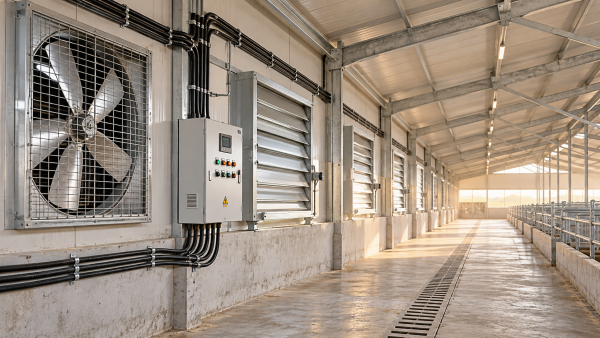
The livestock climate control price is not just the cost of fans, heaters, cooling equipment, and a controller. Installed cost also depends on electrical capacity, building modifications, controls wiring, commissioning, and the level of backup required. A low equipment quote can become an expensive project if it excludes these items.
There is no defensible universal price for an unspecified building: species, animal numbers, climate, building condition, and system design all change the scope. To establish a usable budget, define the required environmental performance first, request itemized equipment and installation quotes, and compare lifetime operating costs as well as the initial purchase.
What belongs in the project budget?
When a facility is too hot in summer or too damp in cold weather, replacing a single fan may look like the obvious purchase. Yet the problem can involve inlet placement, insufficient electrical supply, controller settings, or restricted airflow. A quote for a fan alone will not establish whether the finished system can address those conditions.
Separate the budget into equipment, installation, commissioning, and ownership costs. This makes exclusions visible before bids are compared and helps distinguish a simple replacement from a redesign.
Taxes, delivery, permits where applicable, disposal of removed equipment, and contingency for concealed conditions should also be identified. They may appear in different parts of a supplier’s quotation or be excluded altogether. Ask each bidder to state the currency, quote validity, payment schedule, and whether freight is delivered to the site or only to a carrier’s terminal.
Define the system before asking for prices
Comparable quotations start with the same design brief. Provide the animal species and production stage, planned occupancy, internal dimensions, insulation and building layout, local outdoor design conditions, and the desired indoor operating range. Include seasonal constraints: a system must provide adequate air exchange in cold weather without relying solely on its maximum summer capacity.
Give bidders information on the existing electrical supply, available fuel and water, drainage, generator capacity, and any equipment intended for reuse. Drawings and photographs can help, but a site inspection is particularly useful when cable routes, roof penetrations, or structural condition are uncertain.
Ask suppliers to identify their design assumptions and show how they selected airflow, heating, and cooling capacity. A larger nameplate fan is not necessarily the better purchase: installed performance depends on pressure losses through shutters, inlets, pads, ducting, and other restrictions. Fan performance should therefore be assessed at the expected operating pressure, not only at free delivery.
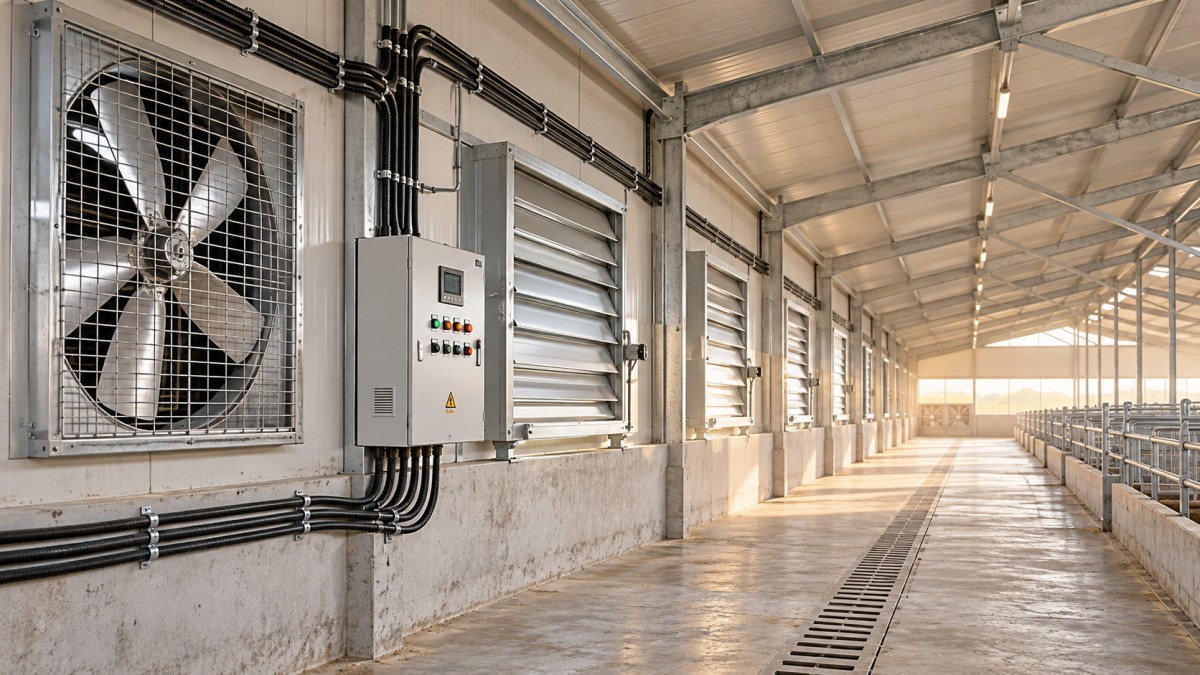
New installation or retrofit?
A new building may allow fan openings, cable routes, water lines, and plant space to be coordinated before construction. A retrofit can reuse viable equipment, but it can also require removal work, weatherproofing, electrical upgrades, or structural changes. Existing equipment should not be assumed reusable until its condition, capacity, and compatibility with the proposed controls have been checked.
Working in an occupied building can affect the installation method. The contractor may need staged shutdowns, temporary ventilation, cleaning controls, or restricted access around feeding and animal movements. Put responsibility and allowances for those measures in the scope rather than leaving them to be negotiated once work has begun.
Equipment choices that change the price
Ventilation and air distribution
Ventilation equipment ranges from basic fixed-speed fans with staged switching to systems using variable-speed drives and more detailed control. Variable operation may improve modulation at part load, but it adds components and is not automatically the lowest-cost choice. Compare the complete arrangement, including compatible motors or drives, electrical protection, control programming, and replacement parts.
Air distribution matters as much as fan capacity. Poorly located or uncontrolled inlets can create drafts or leave stagnant areas, even when the installed fan capacity appears adequate. A bid should show where air enters and leaves, how openings are controlled, and whether the proposed arrangement accounts for partitions and other obstructions.
Heating and cooling
Heating cost depends on the heat required, the selected fuel or energy source, equipment efficiency, exhaust or flue requirements, and the cost of connecting the service. Request a clear distinction between the heater package and fuel-line, venting, electrical, and installation work. The design should account for heat losses and the ventilation rate needed during cold conditions.
Cooling options have different infrastructure needs. Evaporative cooling, for example, requires a suitable water supply, distribution equipment, maintenance access, and a plan for drainage or water management. Its effectiveness depends on outdoor conditions, including humidity; a quote should describe the conditions used to predict performance rather than promising a fixed indoor temperature in all weather.
Controllers, sensors, and alarms
A basic controller may operate staged fans and heaters, while a more elaborate system can manage multiple zones, record conditions, and send alarms. Added capability is useful only if it matches the facility’s operating needs and can be maintained. Identify which sensors are supplied, where they will be installed, how they are calibrated, and what happens when a sensor or communications link fails.
Remote monitoring can create recurring charges or dependencies on a network connection. Ask whether monitoring, software access, updates, and alarm delivery are included in the purchase price or billed separately. Confirm who owns and can access the operating data, and whether essential local control remains available if connectivity is lost.
Installation costs are more than labor
Installation quotes often differ because they assign site work differently. One contractor may include a complete electrical connection; another may assume a separate electrician will provide power at every device. Neither approach is inherently wrong, but the interface must be explicit. Otherwise, the gap between the two scopes becomes an unplanned purchase.
Review these interfaces before awarding the order:
- Electrical: Load assessment, distribution board capacity, protective devices, cabling, isolators, and any supply upgrade.
- Building work: Openings, framing, supports, weather sealing, repairs, and disposal of removed materials.
- Water and fuel: Connection points, pressure or capacity requirements, piping, shutoffs, drainage, and responsibility for utility work.
- Controls integration: Sensor cabling, connections to retained equipment, alarm contacts, network provision, and programming.
- Site access: Lifting equipment, working hours, biosecurity procedures, temporary services, and protection of animals and existing operations.
For each item, record whether it is included, excluded, supplied by the owner, or subject to a provisional allowance. A provisional allowance is not a fixed price: ask what it covers and how the final charge will be established. Where a site inspection has not taken place, expect more uncertainty around concealed wiring, structural work, and the condition of existing equipment.
Compare bids on a like-for-like basis
Before ranking suppliers by total, normalize the scope. Put each proposal into the same schedule and add separately quoted work needed to reach an operational system. Do not fill an unexplained gap with an assumed zero; obtain a written clarification or mark the cost as unresolved.
- Check design equivalence. Compare operating conditions, airflow at stated pressure, heating and cooling assumptions, zones, and control functions. Different performance commitments are not equivalent bids.
- Reconcile quantities and inclusions. Confirm the number and type of fans, inlets, sensors, alarms, guards, and accessories, together with installation and commissioning.
- Identify owner costs. Add separately procured electrical, structural, water, fuel, network, and disposal work to the relevant bid.
- Review commercial terms. Compare delivery, payment milestones, warranty coverage, response arrangements, exclusions, and the treatment of variations.
- Resolve exceptions in writing. Ask suppliers to explain deviations from the specification and price optional items separately.
A useful comparison distinguishes firm prices from estimates and allowances. It also records who is responsible for coordination: if equipment and installation are purchased separately, the contract should define who verifies compatibility, handles delivery damage, and corrects a problem discovered during startup.
Budget beyond handover
Energy and fuel expenditure depend on local tariffs, weather, animal occupancy, control settings, equipment efficiency, and operating hours. Water use and water-treatment needs may also matter for evaporative systems. Ask bidders for the assumptions behind any operating-cost estimate; projected savings cannot be compared reliably when the baselines differ.
Include routine cleaning, sensor checks, belt or bearing service where applicable, consumables, spare parts, and technician visits. Establish whether the facility’s staff can perform basic maintenance and obtain replacement components without a proprietary service agreement. An inexpensive controller may be less attractive if essential support or replacement sensors carry significant recurring costs.
Reliability provisions deserve a separate line in the budget. Depending on the facility and its risks, these may include an independent alarm, backup power connection, emergency ventilation arrangement, or spare critical components. Specify the desired response to power, fan, controller, and communications failures; do not assume that a standard equipment warranty provides a backup operating system.
Make commissioning part of the purchase
A system is not ready for acceptance merely because every component is mounted. The quotation should state who checks fan rotation, inlet operation, sensor readings, staged or variable control, heating and cooling sequences, and alarm functions. Where practical, agree how performance will be verified against the design and what conditions are needed for each test.
Seasonal limits can prevent every function from being demonstrated at handover. In that case, document which checks were completed, what remains outstanding, and who will return to perform the remaining tests when suitable conditions occur. Ask for operating instructions, wiring information, equipment lists, warranty documents, and a record of initial settings.
Release criteria should address unresolved defects as well as successful startup. A bid that includes commissioning, training, and a defined correction process may cost more initially than an equipment-only offer, but it gives the buyer a clearer basis for determining whether the purchased system is working as specified.
Related Intelligence
- Climate Control & VentilationLivestock Climate Control System Prices: Equipment and Installation CostsLivestock climate control price depends on equipment, installation and operating costs. Learn how to compare quotes, avoid hidden expenses and plan your budget.
- Climate Control & VentilationHow to Specify Modular Control Panels for Poultry House Ventilation SystemsModular control panels for poultry ventilation: learn how to specify reliable I/O, sensors, alarms, variable-speed fans, and future-ready expansion.
- Climate Control & VentilationWhat Variable Speed Insights Matter Most When Optimizing Greenhouse Ventilation?Variable speed insights reveal how fan speed affects humidity, airflow, stability, and energy use in greenhouse ventilation. Learn what to adjust first for smarter, more reliable climate control.
The Morning Broadsheet
Daily chemical briefings, market shifts, and peer-reviewed summaries delivered to your terminal.