

The Authority in Global Agricultural Chemistry & Bio-Resources
How to Specify Modular Control Panels for Poultry House Ventilation Systems
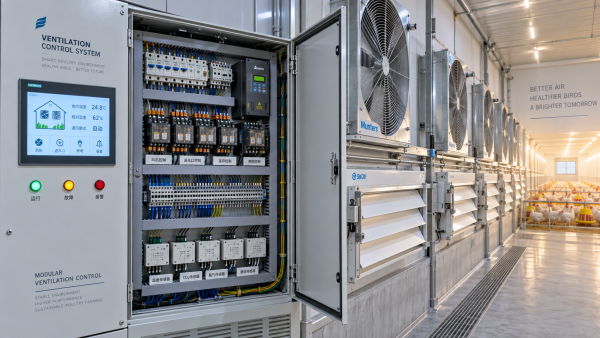
A ventilation panel should be specified from the house’s control problem outward, not from the panel enclosure inward. The right modular control panels are those that can maintain the required ventilation stages, respond reliably to changing temperature and static pressure, protect birds during equipment faults, and still be serviceable when the house layout or production program changes.
That sounds straightforward, but many specifications fail because they begin with relay quantity, screen size, or a preferred controller brand. Those details matter, yet they do not establish whether the panel can control the actual loads, interpret the right sensors, or handle failure conditions without creating a welfare and production risk. A better specification begins with an operating sequence: what the house must do in minimum ventilation, transitional ventilation, tunnel mode, cooling mode, cold starts, power interruptions, and alarm events.
Start with the ventilation sequence, not the hardware list
Before comparing modular control panels, document how air is expected to move through the building across the production cycle. A broiler house, breeder house, pullet house, and layer house can all use staged or variable ventilation, but their setpoints, ventilation priorities, inlet behavior, and response to heat load may differ. The panel has to support the intended sequence rather than force the operation into the limitations of a preconfigured controller.
At minimum, the specification should identify:
- Ventilation zones and whether they must operate independently.
- All controlled loads: exhaust fans, circulation fans, inlet actuators, cooling pumps, solenoids, heaters, lighting interfaces, and standby equipment.
- Which fans are fixed-speed, which require variable-speed control, and which must start in a fixed order.
- How minimum ventilation timing is handled during colder conditions.
- What conditions trigger tunnel ventilation, evaporative cooling, or emergency full-speed operation.
- Which alarms demand local action, remote notification, automatic backup, or a combination of these responses.
This work exposes a common selection error: assuming every fan needs an individual output. In some houses, several loads can reasonably be controlled as a group. In others, grouping hides performance differences between fan banks, makes fault diagnosis harder, or prevents the system from matching ventilation capacity to the required stage. The correct output count follows the operating sequence and electrical design, not a generic “one relay per fan” rule.
Modularity is useful when it reflects this logic. A base control section can manage the core ventilation process, while expansion modules serve additional fan stages, extra environmental zones, water cooling circuits, alarm contacts, or future house extensions. It is less useful when the system requires multiple add-on modules simply to deliver ordinary control and safety functions.
Define I/O by function and failure consequence
Input and output capacity is often evaluated as a simple point count. A more reliable method separates each point by its function, signal type, electrical duty, and consequence of loss. This produces a panel specification that installers can build correctly and maintenance teams can understand later.
Request an I/O schedule rather than accepting a total capacity figure. It should show every physical point, its label, its normal state, its operating voltage, the connected device, and its behavior during controller failure or loss of communications. Spare I/O is sensible, but it should be allocated deliberately. A few accessible spare inputs and outputs can prevent a later upgrade from requiring a new enclosure or a separate auxiliary panel.
Do not confuse spare I/O with electrical spare capacity. The enclosure, incoming supply, terminals, protective devices, heat dissipation, and cable routing must also accommodate the intended future loads. A panel can have unused digital outputs while having no practical room to add contactors, drives, or safe field wiring.
Variable-speed fan control needs a system-level specification
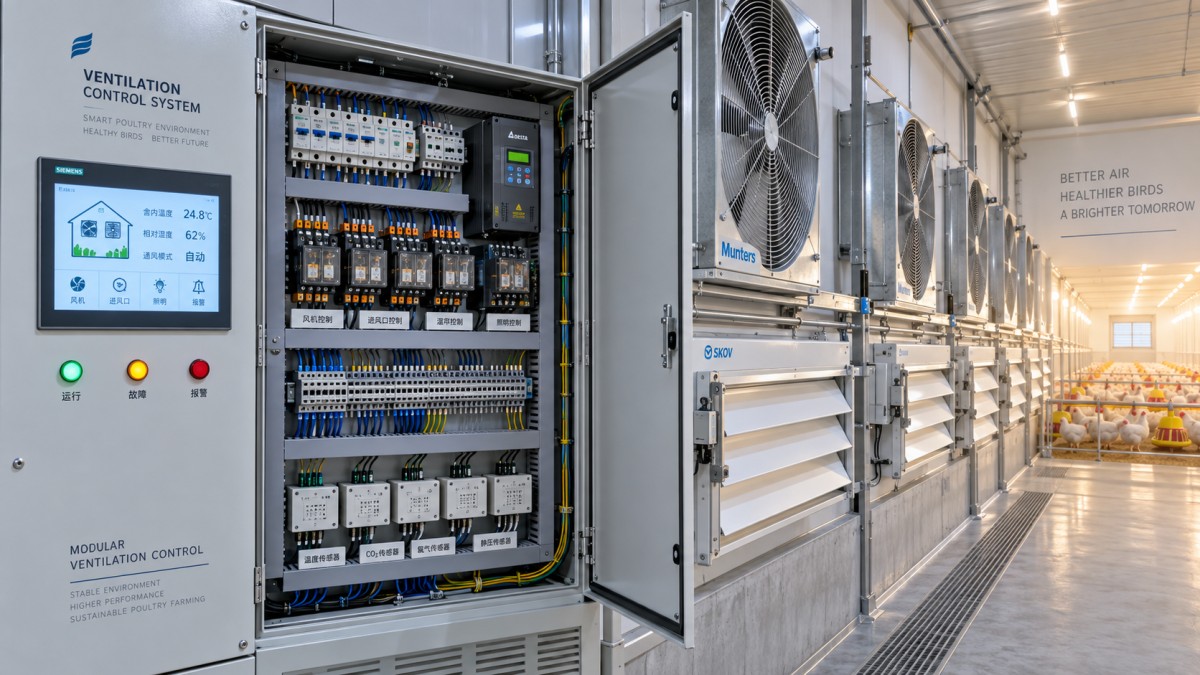
Variable-speed fans can improve control resolution and reduce unnecessary cycling, but they raise the technical standard for panel selection. The panel must provide a stable command signal to the drive or electronic motor control, receive meaningful status information, and respond predictably if that control path fails.
Specify whether the speed command is analog, network-based, or generated through a dedicated drive interface. The choice affects wiring, commissioning, fault isolation, and replacement options. A technically capable controller can still perform poorly if an analog signal is exposed to electrical noise, if grounding is inconsistent, or if the drive fault is not returned to the panel as a distinct alarm condition.
The operating sequence should also state what happens below the fan’s usable speed range. Some fans cannot produce dependable airflow or pressure at very low command levels. Others require a defined start routine before accepting a lower running speed. The panel logic should respect those equipment limits. It is not enough to specify a percentage-based speed output without confirming the fan and drive behavior behind it.
For critical ventilation capacity, assess whether a failed variable-speed device can be bypassed, replaced by staged fixed-speed equipment, or automatically compensated for by other fan groups. The answer depends on house design and the role of the fan bank. A small circulation fan and a primary tunnel fan should not receive the same failure treatment in the specification.
Sensor architecture determines whether automation can be trusted
Temperature is only one input into poultry-house ventilation control. Depending on the ventilation design, the panel may also need static pressure, humidity, ammonia-related monitoring through separate systems, water flow or pressure status, inlet position, equipment run feedback, and power condition signals. Not every house needs every measurement. Adding sensors without a clear decision purpose increases maintenance burden and can create false confidence.
For each sensor, define four things: its control role, its alarm role, its physical location, and its fallback behavior. A temperature sensor used for routine averaging may be handled differently from one placed near a high-risk zone for alarm detection. A static-pressure sensor might be essential to inlet control but unsuitable as the sole indication that adequate fresh-air exchange is occurring.
Sensor redundancy should be directed toward the most consequential decisions. Redundant temperature sensing may be justified where a single erroneous reading could suppress ventilation or cause unnecessary high-speed operation. In contrast, duplicating a low-value signal while leaving the main fan proof-of-operation unmonitored does little for resilience.
Calibration and replacement also matter. Select sensors and input modules that can be identified, tested, and replaced without rewriting the entire control program. Where a system uses proprietary sensor types or closed communication arrangements, the evaluator should understand the implications for stocking spares and long-term service availability.
Specify alarm logic as an operating response
Alarm systems are frequently described too vaguely: “high temperature alarm,” “power failure alarm,” or “remote notification.” Those labels do not define how the panel behaves when the event occurs. An effective alarm specification identifies the detection method, delay rules, notification path, required automatic response, and reset conditions.
A high-temperature alarm, for example, may require more than sending a message. It may need to command additional fan capacity, open inlets to a defined safe position, start backup equipment, or place certain outputs into a fail-safe state. A communication loss alarm should not be mistaken for confirmation that the house is protected locally. Local control and local alarming should continue even when a farm network, router, cloud platform, or remote operator is unavailable.
Power-loss scenarios need equal attention. Determine whether the panel needs a backup supply for control and alarming, how generator status is monitored, and which outputs return safely after restoration. Restart sequencing is important when several motors may come online following an outage. Starting everything simultaneously can overload electrical infrastructure or create a chaotic airflow transition.
Alarm fatigue is another practical risk. Panels that issue repeated low-priority alerts for normal transitional conditions can lead to delayed response when a genuine fault occurs. Classify alarms by urgency and configure delays that filter harmless short events without masking a developing failure. The alarm list should be reviewed alongside the operating procedure, not only during electrical design.
Environmental construction is part of control reliability
Poultry houses are demanding electrical environments. Dust, moisture, washdown exposure, corrosive gases, temperature swings, vibration, and rodents can affect enclosures, terminals, cooling paths, cable entries, and field devices. The panel’s environmental protection rating must match where it will be installed and how the surrounding area is cleaned. A panel located in a protected service room has a different enclosure requirement from one mounted directly in a humid, dusty production area.
Look beyond the enclosure label. Evaluate door seals, cable glands, filtered ventilation or heat-management provisions, corrosion-resistant hardware, terminal accessibility, internal separation between power and low-voltage control wiring, and labeling that remains readable over time. High-power components and variable-frequency drives generate heat; sealing an enclosure without a considered thermal design can shorten component life. Conversely, a ventilated panel without appropriate filtration may accumulate dust where it is most damaging.
Maintainability should be visible in the layout. A technician should be able to trace a fan output, isolate a field circuit, replace a fuse or relay, and identify a sensor terminal without dismantling unrelated assemblies. Modular construction helps when modules are clearly labeled, electrically documented, and positioned for access. It becomes a liability when it creates a maze of undocumented proprietary connections.
Integration should serve the farm’s decision process
Integration with a farm management platform can be useful for remote status, environmental trend review, alarm escalation, and comparing houses. It should not be the first criterion used to select a control panel. First establish that the local panel can control the house safely and independently. Then assess how it exchanges data with supervisory systems.
Ask what information is available, how frequently it is updated, whether commands can be issued remotely, and what permissions govern those commands. Remote visibility is generally lower risk than unrestricted remote control. When remote changes are allowed, the system should make it clear who changed a setpoint, when it changed, and whether local operating limits still apply.
Open or well-documented communication options can reduce integration friction, especially where different houses use different equipment generations. However, compatibility claims should be tested against the actual points needed: fan stage status, speed demand, fault conditions, temperatures, pressure values, setpoints, and alarm acknowledgments. A system that exports only a few summary values may not support meaningful diagnostics.
Use a staged evaluation before issuing the purchase specification
A practical evaluation process usually has three passes. The first is operational: map the ventilation sequence and all credible abnormal conditions. The second is electrical and mechanical: confirm I/O, motor-control interfaces, enclosure arrangement, power distribution, and installation environment. The third is lifecycle-focused: examine commissioning tools, documentation, spares, software access, diagnostic visibility, and support responsibilities.
During supplier review, require a proposed control narrative and point schedule in addition to a bill of materials. The narrative should explain how the system transitions through ventilation stages, how sensor failures are handled, and what each critical alarm causes the panel to do. This makes it much easier to compare proposals that appear similar on a component list but embody different assumptions about protection and operation.
Commissioning should be treated as a proof exercise, not a screen configuration exercise. Test each sensor, prove each fan output and status return, verify inlet direction and limits, simulate important alarm conditions, and observe restart behavior. The panel is ready when the house responds correctly to realistic conditions, including faults, rather than merely when every device can be switched on from a touchscreen.
The strongest specification leaves room for expansion while being precise about today’s ventilation sequence and failure response. That balance is what makes a modular architecture valuable: it can evolve with the operation without asking the poultry house to accept avoidable compromises in airflow control, energy use, or emergency protection.
Related Intelligence
- Climate Control & VentilationHow to Specify Modular Control Panels for Poultry House Ventilation SystemsModular control panels for poultry ventilation: learn how to specify reliable I/O, sensors, alarms, variable-speed fans, and future-ready expansion.
- Climate Control & VentilationWhat Variable Speed Insights Matter Most When Optimizing Greenhouse Ventilation?Variable speed insights reveal how fan speed affects humidity, airflow, stability, and energy use in greenhouse ventilation. Learn what to adjust first for smarter, more reliable climate control.
- Climate Control & VentilationPoultry Ventilation for Broilers: How to Balance Airflow, Temperature, and Litter QualityPoultry ventilation for broilers made practical: learn how to balance airflow, temperature, humidity, and litter quality to improve flock health, growth, and house performance.
The Morning Broadsheet
Daily chemical briefings, market shifts, and peer-reviewed summaries delivered to your terminal.
