

The Authority in Global Agricultural Chemistry & Bio-Resources
How Long Does Laboratory Research for New APIs Typically Take?
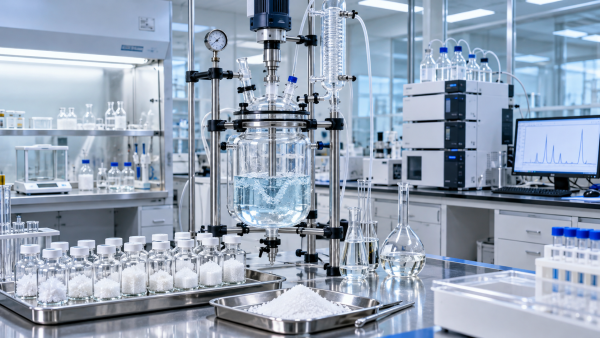
Laboratory research for a new active pharmaceutical ingredient (API) can take several months to several years, depending on what “new” means and what the laboratory must deliver. Producing a first sample of an already defined molecule is a much narrower task than developing a reproducible synthesis, understanding impurities, and establishing a process suitable for scale-up.
A practical planning distinction is between making the molecule and developing a reliable way to manufacture it. Initial synthesis may be achievable within weeks or months when the chemistry and starting materials are accessible. Process development can require many additional months and, when major technical problems remain unresolved, extend beyond a year. Discovering and selecting an entirely new drug candidate involves a broader research program that may take years before API process development has a stable target.
What does “laboratory research for a new API” actually include?
The phrase can describe substantially different assignments. A supplier may call an API “new” because it has never manufactured the compound, even though published synthesis routes and established specifications already exist. A drug developer may use the same term for a new molecular entity whose chemistry, biological properties, and eventual manufacturing requirements remain uncertain.
Those projects should not share the same scheduling assumptions. Reproducing a documented route starts with a defined destination. Investigating an unfamiliar molecule may require route invention, repeated changes to the candidate structure, or work on an alternative salt or solid form.
Laboratory work may also cover different endpoints:
- First confirmed synthesis: enough material to establish identity and support initial investigation.
- Research supply: reproducible preparation of material meeting an agreed specification for a defined study.
- Process development: improvement of synthesis, isolation, purification, and analytical controls.
- Scale-up preparation: evidence that the proposed process can be transferred to larger equipment with appropriate safety and quality controls.
A delivery date becomes meaningful only after the endpoint is defined. “Research completed” should therefore be tied to specific material, data, and documentation—not simply to a successful reaction.
What is a reasonable timeline for each stage?
No universal industry timetable applies to all APIs. The following horizons are broad planning guides, not statistical averages or supplier commitments. They assume that a molecule has already been selected; they do not include the full drug-discovery program.
These stages overlap and should not be added mechanically. Analytical development can begin while routes are being evaluated. Safety testing can eliminate an unsuitable route before extensive optimization. Conversely, a late route change can force substantial analytical and impurity work to be repeated.
For an unfamiliar small-molecule API, a schedule expressed in months is generally more credible than an unconditional promise of completion within a few weeks. However, a long schedule is not automatically evidence of thorough research: its credibility depends on defined experiments, decision points, and deliverables.
Why does the first successful synthesis not establish the completion date?
A first synthesis proves that the target can be made under the tested conditions. It does not establish that the process is reproducible, economical, safe at larger scale, or capable of consistently meeting the intended quality requirements.
A laboratory procedure might depend on chromatography, very dilute reaction conditions, unusual reagents, or tightly controlled addition rates. These can be acceptable for producing a small research sample but create problems when larger quantities are required. Replacing such operations with scalable alternatives is development work, not merely a purchasing or equipment task.
Purification illustrates the difference. Obtaining one clean sample does not explain where impurities originate, whether they accumulate when solvents are recycled, or whether the isolation process reliably removes them. A route may require changes to reaction conditions or intermediate purification before its impurity profile becomes manageable.
The more useful milestone is reproducible performance against an agreed specification. Even that milestone must state the scale, number of demonstrated preparations, analytical methods, and intended use of the material.
Which technical problems are most likely to extend the schedule?
Molecular complexity matters, but step count alone is a weak predictor. A longer route with established reactions may be easier to develop than a short route containing one poorly selective or hazardous transformation.
Stereochemical control can be decisive. If the API requires a particular stereoisomer, the process must reliably achieve and measure the necessary selectivity. Developing asymmetric chemistry or a practical separation can become the critical path.
Unstable intermediates create a different problem. Material may degrade during storage, work-up, or analysis. The laboratory then needs to distinguish reaction failure from handling-related loss and determine whether intermediates should be isolated, stored under controlled conditions, or carried directly into the next step.
Solid-state behavior can also change the timeline. Salt selection, polymorphism, solvate formation, and crystallization behavior may affect isolation, stability, and downstream formulation. Not every early project requires an exhaustive solid-form program, but an unresolved form can undermine an otherwise successful synthesis.
Starting-material availability adds calendar time without necessarily increasing experimental difficulty. A custom intermediate, specialized catalyst, or impurity reference standard may require external preparation. If those materials are on the critical path, laboratory capacity alone cannot shorten the schedule.
How much time do analytical methods and impurity studies add?
They should be treated as part of API development rather than a final inspection step. Without suitable analytical methods, apparent improvements in yield or purity may be misleading. A method may fail to separate a relevant impurity, detect degradation, or distinguish closely related stereoisomers.
Early research can use methods sufficient for the immediate experimental question. As the intended use advances, stronger evidence of method suitability and, where required, validation becomes necessary. The required work depends on the development stage and applicable regulatory expectations; full commercial-stage validation should not be assumed for every exploratory sample.
Impurity characterization may require isolation, structural analysis, or synthesis of reference materials. Certain potentially mutagenic impurities need particular attention under the principles of ICH M7. ICH Q3A addresses impurities in new drug substances within its scope. Neither guideline establishes a fixed laboratory research duration.
A “high-purity” result is therefore not a complete assessment of readiness. The relevant questions are what the method measures, which impurities remain unidentified, and whether the specification is appropriate for the material’s intended use.
Does preparing for GMP production mean laboratory research is finished?
No. Laboratory research, GMP manufacturing, and regulatory readiness are related but distinct. A successful development batch does not by itself demonstrate process validation, establish a complete control strategy, or support every proposed clinical or commercial use.
ICH Q11 provides principles for drug-substance development and manufacture, while ICH Q7 addresses GMP for APIs within its scope. These frameworks help define appropriate controls and documentation; they do not prescribe a standard number of months for research.
Preparation for a GMP campaign may require technology transfer, equipment assessment, approved manufacturing instructions, suitable analytical procedures, and qualified material sources. Some activities proceed alongside laboratory development, while others depend on decisions that the laboratory has not yet resolved.
GMP status also does not mean that an API is automatically approved for a particular medicine or market. A timeline should distinguish laboratory completion, first GMP manufacture, regulatory submissions, and commercial readiness rather than combining them under one “API development” date.
Why can scale-up send a project back to the laboratory?
Larger equipment changes the conditions under which chemistry occurs. Mixing, heat removal, reagent addition, filtration, and drying may behave differently from their laboratory equivalents. A reaction that appears controlled in a small vessel can generate unacceptable heat accumulation or a different impurity profile at larger scale.
Isolation can become the bottleneck even when the reaction transfers successfully. Fine particles may filter poorly, a slurry may become difficult to handle, or drying conditions may alter the solid form. Resolving these problems can require new crystallization conditions or changes earlier in the synthesis.
Laboratory completion should therefore not be interpreted as a guarantee that the process will scale without modification. A credible handover identifies the operating ranges already investigated, the assumptions behind equipment selection, and the remaining experiments needed before increasing batch size.
Can parallel work or automation shorten the research period?
Yes, when the limiting factor is experimental capacity. Parallel route screening, reaction optimization, and early analytical development can reduce waiting between decisions. Automated experimentation can help explore defined variables efficiently.
These approaches do not eliminate scientific dependencies. Impurity standards may not be available until an impurity has been identified. Detailed optimization may have limited value before the route is selected. Stability evidence also needs sufficient observation time for the intended decision; it cannot be replaced simply by running more synthesis experiments.
A sensible accelerated program distinguishes tasks that can proceed independently from those that depend on earlier results. Starting every activity immediately can increase expenditure and rework if the molecule, route, or solid form subsequently changes.
How should a supplier’s proposed timeline be evaluated?
The strongest proposals separate experimental progress from calendar dependencies. They identify what is already known, what must be demonstrated, and which external materials or decisions could delay the work.
Useful questions include:
- Does the schedule begin from a published route, an internally demonstrated route, or an untested proposal?
- What quantity, specification, and documentation define successful completion?
- Which starting materials and reference standards are already available?
- How will reproducibility be demonstrated before the process is transferred?
- Which impurity, solid-form, or safety questions remain open?
- What result would trigger route redesign or a revised delivery date?
Milestone-based schedules are more informative than a single final deadline. Route feasibility, reproducible synthesis, impurity characterization, and scale-up readiness represent different levels of evidence. Payments and supply commitments can be aligned with those deliverables without pretending that all scientific uncertainty has disappeared.
For cross-border projects, separate the research completion date from the date material can actually be received and used. Shipping arrangements, import requirements, release documentation, and destination testing may affect availability even after laboratory work is complete.
The defensible answer to “how long does laboratory research typically take for new APIs?” is therefore months for a defined synthesis and development assignment, potentially years when discovery or substantial process uncertainty is included. The decisive planning document is not a generic duration: it is an agreed endpoint supported by demonstrated chemistry, appropriate analytical evidence, and an explicit account of what remains unresolved.
Related Intelligence
- APIs & IntermediatesProcurement Planning: Which Resource Reports Help Prevent Material Shortages?Discover how procurement planning resource reports reveal usable stock, shortage dates, and supplier risks so you can prevent material shortages and keep production on track.
- APIs & IntermediatesHow Long Does Laboratory Research for New APIs Typically Take?How long does laboratory research typically take for new APIs? Explore realistic timelines, key delays, and supplier milestones to plan development with confidence.
- APIs & IntermediatesBuyer-Focused Vendor Screening: How Procurement Teams Verify Supplier Fit and RiskBuyer-focused vendor screening helps procurement teams verify supplier fit, compliance, quality, and supply-chain resilience—reduce risk and make smarter sourcing decisions.
The Morning Broadsheet
Daily chemical briefings, market shifts, and peer-reviewed summaries delivered to your terminal.
