

The Authority in Global Agricultural Chemistry & Bio-Resources
Sanitary Design Risks in Milk Processing Tanks and How Plants Can Reduce Them
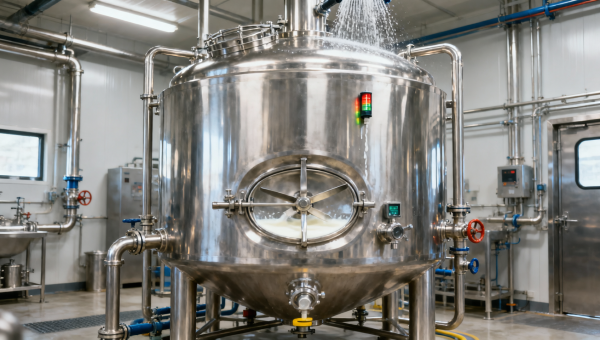
Where sanitary failures usually start in dairy tank systems
Milk does not tolerate poor surface hygiene for long. A storage or mixing vessel can look clean after a rinse and still hold product residues in weld shadows, dead legs, gasket grooves, outlet seats, or temperature probe ports. For quality and safety teams, that gap between visual cleanliness and microbiological cleanliness is where many tank-related failures begin.
In milk processing, the tank is rarely an isolated asset. It sits between cooling, transfer, mixing, holding, and cleaning steps. If sanitary design is weak at any of those points, contamination risk spreads beyond one vessel. The result may be elevated plate counts, flavor defects, shortened shelf life, recurring environmental positives, or batch segregation while teams try to identify the source.
The risk is higher when plants process multiple products, switch between raw and pasteurized streams, or run long hold times. Even a well-managed CIP routine can struggle if the vessel geometry, internal fittings, drainability, or agitator design make full cleaning difficult.
Why milk tanks create unique sanitary challenges
Milk leaves behind proteins, fat films, mineral deposits, and biofilm precursors that behave differently across temperatures. Cooling slows microbial growth, but it also changes viscosity and residue behavior. Mixing improves uniformity, yet agitators, baffles, and shaft seals add surfaces and crevices that must be cleaned effectively. Tanks that alternate between storage and blending often face the most difficult balance: they need stable temperature control, gentle product handling, and hygienic internals that remain fully cleanable after every cycle.
That is why quality and safety personnel should evaluate sanitary design together with process duty. A tank built mainly for volume may not perform well when frequent cleaning, rapid product changeover, or sensitive dairy formulations are involved. In practice, the sanitary suitability of milk processing tanks depends on more than stainless steel grade alone.
Common sanitary design risks that quality teams should inspect
Dead zones and incomplete product sweep
Any area with weak fluid movement can trap milk solids. This often happens near poorly placed nozzles, oversized ports, internal ladders, support brackets, or horizontal connections that do not self-drain. During production, such pockets collect residue. During cleaning, they may receive less mechanical action, lower detergent concentration, or reduced rinse flow.
Teams usually notice this problem indirectly: repeated swab positives in the same location, residue after maintenance access, or unexplained quality drift after extended production runs. Mapping these repeat findings against vessel geometry often reveals that the issue is structural rather than procedural.
Rough welds, pits, and surface damage
Sanitary performance depends heavily on surface finish and weld quality. Over-ground welds, undercut areas, porosity, and heat tint can all create adhesion points for milk solids and microorganisms. Minor mechanical damage from tools or aggressive cleaning can also turn a previously acceptable surface into a recurring trouble spot.
Inspection should not stop at visible shell seams. Agitator mounts, manway surrounds, sensor ferrules, and outlet assemblies deserve equal attention because they often combine weld complexity with frequent exposure to product buildup.
Drainability problems after cleaning
A tank that does not fully drain after a rinse or CIP cycle carries two problems into the next run: residual cleaning solution and residual water. The first can affect product chemistry or flavor. The second can dilute product and create conditions for microbial growth in low-flow areas. Sloped bottoms, outlet positioning, internal geometry, and installation level all influence how much liquid remains behind.
This is one reason sanitary review should include the installed condition, not only the fabrication drawing. A well-designed vessel can lose hygienic performance if it is set out of level, connected with poorly routed piping, or modified during site commissioning.
Agitator and seal hygiene weaknesses
Mixing systems are frequent risk points in dairy plants. Shaft penetrations, seal housings, and blade attachments are harder to clean than open shell surfaces. If the process requires intermittent blending during cooling or holding, residues may repeatedly dry and re-wet around these features, making them more difficult to remove. Agitation speed also matters. Excess shear can entrain air or destabilize some formulations, while insufficient circulation leaves temperature or fat distribution uneven.
When plants are reviewing milk processing tanks for storage, blending, or cooled holding, the hygienic design of the agitator zone deserves the same attention as tank capacity and cooling performance. A vessel may meet process volume requirements yet still create sanitation headaches if the mixing assembly introduces hard-to-clean details.
Instrument connections that compromise cleanability
Temperature probes, level sensors, sample valves, pressure instruments, and sight devices are necessary, but each penetration creates a sanitation decision. Long insertion lengths, poorly oriented ports, and fittings that extend into the product zone can become residue traps. Sample valves are especially sensitive because they are touched often and may not be cleaned with the same consistency as fixed piping.
For safety managers, this is also a procedural issue. The more manual contact points a system has, the stronger the need for controlled sanitation steps, verification frequency, and maintenance discipline.
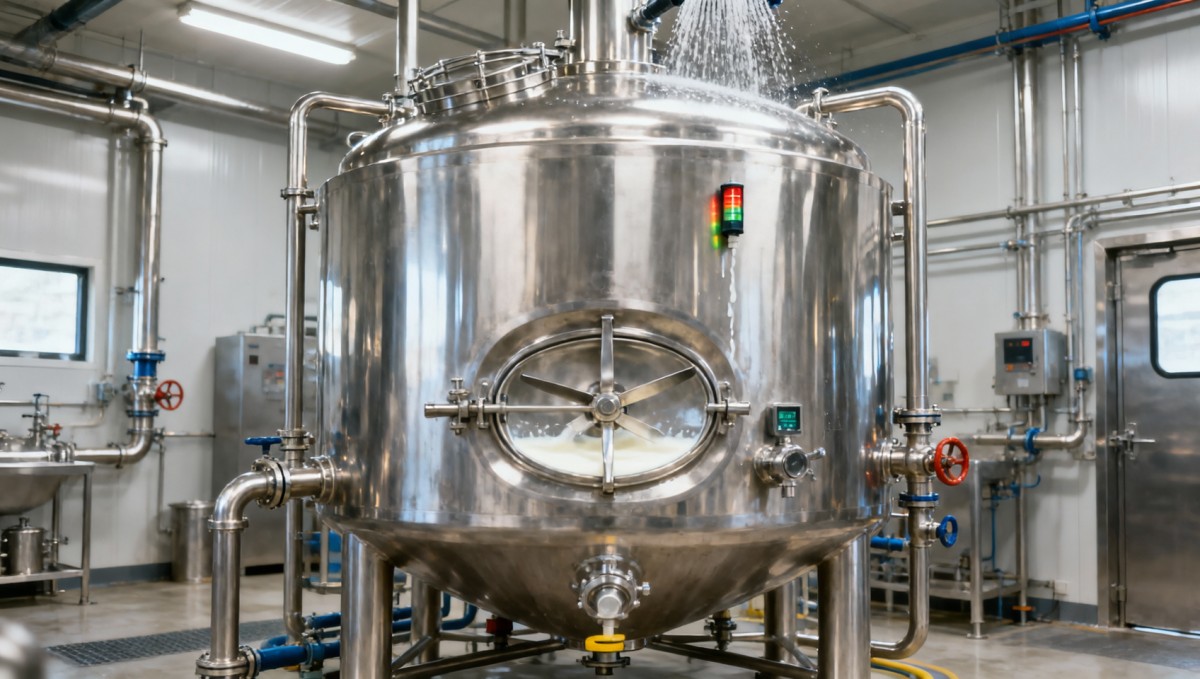
Cooling and temperature control can either reduce risk or hide it
Cooling is often treated as the main protection step in raw milk storage, but low temperature is not a substitute for hygienic design. It suppresses microbial growth; it does not remove residues or prevent contamination from persistent niches. In fact, tanks with uneven cooling may allow warmer boundary zones near the top, around fittings, or in low-circulation corners. Those areas can become disproportionate contributors to quality loss.
Quality teams should pay attention to:
- Whether cooling jackets or plates create uniform product temperature throughout the vessel
- How mixing supports temperature consistency without creating extra sanitary risk
- How long milk remains in the tank before transfer or further processing
- Whether startup and shutdown periods leave product in partially controlled conditions
Temperature records can look acceptable at the bulk level while local deposits remain undisturbed. If shelf-life variation persists despite compliant cooling logs, sanitary design around low-flow internals should move higher on the investigation list.
Why CIP success is often a design question before it becomes an operations question
Plants frequently respond to contamination events by strengthening chemicals, extending wash time, or increasing cleaning frequency. Those steps may help, but they do not solve a tank that is inherently difficult to clean. Effective CIP depends on four conditions working together: correct chemistry, temperature, exposure time, and mechanical action. Tank design directly influences the fourth factor and can limit the value of the other three.
A vessel with poor spray coverage, shadow areas behind internals, or weak return flow may never receive consistent cleaning action no matter how carefully the CIP skid is operated. In those cases, operators end up compensating with longer cycles, more water, more detergent, and more downtime.
For quality and safety teams, a useful check is to compare recurring hygiene issues with CIP repeatability:
Checks that should be built into tank specification and acceptance
Many sanitary problems are cheaper to prevent during specification than to correct after installation. Procurement documents often focus on volume, material, pressure, and cooling duty, while sanitary details remain too general. That leaves room for tanks that satisfy mechanical requirements but create avoidable quality risk in service.
For new projects or replacements, quality and safety teams should push for clearer review points:
- Internal finish expectations for product-contact surfaces
- Weld quality and finishing requirements at all product-contact points
- Proof of drainability in the intended installed orientation
- Cleanability of agitators, seals, sample valves, and instruments
- Access for inspection of top head, bottom outlet, and mixing components
- CIP device placement relative to internals and shell geometry
- Compatibility with the plant’s actual cleaning chemistry and cycle profile
If the vessel will handle both cooling and mixing, those functions should be evaluated together. A tank optimized for gentle storage may need different internal arrangements than one used for frequent ingredient blending. The same vessel can perform well in one duty and poorly in another.
Operational habits that often amplify sanitary design weaknesses
Even a hygienic vessel can drift into higher risk when plant routines do not match design assumptions. Long idle periods with residual moisture, delayed cleaning after emptying, partially opened valves during CIP, and unverified reassembly after maintenance all increase exposure. In milk systems, small execution gaps tend to show up quickly because residues are nutrient-rich and temperature-sensitive.
Several plant habits deserve close review when tank-related hygiene issues persist:
- Running longer campaigns than the vessel was effectively validated for. Extended holds may be workable under some conditions, but they place more stress on mixing uniformity, cooling stability, and residue control.
- Treating every dairy product the same. Cream-rich products, fortified milk, and blends with added solids can leave different deposit patterns from standard raw or pasteurized milk.
- Focusing on chemical concentration while ignoring mechanical cleanability. Stronger chemistry cannot fully offset dead zones or bad weld geometry.
- Approving repairs without sanitary review. Replacement fittings, field welds, or improvised supports can quietly introduce hard-to-clean features.
How to reduce risk without waiting for a major equipment replacement
Not every plant can replace a problematic vessel immediately. Risk reduction often starts with a structured sanitary gap review. Walkdowns should involve production, quality, maintenance, and CIP personnel together, because each group sees a different part of the problem. Maintenance may notice recurring seal wear; operators may know where foaming or poor mixing occurs; quality may see the same swab trend returning after every weekend shutdown.
Practical improvement steps usually include rechecking spray coverage, shortening unsupported instrument intrusions, improving drain orientation, replacing damaged gaskets, tightening inspection after maintenance work, and separating duties between storage and heavy mixing where feasible. Some plants also benefit from revising hold-time limits or cleaning triggers based on product type rather than using a single rule for every run.
Where tank replacement is under review, the key question is not simply whether a new vessel can hold the required volume. It is whether the cooling, mixing, access, and cleanability features match the plant’s actual hygiene risk profile. That is the point at which sanitary design stops being an engineering detail and becomes a preventive control.
What quality and safety managers should prioritize
The most useful mindset is to treat recurring tank sanitation issues as a system interaction: product behavior, vessel geometry, temperature control, mixing duty, CIP effectiveness, and maintenance practice all overlap. If one factor is weak, the others may hide the problem temporarily but rarely remove it.
For milk operations, the highest-value checks are usually the least glamorous ones: whether the vessel drains completely, whether fittings are truly hygienic in place, whether cooling is uniform, whether agitator assemblies remain cleanable over time, and whether acceptance criteria covered real operating conditions instead of nominal design claims. Plants that manage those points well are generally better positioned to control contamination risk before it reaches finished product or triggers repeated investigation cycles.
Related Intelligence
- Grain Silos & StorageHow Modular Feed and Grain Systems Support Scalable Storage and Processing ExpansionModular feed and grain systems enable smarter, scalable expansion across storage, conveying, processing, and loadout. Discover how to eliminate bottlenecks, protect future capacity, and keep operations moving.
- Grain Silos & StorageHow to Size a Grain Pre-Cleaner for Capacity, Crop Type, and Impurity LoadGrain pre cleaner machine sizing guide: match capacity, crop type, moisture, and impurity load to improve flow, separation quality, and downstream performance.
- Grain Silos & StorageHow Can You Verify That a Grain Handling System Meets Export Standards?How do I know if a grain handling system meets export standards? Explore practical checks for traceability, sanitation, quality control, and export-ready compliance.
The Morning Broadsheet
Daily chemical briefings, market shifts, and peer-reviewed summaries delivered to your terminal.
