

The Authority in Global Agricultural Chemistry & Bio-Resources
HACCP in Food Enzyme Processing: Hazard Analysis and Critical Control Points
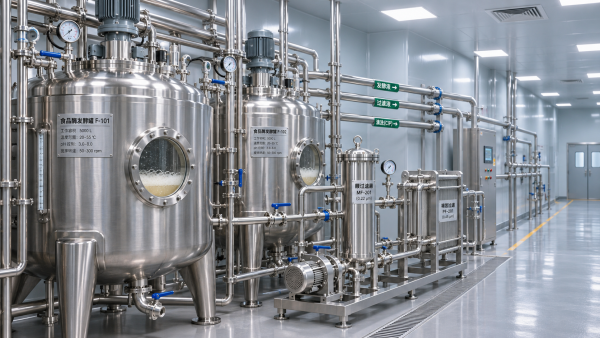
HACCP in food enzyme processing starts with a product-specific hazard analysis: identify hazards that are reasonably likely to require control, determine where those controls belong, and establish critical control points only where a step is essential to prevent, eliminate, or reduce a significant hazard to an acceptable level. A fermentation parameter, filtration step, or metal detector is not automatically a CCP; its designation depends on the organism, process, intended use, and other controls in place.
The assessment must cover the enzyme preparation as supplied, including carriers, stabilizers, and other formulation ingredients. Enzyme activity is an important quality attribute, but an activity result alone does not establish microbiological or chemical safety.
Define the product and process before assigning CCPs
A useful HACCP plan begins with a precise product description: enzyme identity and source, production strain where applicable, physical form, formulation ingredients, storage conditions, intended food uses, and expected handling by the customer. Record whether the enzyme is intended for use in a process with a subsequent validated kill step or in a food that receives no further lethal treatment. That distinction affects the significance of microbial contamination and the controls needed before release.
Map the actual process, including material transfers, hold tanks, rework, shared equipment, cleaning, packaging, and storage. For a fermentation-derived preparation, the main path may run from inoculum preparation and fermentation through cell separation, concentration, formulation, and filling. Other enzymes originate from plant or animal material and require a different analysis of source-specific contaminants and raw-material handling.
Confirm the flow diagram against operations on the production floor. A temporary collection vessel or a recovered process stream can introduce a hazard that is invisible in a simplified diagram. The plan should also identify where equipment is open, where product is held without temperature control, and where materials from different batches are combined.
Separate prerequisite controls from critical control points
HACCP relies on prerequisite programs for conditions such as sanitation, water quality, supplier approval, maintenance, pest control, personnel hygiene, and traceability. These controls are part of the food safety system even when they are not designated CCPs. Their effectiveness matters: a recurring sanitation failure can change the hazard assessment and require stronger controls at a particular step.
For each hazard, consider its severity and likelihood in the absence of the control being assessed. Then identify a control measure and determine whether a later step will reliably address the hazard. A CCP requires a measurable or observable critical limit, monitoring capable of detecting loss of control, and an action when that limit is exceeded. A step may instead be managed through a documented prerequisite or operational control when that arrangement is appropriate to the hazard analysis.
For example, a validated heat treatment could be a CCP if it is relied on to control a significant microbial hazard. Temperature alone would be incomplete: the limit must reflect the validated time and temperature combination, product flow, and the coldest or least-treated part of the system. Conversely, a heat step used mainly to adjust enzyme activity should not be assumed to provide a microbial reduction without supporting evidence.
Hazards across enzyme production
Raw materials and production organisms
Incoming substrates, nutrients, processing aids, water, and formulation ingredients can introduce microorganisms, chemical contaminants, allergens, or foreign material. The relevant hazards vary with origin and processing. A plant-derived substrate, for example, calls for consideration of contaminants associated with its source; a mineral processing aid requires controls appropriate to its composition and intended use. Supplier specifications and verification results should address the hazards identified for the material rather than relying solely on a general certificate of analysis.
For microbial enzymes, document the identity and suitability of the production organism and the controls that maintain strain integrity. An approved strain record does not establish that every fermentation is free from contamination. Culture handling, inoculum transfers, equipment sanitation, and investigation of unexpected growth patterns remain relevant. Where the organism or a contaminant has the potential to produce an undesirable metabolite, the hazard assessment should address how its presence is prevented, controlled, or assessed.
Source materials also affect allergen management. Carryover from a substrate or formulation ingredient must be evaluated with reference to the finished preparation and applicable requirements. A shared production line introduces a separate cross-contact pathway that cleaning validation and changeover controls must address.
Fermentation and intermediate holds
Temperature, pH, aeration, and fermentation time influence growth and enzyme yield, but a normal process trend does not prove the absence of a contaminant or toxin. Equally, an abnormal trend does not identify the cause: equipment faults, feed changes, and microbial contamination can produce similar signals. Investigations should connect process data with sampling, equipment history, and the identity of the material affected.
Intermediate holds deserve particular attention when product is transferred between fermentation, separation, and concentration. Record the start and end of the hold, product temperature where relevant, vessel status, and any exposure to the environment. A hold limit should be supported by evidence for the specific material and conditions; a limit established for a concentrated preparation cannot automatically be applied to an earlier, nutrient-rich broth.
Where a deviation creates conditions favorable to growth, returning the vessel to its target temperature does not establish that the intervening exposure was safe. Assess the entire time outside the established conditions, the hazards involved, and the ability of later steps to control them before deciding the batch disposition.
Separation, filtration, and concentration
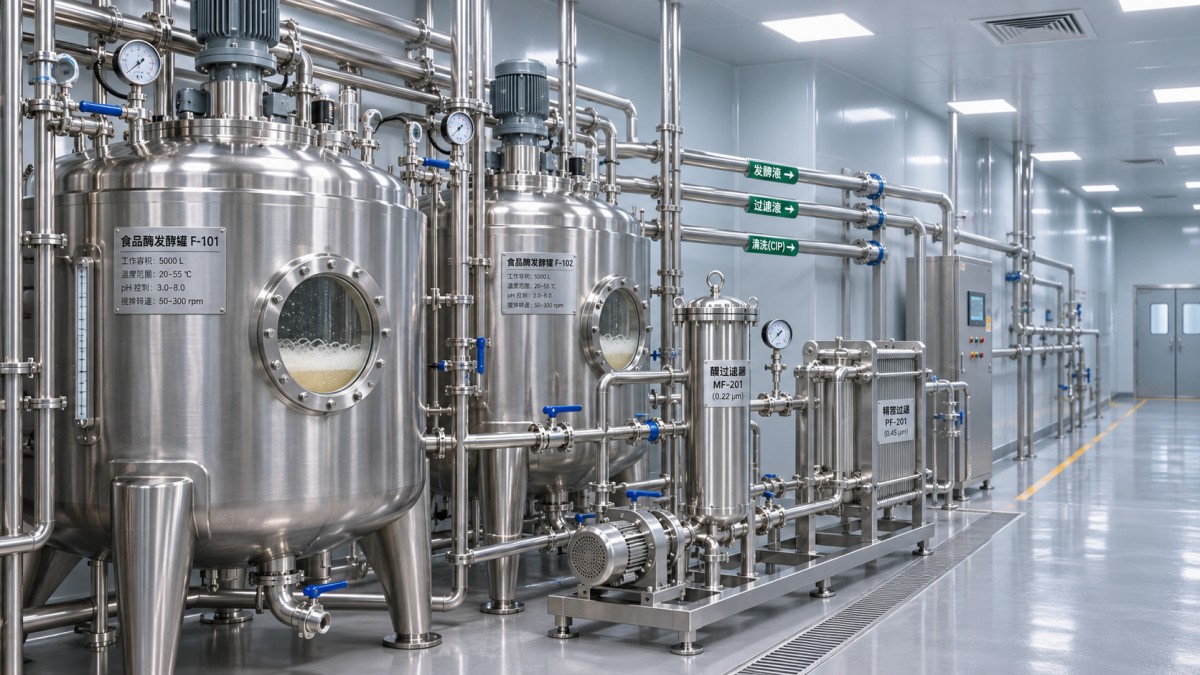
Cell removal and clarification reduce suspended material, but their safety significance depends on the validated performance of the equipment and the hazard being controlled. A filter selected to remove cells or improve clarity is not necessarily capable of retaining a smaller contaminant. Pore size claims, membrane integrity, differential pressure, and the characteristics of the process fluid need to be interpreted together.
Concentration changes the mass balance. A contaminant that passes into the retained fraction can become more concentrated along with the enzyme. Likewise, a reduction in viable cells does not demonstrate removal of a heat-stable or soluble substance. The hazard analysis should identify which fraction contains the enzyme, where a particular contaminant would be expected to go, and what evidence supports its removal or control.
Filter damage, bypass leakage, and incorrect assembly can defeat an otherwise suitable separation step. Where filtration is a safety control, define the relevant integrity or operating checks, their timing, and the response to a failed result. A failed post-use test calls for assessment of all material processed since the last acceptable indication of integrity, subject to the established investigation procedure.
Formulation, drying, and packaging
Downstream handling can reintroduce hazards after an earlier control step. Carriers and stabilizers require their own specifications and receipt controls; dry ingredients can contribute contamination even when the enzyme concentrate was previously treated. Water added during standardization should meet the requirements established for its use, and tanks and filling equipment need effective cleaning between products.
Drying changes the risk profile but does not automatically make a product sterile. Residual moisture and storage conditions affect stability and, where conditions permit, microbial growth. If drying is relied on for pathogen reduction, its safety performance must be validated for the product and equipment rather than inferred from the final moisture result.
Physical hazards require attention at milling, blending, sieving, and packing. A metal detector or other foreign-material control should be selected for the hazard and product presentation. Its demonstrated sensitivity must account for the actual pack, product effect, and contaminant characteristics. Challenge tests verify the system under defined conditions; they do not establish that every possible fragment will be detected.
Set limits that can be monitored and acted on
A critical limit separates acceptable from unacceptable operation at a CCP. It should be tied to the hazard and supported by validation, which may include scientific evidence, equipment studies, and process-specific trials. For a thermal step, the validated conditions must cover relevant product properties, such as viscosity and solids content, as well as equipment behavior during startup, normal flow, and shutdown.
Monitoring must occur often enough to identify affected product if control is lost. Continuous recording can show a process trend, but only if the sensor is correctly located, calibrated, and reviewed. A periodic manual reading can miss a short excursion between checks. Where a CCP uses a detection device, monitoring includes confirming the device and rejection mechanism function under the specified test conditions.
Define corrective action before an incident occurs. The action needs to restore control, identify and segregate potentially affected material, evaluate its disposition, and record the investigation. Reprocessing is acceptable only under an assessed procedure that demonstrates the hazard can be controlled and that the reprocessing itself does not introduce a new problem. A passing finished-product sample alone may be insufficient to release a batch when contamination is unevenly distributed or the sampling plan cannot detect it reliably.
Verification, records, and changes
Validation establishes that a control measure is capable of controlling the hazard under defined conditions. Verification establishes that the plan is being followed and remains effective. Depending on the control, verification can include review of monitoring and deviation records, calibration, inspection of equipment, internal audits, and targeted analytical testing. Testing is most useful when the sampling location, method, and acceptance criteria answer a specific question about the process.
Records should connect each batch to its raw materials, process conditions, CCP monitoring, deviations, disposition, and distribution. Where batches are pooled or reworked, traceability needs to preserve the relationship between contributing lots and the finished lots. This is especially important when a later investigation identifies an issue in a shared intermediate.
Reassess the HACCP plan when a change could alter the hazard or the performance of a control: a new production strain, substrate, membrane, formulation ingredient, equipment configuration, hold time, or intended use. An equivalent activity result after a process change does not by itself confirm equivalent safety. Document the assessment and complete any necessary validation before relying on the revised process.
HACCP plans should align with the food safety requirements applicable to the product and its markets. Certification to a food safety management scheme, where pursued, involves the scheme’s full requirements and audit process; a HACCP plan alone does not establish certification.
Related Intelligence
- Food Grade EnzymesHACCP in Food Enzyme Processing: Hazard Analysis and Critical Control PointsHACCP enzyme processing: Discover how to assess hazards, identify critical control points, and strengthen food enzyme safety from fermentation to packaging.
- Food Grade EnzymesWhat Drives Industrial Enzyme Costs? Activity, Format, and Supply Risk ExplainedIndustrial enzyme cost factors explained: compare activity, formulation, shelf life, documentation, and supply risk to reduce process costs and improve purchasing decisions.
- Food Grade EnzymesIs There a Global Standard for Biochemical Engineering Product Quality?Is there a global standard for biochemical engineering product quality? Explore GMP, ISO, traceability, and supplier checks for confident global sourcing.
The Morning Broadsheet
Daily chemical briefings, market shifts, and peer-reviewed summaries delivered to your terminal.