

The Authority in Global Agricultural Chemistry & Bio-Resources
Maca Root Extract Bulk Buying Guide: Specs, Purity Grades, and MOQ Explained
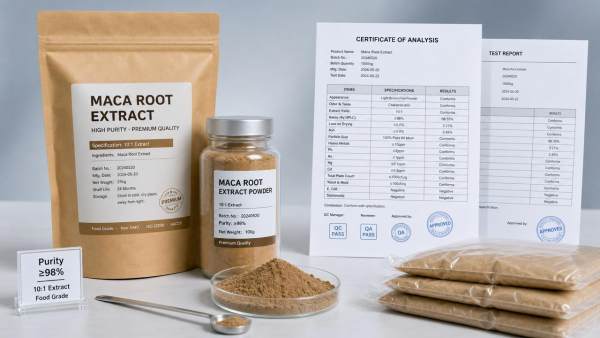
Why does maca root extract bulk buying require more than a price comparison?
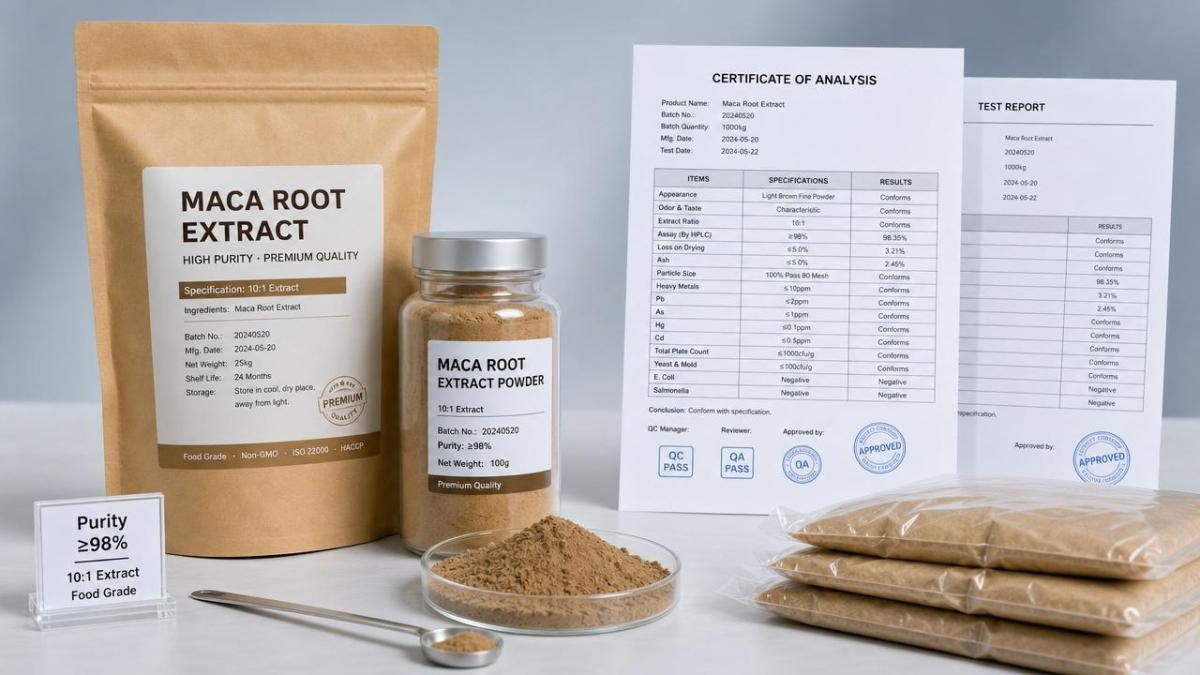
Maca root extract bulk sourcing looks simple at first glance. A quote arrives, a potency number appears, and the unit cost seems easy to compare.
In practice, the real difference sits behind the specification sheet. Extract ratio, marker compounds, carrier content, and moisture all affect usable value.
That is why serious buyers rarely judge maca root extract bulk offers by price per kilogram alone. They compare effective content, compliance, and supply consistency together.
This matters even more in regulated ingredient chains. ACC often highlights that bio-extract procurement now overlaps with traceability, audit readiness, and cross-border documentation.
A low quote can become expensive if the batch fails identity testing, contains undeclared excipients, or cannot support label claims in downstream products.
So the better question is not just, “What does maca root extract bulk cost?” It is, “What exactly is being priced, and how reliably can it be supplied?”
What specifications actually matter when comparing maca root extract bulk offers?
Most confusion starts with the word “specification.” Suppliers may use it to describe extract ratio, assay level, physical appearance, or a full quality standard.
For maca root extract bulk procurement, five items usually deserve early attention.
- Extract ratio, such as 4:1, 10:1, or 20:1, showing concentration relative to raw root.
- Marker or active testing, where applicable, including macamides or other agreed compounds.
- Carrier and excipient content, especially maltodextrin or starch used for spray drying.
- Microbiological limits, heavy metals, pesticide residues, and solvent compliance.
- Physical form, including mesh size, color variation, solubility behavior, and moisture.
Extract ratio is often misunderstood. A higher ratio does not automatically mean better quality if raw material quality, processing temperature, or filler content are unclear.
More useful is a combined reading of ratio and test method. If one supplier offers 10:1 and another offers 4:1 with validated marker testing, the second quote may be stronger.
Need-to-know details should be confirmed before sample approval. This avoids later disputes over whether the delivered maca root extract bulk matches the original offer.
A quick comparison table helps separate headline claims from usable purchasing data
This kind of screening is common in fine chemicals and botanical ingredients alike. The logic is simple: compare what will actually enter production, not what only sounds impressive.
How should purity grades be read without falling for marketing language?
Purity grades in maca root extract bulk trade are not always standardized in the same way as synthetic APIs. That creates room for vague wording.
Terms like “premium,” “high purity,” or “pharma grade” can appear in sales sheets. On their own, those labels say very little.
A safer interpretation starts with documentary evidence. Ask whether the grade refers to active concentration, reduced contaminants, process control, or intended application.
For example, one maca root extract bulk grade may target dietary supplement blending. Another may be developed for tablets, instant beverages, or functional premix systems.
The grade then relates to flowability, moisture, bulk density, and microbial performance as much as to concentration. That distinction changes buying decisions.
More credible suppliers usually explain purity through measurable criteria:
- Declared active or marker range
- Absence or limit of residual solvents
- Carrier percentage and allergen status
- Compliance with food, supplement, or local import standards
- Third-party test support or validated in-house methods
If “high purity” cannot be linked to a COA, specification, or process statement, it should not influence supplier ranking.
That cautious approach mirrors ACC’s broader editorial view on ingredient markets. In complex supply chains, definitions must be backed by verifiable standards.
MOQ looks simple on paper, so why does it change the real landed cost?
Minimum order quantity is more than a negotiation point. It affects freight efficiency, warehouse planning, shelf life exposure, and cash tied up in safety stock.
With maca root extract bulk, MOQ often varies by grade, packaging format, and whether the material is standard stock or custom processed.
A small MOQ may sound attractive, especially for trial-stage demand. Yet the unit price can rise sharply because production changeovers and testing costs are spread across fewer kilograms.
On the other hand, a larger MOQ may reduce the quote but increase expiry risk. Botanical extracts can lose commercial value if inventory turns are slower than expected.
A practical way to assess maca root extract bulk MOQ is to compare three numbers together:
- Consumption over one release cycle
- Lead time including customs and retesting
- Shelf life remaining at delivery
If MOQ exceeds likely use during a stable shelf-life window, the apparent discount may not be a real saving.
In actual sourcing rounds, better outcomes often come from discussing staggered releases, blanket orders, or shared forecasting rather than pushing only for a lower MOQ.
What MOQ questions are worth asking before final approval?
A short checklist can reveal whether the quoted MOQ is operationally manageable or only commercially convenient for the seller.
- Is the MOQ tied to one batch, one pallet, or one packaging configuration?
- Can the order be split across multiple scheduled shipments?
- Does each release keep the same COA parameters?
- Will custom labeling or documentation increase MOQ?
- What happens if crop variation changes color or assay mid-contract?
When two quotes look similar, what usually separates a dependable supplier?
The shortlist often becomes difficult when two maca root extract bulk offers land in the same price band. That is where non-price evidence becomes decisive.
First, check traceability depth. Can the supplier connect batch records to origin, harvest season, extraction lot, and final packaging records?
Next, look at testing discipline. One current COA is useful, but trend consistency across multiple lots is more revealing.
It also helps to review responsiveness around technical questions. Reliable partners usually answer directly about methods, deviation handling, and specification tolerances.
For maca root extract bulk, stronger supplier evaluation usually includes these checks:
- Audit documents for GMP, HACCP, ISO, or equivalent controls
- Origin transparency for raw maca and extraction location
- Change notification process for formula, carrier, or test method
- Packaging suitability for moisture and transit stability
- Corrective action history if out-of-spec events occur
This is especially relevant in sectors where botanical ingredients sit beside fine chemical standards. Buyers increasingly expect the same documentation discipline across both categories.
What mistakes raise the cost of maca root extract bulk purchases later on?
The most expensive errors usually happen before the first purchase order is issued. They begin with assumptions left untested.
One common mistake is approving a sample that does not match the commercial batch format. A hand sample may have different moisture or carrier behavior from full production.
Another is treating all 10:1 extracts as interchangeable. Without process and assay detail, that comparison can be misleading.
Some teams also overlook freight and testing friction. A lower ex-works quote can lose its advantage after import clearance, retesting, and delayed release.
Then there is the documentation gap. Missing allergen statements, solvent declarations, or pesticide data can slow product launch more than price differences do.
A cleaner buying process for maca root extract bulk usually follows this sequence:
- Define end-use requirements before requesting quotes
- Align sample, specification, and commercial lot expectations
- Compare effective content rather than list price only
- Review MOQ against lead time and inventory turnover
- Confirm documentation package before contract release
That approach reduces surprises and makes supplier discussions much more productive, especially when scaling from testing volume to routine purchase volume.
So what is the most practical next step before choosing a maca root extract bulk supplier?
Start by converting internal needs into a decision sheet. Include target ratio, marker expectation, carrier limits, micro standards, documentation needs, and realistic order rhythm.
Then request comparable offers in the same format. That sounds obvious, but it is often the missing step behind confusing price gaps.
For maca root extract bulk, the winning offer is usually the one that balances verified quality, stable supply, and workable MOQ with the fewest downstream complications.
In broader ingredient markets, that is also the lesson repeated across ACC coverage. Better procurement decisions come from structured comparison, not from chasing the lowest visible quote.
If a shortlist is already in place, the next useful move is simple: line up each supplier against the same technical checklist, landed-cost model, and batch documentation standard.
That makes the final choice clearer, faster, and far more defensible when maca root extract bulk becomes a recurring part of supply planning.
Related Intelligence
- Botanical ExtractsChoosing Botanical Extracts for Pharmaceuticals: Potency, Purity, and ComplianceBotanical extracts for pharmaceuticals: learn how to assess potency, purity, traceability, and GMP compliance for confident, regulatory-ready supplier selection.
- Botanical ExtractsBotanical Extracts Market Outlook: Supply, Pricing, and Buyer RisksBotanical extracts market insights on supply, pricing, quality control, and buyer risks—compare suppliers confidently and protect your sourcing strategy.
- Botanical ExtractsEurope Botanical Extracts Market: Key Growth Drivers, Risks, and OpportunitiesEurope botanical extracts market insights: explore growth drivers, regulatory risks, supply-chain challenges, and scalable opportunities for compliant, high-value ingredients.
The Morning Broadsheet
Daily chemical briefings, market shifts, and peer-reviewed summaries delivered to your terminal.
