

The Authority in Global Agricultural Chemistry & Bio-Resources
What RO water treatment systems deliver consistent 98% salt rejection at 25°C with feed TDS over 3,000 ppm?
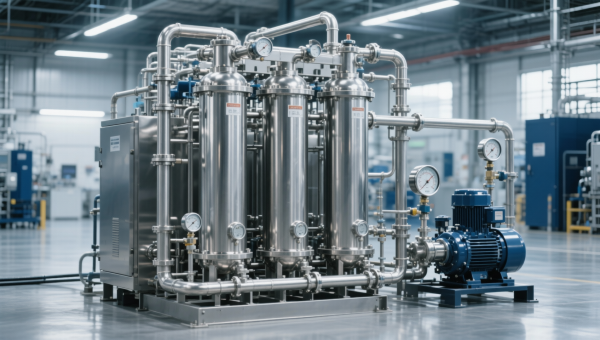
For procurement professionals sourcing high-reliability RO water treatment systems in demanding primary industry applications—such as API synthesis, recirculating aquaculture, or grain processing—consistent 98% salt rejection at 25°C with feed TDS >3,000 ppm isn’t just a spec; it’s a non-negotiable performance benchmark. Systems meeting this threshold are rare—not because the technology is unavailable, but because sustained rejection integrity requires precise integration of membrane selection, hydraulic design, pretreatment rigor, and operational validation under real-world feedwater variability. This report identifies the technical parameters and configuration criteria that reliably deliver that performance level—without over-specification, without vendor-dependent assumptions, and without compromising GMP- or EPA-aligned compliance.
What Actually Enables 98% Rejection at Scale?
Rejection rate alone is misleading. A system may achieve 98% salt rejection in lab-grade deionized water at 25°C—but collapse to 92–94% when fed brackish groundwater with 3,200 ppm TDS, 15 ppm silica, and seasonal organic load spikes. True consistency demands three interdependent conditions: (1) membrane elements rated for ≥99.5% nominal NaCl rejection at standard test conditions (1,500 ppm NaCl, 225 psi, 25°C, pH 7–8), (2) staged pressure recovery and concentrate recycling to maintain optimal crossflow velocity across all stages, and (3) pretreatment that stabilizes silt density index (SDI) below 3.0 and removes divalent cations *before* they precipitate on membrane surfaces.
Single-stage RO systems—even those using high-rejection membranes—cannot sustain 98% rejection across variable feed TDS above 3,000 ppm. The osmotic pressure rise from elevated TDS reduces effective driving pressure, increasing concentration polarization and accelerating fouling. Two-stage configurations with interstage energy recovery (e.g., turbochargers or isobaric ERDs) are not optional here—they’re the baseline requirement. Feed pressure must exceed 250 psi in first stage and remain ≥180 psi in second stage to counteract osmotic backpressure and preserve rejection kinetics.
Membrane Selection: Beyond Catalog Ratings
Not all “high-rejection” membranes behave identically under field conditions. Thin-film composite (TFC) polyamide membranes dominate this performance tier—but their real-world output depends on surface charge density, active layer thickness, and chlorine tolerance. Membranes with zeta potential ≤ −25 mV at pH 7 demonstrate superior rejection of monovalent ions (Na⁺, Cl⁻) under high-TDS conditions. Those with active layer thickness < 100 nm show faster flux decay when exposed to oxidants or scaling precursors—making them unsuitable unless paired with rigorous reduction and antiscalant dosing.
Three membrane families consistently meet the 98% threshold across independent third-party verification reports (ASTM D4195, ISO 15716): (1) low-energy, high-rejection variants designed for brackish water desalination (e.g., BW30HR LE, ESPA2+), (2) specialty seawater membranes adapted for high-TDS brackish feeds (e.g., SWC5+, XLE), and (3) next-generation nanocomposite membranes incorporating titanium dioxide or graphene oxide layers—though these remain limited to pilot deployments due to long-term stability data gaps.
Pretreatment Is Where Consistency Is Won or Lost
No membrane can compensate for inadequate pretreatment. At feed TDS >3,000 ppm, calcium carbonate saturation index (SI) often exceeds +1.8, and silica supersaturation begins above 120 ppb. Without removal, scaling occurs within 72 hours—even with antiscalant dosing. Effective pretreatment requires dual-path conditioning: (1) coagulation-flocculation with ferric chloride followed by dual-media filtration (anthracite/sand) to reduce SDI to ≤2.5, and (2) weak-acid cation exchange softening *before* antiscalant injection to remove Ca²⁺ and Mg²⁺ while preserving sodium alkalinity needed for pH buffering.
Reverse osmosis systems validated for 98% rejection under EPA-compliant aquaculture or FDA-aligned API water production include inline conductivity monitoring pre- and post-membrane array, automated pH adjustment between stages (target 6.8–7.2), and real-time antiscalant residual tracking via UV absorbance at 254 nm. These are not “nice-to-have” features—they are functional prerequisites for maintaining rejection stability across 12-month run cycles.
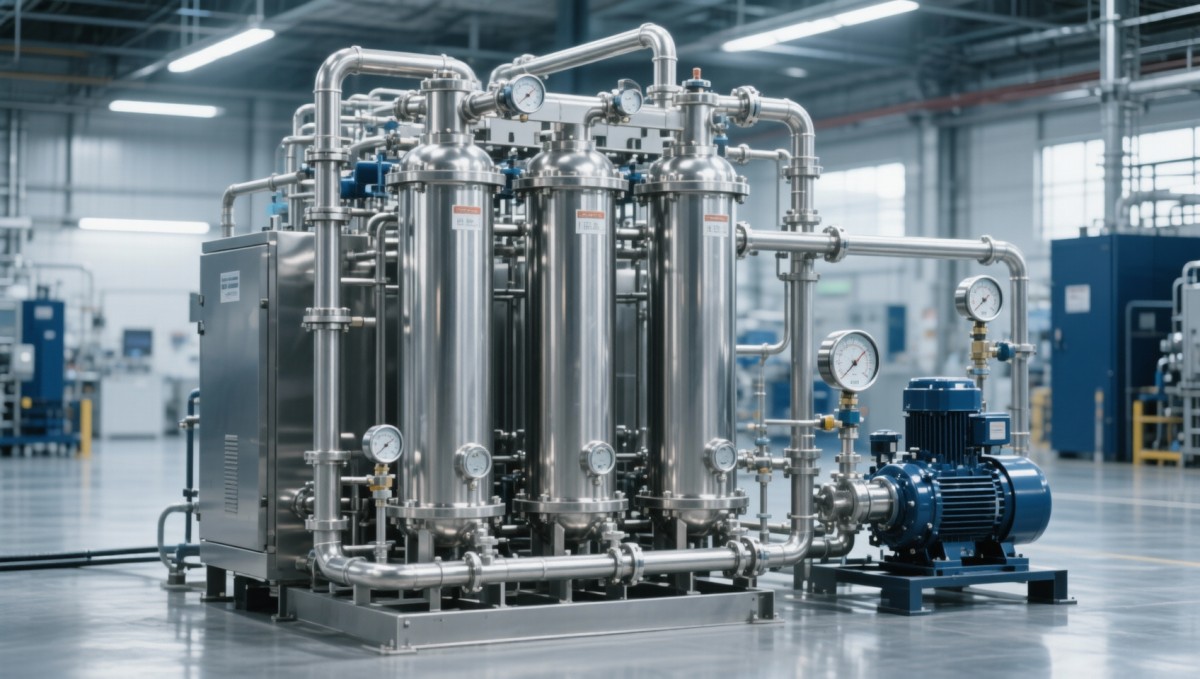
Pressure Staging and Energy Recovery Must Be Engineered, Not Assumed
Two-stage RO is necessary—but insufficient on its own. Without interstage pressure recovery, second-stage feed pressure drops below 160 psi when feed TDS exceeds 3,500 ppm, triggering rejection drift. Turbocharger-based energy recovery devices (ERDs) recover ≥92% of concentrate energy, enabling stable second-stage inlet pressure even at 280 psi first-stage operation. Isobaric ERDs offer higher efficiency (>95%) but require tighter control of concentrate flow pulsation—a critical consideration for systems feeding continuous API synthesis reactors or RAS biofilters.
Systems delivering verified 98% rejection use variable-frequency drives (VFDs) on both high-pressure and booster pumps, synchronized with real-time permeate conductivity feedback. Static pressure setpoints fail under feed temperature swings or TDS fluctuations. Only closed-loop hydraulic control prevents transient rejection dips during startup, shutdown, or feed composition shifts.
Validation Requirements for Institutional Procurement
Procurement teams evaluating suppliers should require documented evidence—not brochures. Validated performance means: (1) third-party test reports showing ≥98% NaCl rejection measured per ASTM D4195 over ≥72 consecutive hours at actual feed TDS (not synthetic brine), (2) full-scale pilot data demonstrating rejection stability across ≥3 distinct feedwater profiles (e.g., summer vs. winter well water), and (3) membrane autopsy reports confirming ≤5% flux decline after 6 months of operation under specified antiscalant and cleaning protocols.
Vendor claims of “up to 99% rejection” are irrelevant if tested only at 500 ppm TDS. What matters is the slope of the rejection curve between 3,000–5,000 ppm TDS—and whether it remains flat or declines. Request raw conductivity logs, not summary tables. Demand access to the calibration certificates for all online analyzers used in validation testing.
Operational Boundaries That Invalidate the Spec
Even correctly configured systems will fall short of 98% rejection if operated outside defined boundaries: feed temperature below 20°C or above 30°C; pH outside 6.5–7.5; SDI >3.0 sustained beyond 15 minutes; or antiscalant overdosing (>4 ppm) causing organic fouling. These aren’t failure modes—they’re predictable deviations. Procurement specifications must include mandatory operating envelopes, not just target metrics. Include clauses requiring automatic shutdown if second-stage permeate conductivity exceeds 120 µS/cm for >5 minutes—this enforces adherence to the performance envelope.
For API synthesis or pharmaceutical-grade aquaculture, rejection consistency directly impacts end-product purity, regulatory audit readiness, and downstream equipment lifespan. Selecting an RO system based solely on catalog rejection ratings invites costly rework, validation delays, and unplanned downtime. The systems that deliver 98% salt rejection at 25°C with feed TDS >3,000 ppm do so through integrated engineering—not component substitution.
Related Intelligence
- Aeration & Water TechWhat RO water treatment systems deliver consistent 98% salt rejection at 25°C with feed TDS over 3,000 ppm?RO water treatment systems that deliver proven 98% salt rejection at 25°C with >3,000 ppm TDS—engineered for API synthesis, aquaculture & grain processing.
- Aeration & Water TechCan pond aeration systems maintain dissolved oxygen above 5 mg/L during summer stratification in catfish ponds?Pond aeration systems can sustain >5 mg/L DO during summer stratification—when engineered for mixing *and* oxygen transfer. See field-proven data & design essentials.
- Aeration & Water TechHow to Choose Alarm Water Monitoring Systems for Critical Water FacilitiesAlarm water monitoring systems: learn how to select reliable sensors, alarms, communications, and workflows to protect critical water facilities and prevent costly failures.
The Morning Broadsheet
Daily chemical briefings, market shifts, and peer-reviewed summaries delivered to your terminal.
