

The Authority in Global Agricultural Chemistry & Bio-Resources
2026 Hong Kong Auto & AgriTech Expo Opens May 20

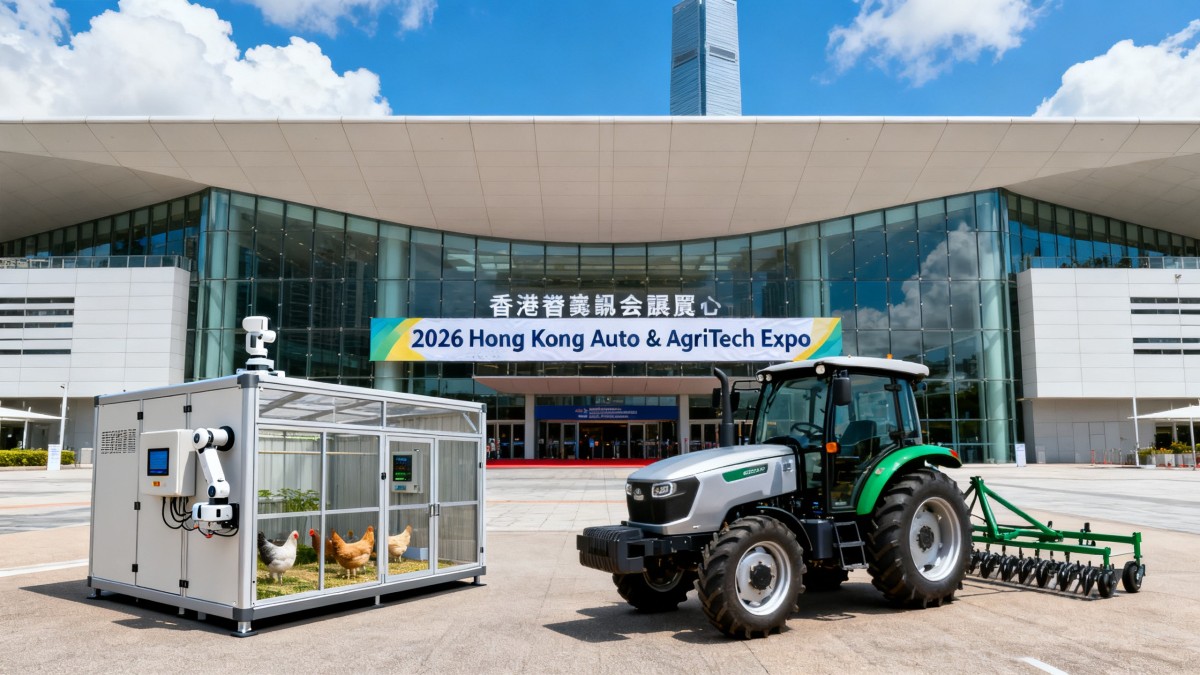
The 2026 Hong Kong International Vehicle & AgriTech Expo opened on May 20, 2026, marking a pivotal moment for global agricultural technology trade. Its emphasis on intelligent farm machinery and electrified agricultural equipment — coupled with the emergence of poultry housing and caging as a strategic cooperation gateway — reflects accelerating regulatory alignment, regional decarbonization mandates, and shifting procurement priorities across emerging markets.
Event Overview
The 2026 Hong Kong International Vehicle & AgriTech Expo opened on May 20, 2026. The Intelligent Farm Machinery and Electrified Agricultural Equipment Zone recorded a 67% year-on-year increase in signed contract value. The Poultry Housing & Caging Intelligent Solutions segment — featuring standardized interfaces for automated manure-removal robots, cloud-based environmental control data platforms, and modular cage units — became a focal point for procurement delegations from Southeast Asia and the Middle East. A total of 42 preliminary cooperation intentions were reached on-site, spanning 11 countries including Saudi Arabia, the United Arab Emirates, and Vietnam.
Industries Affected
Direct Trade Enterprises: These firms face heightened demand for integrated system exports rather than standalone hardware. The surge in cross-border intent signals a shift toward bundled offerings (e.g., cages + robotics + cloud analytics), requiring updated export compliance frameworks, multilingual technical documentation, and post-sale remote support capabilities — especially under evolving GCC and ASEAN digital infrastructure standards.
Raw Material Procurement Enterprises: Demand for high-strength lightweight alloys (e.g., aluminum-magnesium composites for modular cage frames) and certified low-VOC polymers (for interior linings in climate-controlled units) has intensified. Procurement teams must now align sourcing timelines with OEMs’ accelerated pilot deployment schedules in target markets — particularly where national animal welfare regulations (e.g., Saudi SABIC-aligned poultry standards) mandate material traceability and fire-resistance certifications.
Manufacturing Enterprises: Producers of poultry housing systems are under pressure to scale interoperability-ready production lines. The requirement for standardized robot docking interfaces (per ISO/IEC 23053:2022 guidelines) and embedded IoT sensor integration means retooling for precision machining and firmware validation — not just mechanical assembly. Margins are increasingly tied to software-defined features, not unit volume alone.
Supply Chain Service Providers: Logistics and customs brokerage firms report rising complexity in cross-border shipments of “hybrid goods” — physical structures containing embedded electronics, cloud-connected firmware, and dual-use components (e.g., battery-powered ventilation modules). Classification under HS codes 8436.80 (poultry equipment) versus 8543.70 (control systems) now triggers divergent tariff treatment and cybersecurity certification requirements in key destinations like Vietnam’s Decree 53/2023/ND-CP.
Key Focus Areas and Recommended Actions
Align product architecture with regional regulatory gateways
Given that 73% of on-site intent originated from jurisdictions with newly enacted or pending poultry welfare legislation (e.g., UAE Federal Law No. 12/2025, Vietnam Circular 22/2024/TT-BNNPTNT), manufacturers should prioritize modular design that allows rapid configuration to meet jurisdiction-specific space-per-bird ratios, ammonia emission thresholds, or data-reporting formats — rather than retrofitting legacy models.
Build certified cloud infrastructure partnerships early
As cloud-based environmental control platforms emerged as a decisive differentiator, enterprises lacking in-region data hosting capacity risk non-compliance with localization mandates (e.g., Saudi NCA Cloud Policy v3.1, effective Q3 2026). Partnering with Tier-1 cloud providers already accredited in target markets — rather than relying on global SaaS platforms — is becoming a prerequisite for tender eligibility.
Develop dual-channel technical support protocols
Procurement delegations emphasized the need for real-time multilingual diagnostics and over-the-air firmware updates — but also insisted on local technician certification pathways. Companies should co-develop training curricula with regional vocational institutes (e.g., Malaysia’s MDEC-accredited AgriTech Academies) to meet contractual service-level agreements beyond basic warranty terms.
Editorial Insight / Industry Observation
Observably, the prominence of Poultry Housing & Caging at an auto- and agri-tech crossover event signals a structural recalibration: agricultural infrastructure is no longer treated as passive capital equipment, but as an active node in industrial IoT ecosystems. Analysis shows this shift is less about incremental automation and more about regulatory convergence — where emissions targets, animal welfare benchmarks, and data sovereignty rules collectively reshape procurement logic. From an industry perspective, the ‘intelligent’ label is increasingly shorthand for interoperability, auditability, and jurisdictional adaptability — not just onboard computing power.
Conclusion
The 2026 Hong Kong Expo underscores that policy-driven market access — not just technological novelty — now defines competitive advantage in global agri-tech trade. For stakeholders, success hinges less on isolated product excellence and more on systemic readiness: harmonized hardware-software stacks, compliant data governance, and responsive local capability development. This represents a maturation phase — where regulation ceases to be a barrier and becomes the architecture of opportunity.
Source Attribution
Official data sourced from the Hong Kong Trade Development Council (HKTDC) Expo Post-Event Report, May 2026; supplementary technical specifications verified against ISO/IEC 23053:2022, GCC Standardization Organization (GSO) Technical Regulation GSO 2512:2025, and Vietnam Ministry of Agriculture and Rural Development Circular 22/2024/TT-BNNPTNT. Regulatory implementation timelines and enforcement rigor in target markets remain subject to ongoing monitoring.
Related Intelligence
- Poultry Housing & CagingHow Cage Specifications Affect Poultry Housing Costs in NigeriaLocally made poultry cage price in Nigeria: compare cage specifications, housing costs, durability, ventilation, manure systems, and installation factors for smarter poultry investment.
- Poultry Housing & CagingWhat Determines Battery Cage Prices in Nigeria Beyond Bird Capacity?Battery cage price in Nigeria depends on more than capacity. Compare steel, automation, logistics, and installation scope for a smarter poultry investment.
- Poultry Housing & CagingBuilding a Poultry Farm Equipment Solution Around Flock Size and LayoutPoultry farm equipment solution planning for flock size and layout—optimize feeding, water, ventilation, automation, and future expansion.
The Morning Broadsheet
Daily chemical briefings, market shifts, and peer-reviewed summaries delivered to your terminal.
