

The Authority in Global Agricultural Chemistry & Bio-Resources
Wholesale Spirulina Blue Phycocyanin: How to Compare Purity, Color Value, and Solubility
Wholesale Spirulina Blue Phycocyanin: How to Compare Purity, Color Value, and Solubility
For teams sourcing wholesale spirulina blue phycocyanin, price is only the visible layer.
The real purchasing challenge sits in technical consistency, application fit, and supplier control.
A low-cost lot can become expensive fast if color fades, dispersion fails, or labels become inaccurate.
That is why wholesale spirulina blue phycocyanin should be compared through measurable quality indicators.
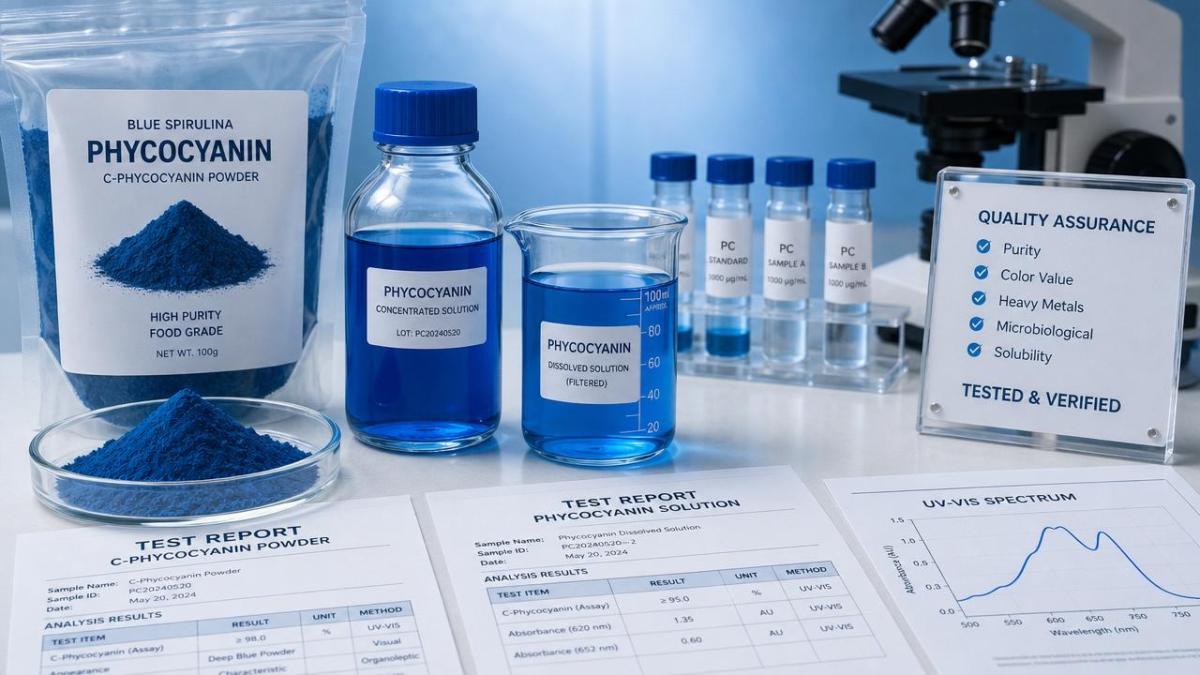
Three metrics matter most in early screening: purity, color value, and solubility.
These factors shape dosage, process stability, sensory performance, and final product economics.
In practical buying decisions, they also reveal how mature a supplier’s extraction and quality systems really are.
This guide breaks down how to compare wholesale spirulina blue phycocyanin in a more disciplined way.
Start With Purity, Not Marketing Language
Purity affects both performance and compliance.
When reviewing wholesale spirulina blue phycocyanin, ask how purity is defined and tested.
Some suppliers describe purity through protein ratios.
Others highlight food grade, cosmetic grade, or higher specification extract grades.
Those labels are useful, but they are not enough on their own.
The better question is simple: what is the exact analytical basis behind the grade offered?
A serious manufacturer should provide a specification sheet and a recent COA.
That paperwork should show phycocyanin content, moisture, ash, microbial limits, and heavy metal controls.
If the purity data feels vague, the process control behind it is often vague too.
What to verify on purity documents
- Testing method used for phycocyanin concentration and protein ratio.
- Batch-to-batch consistency across at least three recent production lots.
- Heavy metal limits for lead, arsenic, cadmium, and mercury.
- Microbiological controls, especially for beverage and nutrition applications.
- Residual solvents, if any solvent-assisted processing is involved.
From a cost perspective, higher purity can reduce dosage rates.
That often offsets a higher unit price.
So when comparing wholesale spirulina blue phycocyanin, evaluate cost-in-use rather than cost per kilogram alone.
Color Value Drives Commercial Appeal
Color value is where many sourcing decisions become more nuanced.
Buyers often request a vivid blue extract, but not every bright sample stays stable in production.
For wholesale spirulina blue phycocyanin, color value should be reviewed together with stability expectations.
A stronger blue tone may look impressive in a lab vial.
But actual value depends on pH range, heat exposure, light resistance, and formula ingredients.
This is especially relevant in beverages, gummies, tablets, dairy alternatives, and powdered blends.
Questions that reveal real color performance
- What is the tested color value range for standard lots?
- How does the color behave under pasteurization or moderate heat?
- What happens in acidic systems below pH 5?
- Does the supplier offer application trial data, not just raw pigment numbers?
- How much overage is usually needed to maintain shade through shelf life?
A reliable supplier of wholesale spirulina blue phycocyanin should discuss use-case fit openly.
If every application is presented as equally suitable, that is usually a warning sign.
In real procurement, honest limitations are often a mark of technical credibility.
Solubility Matters More Than Many Buyers Expect
Solubility directly affects processing speed, appearance, and yield.
Even high-purity wholesale spirulina blue phycocyanin can create problems if it disperses poorly.
Clumping, sediment, or slow dissolution can disrupt mixing lines and create visible defects.
This issue becomes more obvious in cold-fill products and instant powders.
Ask suppliers to define solubility in practical terms.
A statement like “water soluble” is too broad for serious qualification.
Useful solubility checkpoints
- Dissolution time at defined temperature and agitation conditions.
- Clarity or haze level after full dispersion.
- Sedimentation tendency during holding time.
- Behavior in hard water or mineral-rich systems.
- Compatibility with sugars, acids, proteins, and stabilizers.
If possible, request a pilot sample from the same production standard used for bulk orders.
This reduces the risk of approving a polished sample that does not match delivered material.
For wholesale spirulina blue phycocyanin, solubility is often where application claims are either confirmed or exposed.
Compare Suppliers Through a Procurement Scorecard
Once the technical basics are clear, turn them into a repeatable comparison model.
This makes wholesale spirulina blue phycocyanin sourcing less subjective and more defensible internally.
A weighted scorecard also helps align technical, quality, and commercial teams.
This kind of framework is especially useful when several suppliers offer similar headline specifications.
The differences usually appear in consistency, responsiveness, and documentation depth.
Look Beyond the Sample to Supply Reliability
A strong lab sample is only the starting point.
Wholesale spirulina blue phycocyanin purchasing also depends on how reliably the supplier can scale.
Seasonal raw material shifts, extraction capacity, and packaging control all influence delivered quality.
This becomes more important as volumes grow or product launches tighten timelines.
Supplier questions worth asking early
- What is the standard lead time for wholesale spirulina blue phycocyanin?
- How are raw spirulina inputs sourced and qualified?
- What traceability exists from cultivation to finished extract?
- How are deviations, complaints, and replacements handled?
- Can the supplier support growing order volumes without changing the specification?
More experienced manufacturers answer these questions clearly and with records.
Less prepared ones tend to rely on general assurances.
That difference often predicts future friction better than price negotiations do.
How to Make the Final Buying Decision
The best wholesale spirulina blue phycocyanin option is rarely the cheapest quote.
It is the supplier-material combination that performs predictably in your intended formula and supply model.
In most cases, final selection should follow a simple order.
- Eliminate offers with weak purity evidence or incomplete safety data.
- Shortlist materials that meet the target color profile under realistic processing conditions.
- Confirm solubility through in-formula trials, not water-only demonstrations.
- Review landed cost, MOQ, lead time, and replacement terms.
- Place an initial controlled order before committing to larger volume contracts.
That process keeps technical quality and purchasing discipline connected.
It also reduces the chance of discovering hidden problems after commercialization.
For any company evaluating wholesale spirulina blue phycocyanin, the smart move is to buy evidence first, then volume.
When purity, color value, and solubility are verified together, sourcing becomes faster, safer, and far more cost-effective over time.
Related Intelligence
- Natural IngredientsFreeze-Dried Fruit Ingredients: A Packaging Checklist for Bulk StorageBuying freeze dried fruit ingredients? Use this bulk packaging checklist to assess moisture barriers, seals, and pack sizes, reduce waste, and protect quality from storage to production.
- Natural IngredientsBotanical Ingredient Prices in Europe: Comparing Quotes by Grade and Order VolumeCompare Europe botanical ingredients price quotes by grade and order volume. Discover how potency, testing, delivery, and inventory costs reveal real savings before you buy.
- Natural IngredientsMayonnaise vs. Salad Dressing: Ingredient and Texture DifferencesMayonnaise vs. salad dressing: discover key ingredient, texture, stability, and application differences to choose the right product for every recipe.
The Morning Broadsheet
Daily chemical briefings, market shifts, and peer-reviewed summaries delivered to your terminal.
